REVIEW | Kat Sandler’s dark comedy brings Slavic folklore to Edmonton with expressive performances, inventive staging and a mystery that leaves plenty to debate.

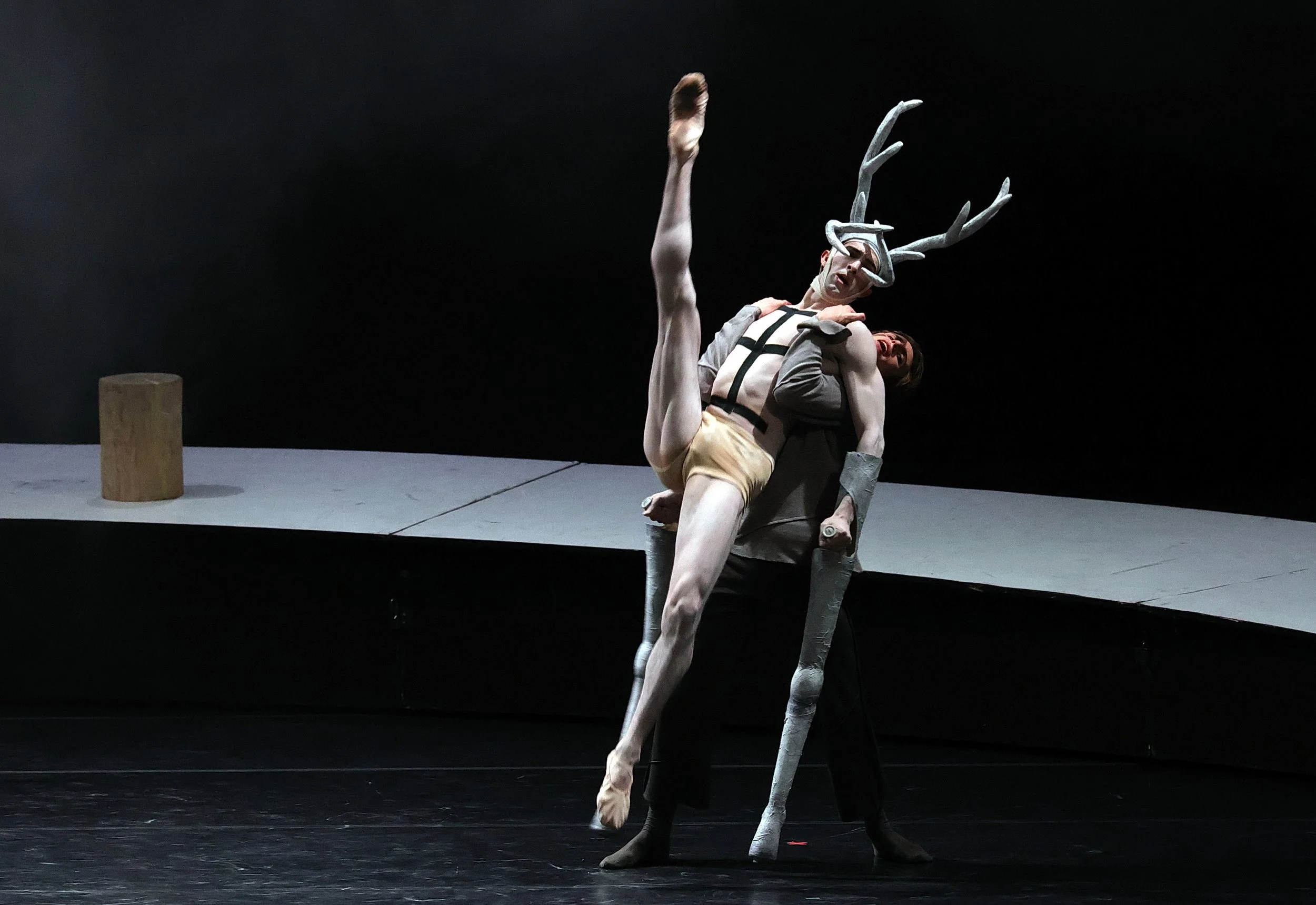
A production photograph from Shadow Theatre’s staging of Yaga at Edmonton’s Varscona Theatre.
Photo credit: Marc J. Chalifoux Photography and Video
Generations of storytellers have described Baba Yaga as a hideous, child-eating witch who flies through forests in a mortar and lives in a hut on chicken legs. They insist she’s too repulsive for anyone to love. In Shadow Theatre’s Yaga, the witch has a few things she’d like to clear up.
N Girgis opens Kat Sandler’s play with a defiant monologue challenging that reputation. She recites the accusations against Baba Yaga, including the claim that her face is the last thing someone sees before dying in terror. Then she points out a fairly obvious contradiction about how undesirable Yaga is — if she’s the grandmother of the devil, somebody must have slept with her.
It’s a terrific opening to a funny, increasingly unsettling mystery. Directed by Lana Michelle Hughes, the Edmonton production relies on three performers, a forest set that becomes an entire town, and lighting and sound cues timed with impressive precision. Sandler’s final twists left me less certain of what had happened than I expected, but the production gave me plenty to enjoy along the way.
N Girgis and the many faces of Yaga
Girgis is especially memorable as Katherine Yazov, a university professor specializing in osteology and zoology who enjoys sex, prefers younger men and takes enormous pleasure in challenging their assumptions about older women. When student Henry (Maxwell Vesely) invites her to his room to show her a lizard that has lost its tail, their conversation veers from animal biology to the practical advantages of having sex on a bed instead of a desk.
Henry is flustered almost immediately. Katherine notices, presses further and seems delighted by his efforts to appear sophisticated. Girgis makes the exchange hilarious through a look or a shift in posture as much as through Sandler’s dialogue. She can make Katherine seem amused, formidable or suddenly irritated without sacrificing the character’s intelligence.
Girgis’s performance stood out across the afternoon for its physical expressiveness. She adjusts her movements, voice and bearing as the production moves among the professor, Baba Yaga and other figures in the story. Her work is forceful without flattening the humour, and the more serious passages have the same attention to character as the jokes.
Her experience includes Life of Pi at the Citadel Theatre and Royal Manitoba Theatre Centre, and Come From Away at Theatre Calgary. She also played Didi in Sandler’s Wildwoman, presented by Alberta Theatre Projects with Gateway Theatre earlier this year, a performance that earned her a 2026 Betty Mitchell Award nomination for outstanding supporting performance in a comedy.
Vesely moves between Henry and Rapp, the private investigator hired by Henry’s wealthy mother when her son disappears. Emily Howard plays Carson, the local officer who is considerably less impressed by Rapp’s confidence than he is. The pair find an enjoyable rhythm in their arguments over procedure, evidence and whether they’re even working together. Vesely and Howard match Girgis’s energy and handle their own character changes convincingly; the production depends on all three performers to populate its small town.
Costume designer Kat Evans gives them useful distinctions, but the actors do much of the work themselves. A change in stance, expression or delivery can establish a new person within seconds, without breaking the momentum of the story.
A forest, a town, a restaurant
The set, designed by cm zuby, was one of my favourite parts of the October 25 matinee. Trees remain in place across the Varscona Theatre stage, their arrangement creating such a convincing sense of depth that it’s difficult to judge where the back of the playing space begins.
Rooms take shape in that forest with a few carefully chosen adjustments. Panels fold down from tree trunks to become desks or tables, while a chair turned or repositioned helps establish the next location. When Katherine’s elderly mother appears in hospital, she draws a curtain across the stage to create the room. The performers take part in the changes, and the audience can enjoy watching the space being repurposed without losing track of the action.
Even Gilchrist’s lighting makes those transformations possible. One part of the stage remains visible while another falls dark enough for furniture to be moved almost unnoticed. The same trees can seem like an ordinary backdrop or a threatening stretch of woods, depending on what the lighting reveals.
Chris Scott’s sound design is equally attentive. During Katherine’s lecture, the clicks that accompany her gestures are synchronized as though she’s operating presentation equipment. At other points, a line delivered live is echoed by a recording, with the two performances matching closely enough to make me think about the rehearsal and technical coordination involved. The music and effects serve the action without overwhelming Sandler’s dialogue. Hughes keeps the scene changes moving while leaving space for the actors’ comic timing.
Who gets to tell Baba Yaga’s story?
Baba Yaga belongs to East Slavic folklore, particularly the storytelling traditions of Ukraine, Russia and Belarus. In different tales, she can devour children, threaten travellers, offer advice or provide the magical help someone needs. Some stories feature three Baba Yagas, often sisters. That instability in her reputation gives Sandler room to question who has been telling the stories and what those tellers think of powerful, independent older women.
Katherine’s sexual confidence provides much of the comedy, although the play also considers what happens when women age beyond the roles others expect them to fill. Its women can be witty, angry, generous, manipulative and frightening. Girgis is especially effective at moving among those possibilities, and I enjoyed the play’s feminist perspective without needing its characters to be admirable in every respect.
At one point, Rapp recalls Elena telling him that they are all Yaga. The line brought to mind the unrelated #IAmJaneDoe campaign, which spread online this October following a lawsuit brought by a woman alleging sexual assault by seven fraternity members and accusing Cornell University of mishandling her report. Social media users adopted the name Jane Doe to express solidarity and, in some cases, to frustrate attempts to identify her. Sandler wrote her play years before the campaign, and her characters’ fictional acts of revenge are quite different from that online response. Still, the idea of women identifying with one another had particular resonance for me this month.
Sandler allows plenty of absurdity into the investigation, from a running dispute over whether artificial sweetener causes multiple sclerosis to jokes about chickens and foul play. The humour draws even the more ominous folklore naturally into the characters’ conversations.
An ending that raises more questions
Henry’s disappearance begins as a detective story, with Rapp convinced that he sees connections the local authorities have overlooked. But witnesses contradict one another, suspicions change, and details that once seemed reliable are called into question. By the final scenes, the audience has been given reasons to doubt much of what it thought it knew.
I left wondering whether anyone had been murdered at all. I enjoy endings that allow for competing interpretations, and our conversation afterward was part of the pleasure of seeing the play. Still, the final twists cast doubt on so much of the investigation that I couldn’t tell which earlier events remained reliable. I wondered whether Sandler meant us to question everything or whether the ending simply left too many loose ends.
Hughes and the cast sustain the comedy and tension through those complications, and the production’s scenic and technical precision remains impressive throughout.
Before the performance, Shadow Theatre described itself as “people-powered,” thanking the subscribers and supporters who make its work possible. With three actors, a versatile forest and a design team making every change count, the phrase suited what followed. The October 25 matinee drew a substantial audience, and the production offered strong evidence of what that community support can put on stage.
Sandler’s play premiered at Toronto’s Tarragon Theatre in 2019, and her eight-episode television adaptation premiered on Crave on October 23. This Edmonton staging is worth seeing for the company’s inventive work and especially for Girgis, whose Katherine is a delight to watch even when the story refuses to tell us precisely what has happened.
Yaga continues at the Varscona Theatre in Edmonton through November 1, 2026.