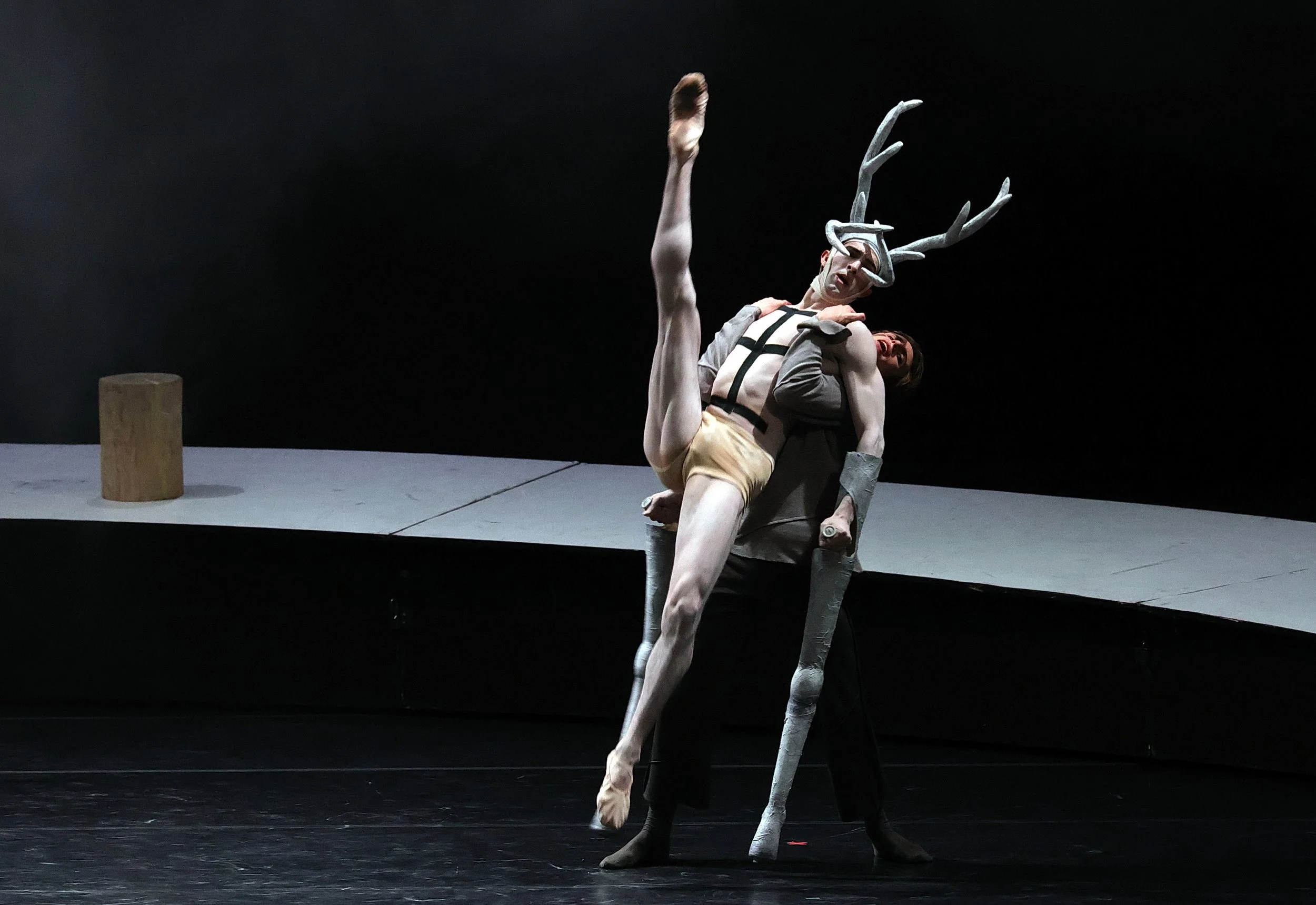
A layered production image from Boy Player, written and performed by Frank Moher, coming to Edmonton’s Gateway Theatre November 4–15, 2026.
Photo credit: The O.V. Arts Centre
During rehearsals for Boy Player, director Jonathan Greenway began throwing crumpled paper at Frank Moher while the playwright-performer worked through a scene in which he watches himself in crisis. Moher asked what the paper was for, but understood the answer before he finished the question. Greenway wanted him to experience the agitation attached to the memory as he performed, giving the audience more than an account of what had happened.
“I couldn’t just see myself going through that crisis, I had to experience the agitation I felt then as well,” Moher said in an email interview. Greenway had once been his scriptwriting student at Vancouver Island University. At their first rehearsal, he brought up an instruction Moher had given him years earlier: “Show, Don’t Tell.” Moher admits he was initially unsure how that applied to a one-person show built around recollection. Greenway's work helped him find ways to put the past onstage.
Written and performed by Moher, Boy Player comes to Workshop West Playwrights’ Theatre at Edmonton’s Gateway Theatre from November 4 to 15, with Greenway directing and projection design by Ray Appel. The autobiographical one-person play follows Moher from an Edmonton childhood through the deaths of his parents and a move to New York, then eventually back to the city where he began acting. The Edmonton engagement follows its 2025 premiere at the Gabriola Theatre Festival and an April 2026 production at Western Edge Theatre in Nanaimo.
Edmonton before New York
For Moher, Edmonton was already a theatre city when he was 12. In 1967, he appeared in Jackpot!, an original Canadian musical staged by the company now known as Walterdale Theatre, at the Centennial Library Theatre. He recalls a busy arts community despite the city's distance from North America's established theatre centres. Sports were another part of that childhood: his father was heavily involved in Edmonton's sporting world, and both interests supplied material for the early part of the play.
That background informs how Moher tells the story of his move to New York. He had been onstage before he arrived there, and he wanted the Edmonton of his childhood to appear as he remembered it, with theatre and sports central to the life around him. “I had already discovered it,” he said of theatre, correcting the idea that New York introduced him to an entirely new world.
The move followed the deaths of his parents within six months of one another. Moher began writing about his experiences as a book, which he is still working on, before remembering something an eighth-grade teacher in New York had told him about boy players in Shakespeare's world. The teacher described young performers, sometimes orphans, who were taken in and raised by theatre companies. Moher recognized a connection to his own history and saw the possibility of telling it as a play. The recollection also gave him a title.
Moher wanted the story to include what was funny or exhilarating about the years that followed, alongside the circumstances that sent him away from Edmonton. Deciding what belonged onstage meant considering the people whose lives intersected with his. “There’s other people’s privacy to consider, even decades later,” he said. Writing alone at his desk made candour easier; speaking those memories aloud to an audience introduced a different kind of vulnerability.
Songs and difficult memories
The songs from Jackpot! stayed in Moher's head for decades, so including them in Boy Player was, as he puts it, almost unavoidable. Other selections have particular dramatic purposes. He chose “Everything’s Coming Up Roses” from Gypsy to illustrate how a rousing musical-theatre number can divert attention from trouble, as Rose herself does when she sings it in the musical.
Another song entered the play unexpectedly. While looking for something on YouTube for his granddaughter, Moher came across “You Matter to Me” from Waitress. He had heard it before, but listening again, he recognized how closely it expressed his feelings for Diana Hart, whom he met after returning to Edmonton. Hart had lived through experiences similar to his, and the song offered a way to convey his affection without relying entirely on spoken recollection.
Moher is particular about the distinction between a musical and what he has made: Boy Player is a play in which music has an important role. His relationship with Hart, now his wife of 47 years, figures in its later scenes. The musical choices follow that progression, reaching from a production he joined as an Edmonton boy to a song he associates with the woman he met when he came home.
Writing autobiographically had allowed Moher to work alone, making decisions about which details to reveal and which belonged to other people. Rehearsal brought Greenway into that process. Moher credits the director with developing staging that allows him to encounter an earlier version of himself while drawing a realization from the memory in the present. They agreed at the outset that their purpose was to put on a show rather than undertake therapy, and Moher speaks warmly of Greenway's approach, even as he jokes about what a long-serving theatre artist can still learn.
Moher's history with Workshop West goes back to its inaugural 1978–79 season, when he appeared in On the Job. The company later produced several of his works, including Prairie Report. He also founded Western Edge Theatre in Nanaimo in 2003, the company where Greenway now serves as artistic director. That shared professional history gives their work on Boy Player another point of connection.
Returning to Edmonton means revisiting the city's theatre community of the 1970s, when Moher came back as a young adult and became part of an expanding local scene. It was during that period that he met Hart. He says he wanted to avoid making Boy Player either relentlessly sad or an exercise in nostalgia, while leaving room for the losses and relationships that remain part of his life.
He remembers growing up in a city “where I could play among the pines in the Groat Ravine and also be in a musical.” Nearly six decades after his appearance in Jackpot!, he is returning to an Edmonton stage with a work that includes the childhood he spent there and the life he made after coming back.
Boy Player runs November 4–15, 2026, at the Gateway Theatre, 8529 Gateway Boulevard NW, with nine performances. Workshop West offers pay-what-you-will admission, and students and teachers can request free tickets for November 12–15 through boxoffice@workshopwest.org.