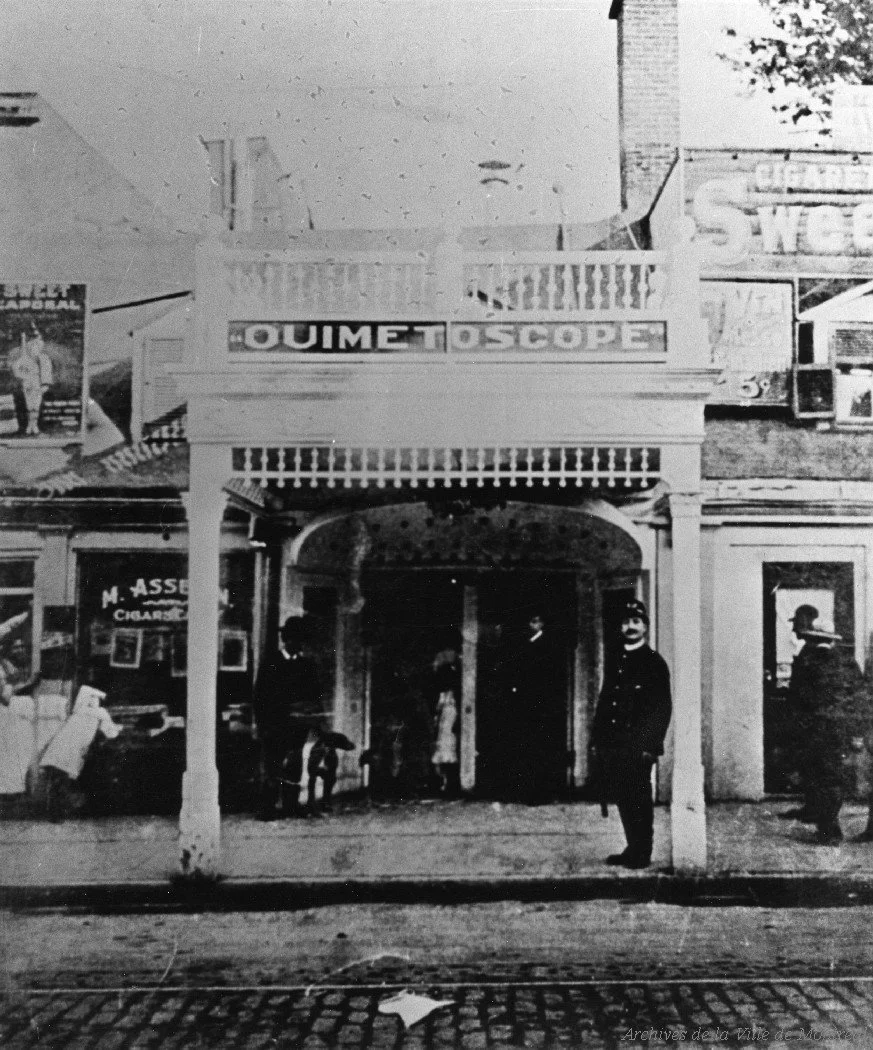
The original Ouimetoscope cinema in Montréal in 1906. Léo-Ernest Ouimet opened the theatre as Canadian filmmakers and exhibitors developed a domestic film industry.
Photo credit: Collection Cinémathèque québécoise / Fonds Léon H. Bélanger, via Wikimedia Commons
On September 3, 1897, the Winnipeg Free Press reported that two men had returned to the city after photographing Manitoba's harvest. E. H. Amet and R. A. “Dick” Hardie had recorded Premier Thomas Greenway working in one of his fields, coat off and sleeves rolled up. Their moving pictures were intended for a travelling entertainment company.
It is an awkward piece of evidence for an uncomplicated account of Canada's first filmmaker. That distinction has long gone to James Simmons Freer, a farmer and former journalist near Brandon whose views of prairie life were exhibited in Britain the following year. Yet the Winnipeg newspaper named other men making strikingly similar pictures in 1897, and within months they were arguing in print about who had arranged, photographed and paid for the films.
The beginnings of Canadian cinema are full of overlapping claims. The first exhibitors did not necessarily make films, the earliest cameramen working in Canada were not necessarily Canadian, and producers did not always photograph the pictures they presented. The surviving accounts reveal an industry being assembled by farmers, photographers, projectionists, travelling showpeople and entrepreneurs in several provinces.
James Freer and the disputed Manitoba films
Freer arrived in Manitoba from England in 1888 and settled on a farm in the Brandon Hills. According to Gene Walz's biography in the Dictionary of Canadian Biography, he bought an Edison movie camera and projector in 1897 and began recording scenes from the farm and nearby communities. The short films associated with him included Six Binders at Work in 100 Acre Wheat Field, Harvesting Scene, with Trains Passing, and Premier Greenway Stooking Grain. Trains, threshing machines and grain fields offered an immediately recognizable account of the region's agricultural economy.
With support from the Canadian Pacific Railway, Freer took his pictures and lantern slides to Britain in 1898 under the programme title Ten Years in Manitoba. He promoted the opportunities available to immigrants on the Prairies and the railway that could bring them there. Further tours followed, including a government-supported trip in 1902. The film screenings formed part of a wider immigration campaign rather than a theatre business built around entertainment alone.
Who took all the photographs is less certain. Writing in Manitoba History in 2012, Ken Goldstein drew on Winnipeg Free Press reports that complicate the conventional Freer account. In September 1897, the paper described Amet and Hardie gathering harvest footage. In a letter published on January 15, 1898, Hardie identified Amet, an American associated with early film technology, as the photographer and disputed the claims of travelling showman John Cosgrove. Cosgrove answered in a letter three days later, asserting his own role in originating and financing the project.
Goldstein suggests that Freer may have acquired some Manitoba scenes photographed by this group, although the surviving documentation does not establish exactly which pictures changed hands. The dispute leaves Freer's touring and promotional activities well documented while making exclusive camera credit for every scene associated with him difficult to sustain. Even in the industry's earliest years, the person exhibiting a film and the person who shot it could be different people.
The exhibitors who introduced moving pictures
The camera had reached Canada before Freer's British tour. In Montréal in June 1896, French operators Louis Minier and Louis Pupier presented the Lumière Cinématographe at 78 rue Saint-Laurent. A notice in La Presse announced a private demonstration for invited guests and journalists on June 27, and the paper reviewed the presentation on June 29. Regular screenings followed. The Cinémathèque québécoise has documented the surviving machine used in those early Canadian exhibitions.
The Montréal presentations are central to the history of cinema-going in Canada, although Minier and Pupier were showing Lumière films brought from abroad. Elsewhere, foreign production companies began photographing Canadian scenes. The American Film Institute records James H. White's Edison production American Falls from Bottom of Canadian Shore as part of a Niagara Falls series filmed in December 1896. Its Canadian vantage point establishes an early instance of filming on Canadian soil; the surviving evidence does not settle who was first to operate a camera in the country.
Travelling exhibitors helped make cinema available beyond the largest cities. Marie Tréourret de Kerstrat and her son Henry de Grandsaignes d'Hauterives began showing motion pictures in Montréal in October 1897. The Dictionary of Canadian Biography identifies Marie as manager of their Historiographe company. They then toured towns in Québec and Ontario and continued into the United States, often presenting films with Henry's live commentary. Marie's work belongs in the early business history of Canadian cinema even though she and her son were born in France.
Léo-Ernest Ouimet builds a film business in Québec
Léo-Ernest Ouimet approached motion pictures from the technical side. Born in Saint-Martin-de-Laval in 1877, he worked as an electrician and projectionist before building a business around the growing demand for films. In 1905 he established the Ouimet Film Exchange, which Parks Canada identifies as the country's first film distribution company. He opened the Ouimetoscope in a former cabaret in Montréal on January 1, 1906, then replaced it with a purpose-built, 1,200-seat cinema in August 1907.
Ouimet also moved into production. Working with cameraman Lactance Giroux, he began making newsreels in 1907, bringing events in Québec onto local screens. He later founded British Canadian Pathé News, which produced Canadian news and advertising films. Ouimet remained active in exhibition, distribution and production.
Québec's earliest surviving moving images also carry evidence of the international circulation of cameras. In September 1898, Lumière operator Gabriel Veyre filmed at Kahnawà, recording members of the Kanien’kehá (Mohawk) community. The short film survives under the historical catalogue title Danse indienne. Film historians André Gaudreault and Germain Lacasse have studied whether it was the first film made in Québec. Its survival establishes the existence of that particular recording, while the title and the circumstances of a visiting French cameraman's work require care when discussing who controlled the representation.
Ontario's early drama and Nova Scotia's first feature company
By 1903, film crews were also staging stories in Canada. Joseph Rosenthal directed and photographed Hiawatha, The Messiah of the Ojibway near Desbarats, Ontario, while working on the Living Canada series for the Charles Urban business. TIFF's Canadian Film Encyclopedia identifies it as the first film drama made in Canada. The lost production adapted Henry Wadsworth Longfellow's poem. The contemporary Charles Urban catalogue described the performers as Ojibwe; its account and photographs provide much of the surviving record available to historians.
The catalogue also attributes the film to a Canadian Bioscope Company. That credit should be kept separate from the Canadian Bioscope Company founded in Halifax in 1912 by British-born Captain H. H. B. Holland. The available records do not demonstrate that the two company names refer to the same organization.
Holland's Halifax company hired Canadian and American performers and production workers and pursued audiences on both sides of the border. Its major undertaking, Evangeline, was filmed in Nova Scotia during the summer of 1913. William H. Cavanaugh and Edward P. Sullivan directed the adaptation of Longfellow's poem, with a screenplay by Marguerite Marquis. American actors played the leads, while local performers appeared in supporting roles. The five-reel production was approximately 75 minutes long and reached Halifax screens in February 1914.
Nova Scotia Archives describes Evangeline as Canada's first commercially produced full-length motion picture. The company went on to make shorter films, but it did not survive the First World War. No complete copy of Evangeline is known to survive. What remains in Canadian collections includes production stills, advertisements and contemporary reviews. The province's first major feature enterprise is therefore documented largely through the paper record left by the people who made and sold it.
British Columbia's cameramen and the Shipmans' feature films
On the Pacific coast, Arthur D. “Cowboy” Kean became an important early commercial cameraman, recording local industries, outdoor events and military activities. His Kean's Canada Films business is credited on footage of the 102nd Battalion preparing to leave Vancouver Island in June 1916. Library and Archives Canada identifies Kean as both producer and photographer of The North British Columbians Warden's Warriors 102nd Battalion CEF Historic Departure. That surviving archival record ties a name, an employer, a place and a production date to the actual moving images.
As feature filmmaking expanded, British Columbia-born Nell Shipman brought another set of skills to the screen. She had already worked in American films as a writer and actor when she scripted and starred in Back to God's Country, shot near Lesser Slave Lake, Alberta, in 1919. David Hartford directed and Ernest Shipman produced. TIFF credits Nell with substantial creative authority over the film, including the adaptation that gave its heroine a more active role. Her subsequent independent filmmaking in the United States included directing, producing, screenwriting and acting.
Ernest Shipman, meanwhile, pursued a Canadian commercial feature industry through locally financed companies. Following the success of Back to God's Country, he organized productions in centres including Winnipeg, Ottawa, Sault Ste. Marie and Saint John. His business relied on selling Canadian settings and stories while finding enough investment and distribution to support feature-length production. TIFF credits him with producing seven Canadian features within three years, a substantial output for an industry whose independent companies often lasted only briefly.
By the early 1920s, Canada's filmmakers had worked in newsreels, industrial and promotional shorts, dramatic films and features. Their business arrangements ranged from international companies dispatching cameras across the border to regional firms funded and staffed partly in the communities where they filmed. Some left footage that can still be viewed; others survive in advertisements, catalogues, newspaper disputes and production photographs.
Freer's British programme began circulating in 1898, just months after the dispute between Hardie and Cosgrove appeared in the Winnipeg Free Press. Historians can document Freer's role in showing Manitoba pictures overseas and Amet's reported work behind a camera in the province. The records have yet to establish whether all the films later attributed to Freer were photographs he made himself.