Edward Clug's Canadian premiere brings dark humour, familiar music and inventive staging to the company's 60th-anniversary season.
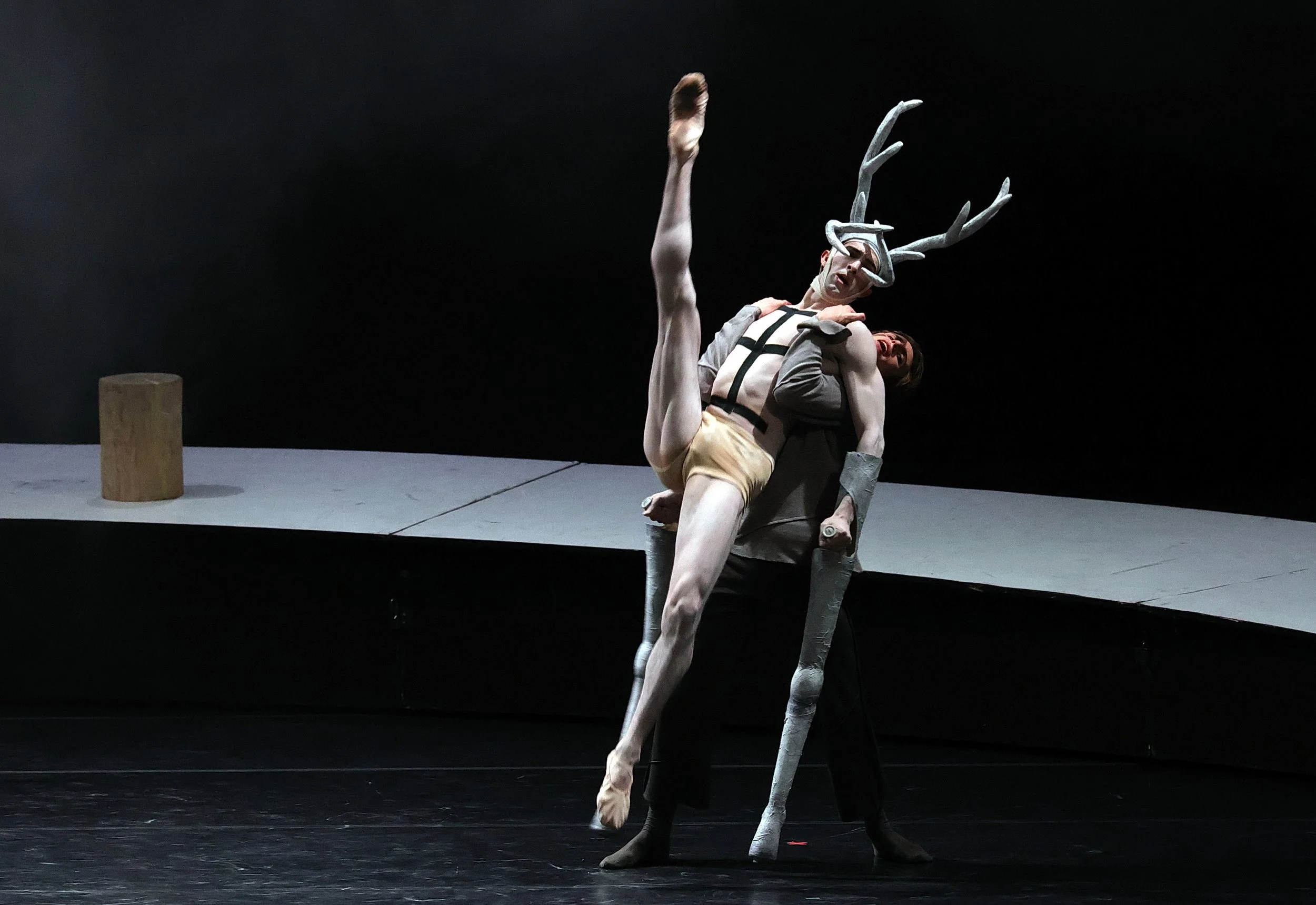
Navrin Turnbull as Peer Gynt supports Emanuele Cazzato as the Deer in Edward Clug's Peer Gynt at Teatro alla Scala in Milan.
Photo credit: Brescia e Amisano / © Teatro alla Scala
Death takes the long way around the stage in Alberta Ballet's Peer Gynt. He has plenty of time to spare, and given the life of the man he's following, he might need it.
Peer Gynt (Aaron Anker, originally from Portland, Oregon) is a boastful Norwegian dreamer with an appetite for wealth, romance and adventures that rarely end as planned. In Edward Clug's ballet, Death is a recurring presence in that improbable journey, sometimes intervening and sometimes watching the trouble Peer leaves behind.
Based on Henrik Ibsen's 1867 dramatic poem, Clug's contemporary ballet made its Canadian debut as part of Alberta Ballet's 60th-anniversary season. At Edmonton's Northern Alberta Jubilee Auditorium on October 24, the production seemed to belong to October. Its strange creatures, eerie costumes, stark scenery and dramatic shadows felt perfectly suited to the approach of Halloween. Set to Edvard Grieg's music, it was creepy, surreal, mesmerizing and often very funny, with absurd comedy giving way to startling moments of grief.
The first act introduces Peer's contentious relationship with his mother, Åse (Paloma Bonnin, from Asunción, Paraguay), who at one point spanks her grown son. Later, the absurdity gives way to a prolonged farewell. Death (Kelley McKinlay, a Métis Albertan raised near Fort Saskatchewan) escorts Åse's body on a wheeled bed around the white oval walkway dominating the stage. He takes the longest possible route as Peer releases a silent, anguished scream. The procession is surreal and beautiful, and Anker makes that soundless reaction painfully legible.
On the drive home, I thought about how refreshing it was to encounter a story I barely knew. I've adored familiar productions and common adaptations of Shakespeare and The Nutcracker, but so often part of watching them involves comparing a new staging with something already lodged in your memory. With Peer Gynt, I was learning the characters as I went and leaving with questions I wanted to investigate. The ballet's dark humour and sometimes unsettling imagery made that experience particularly rewarding.
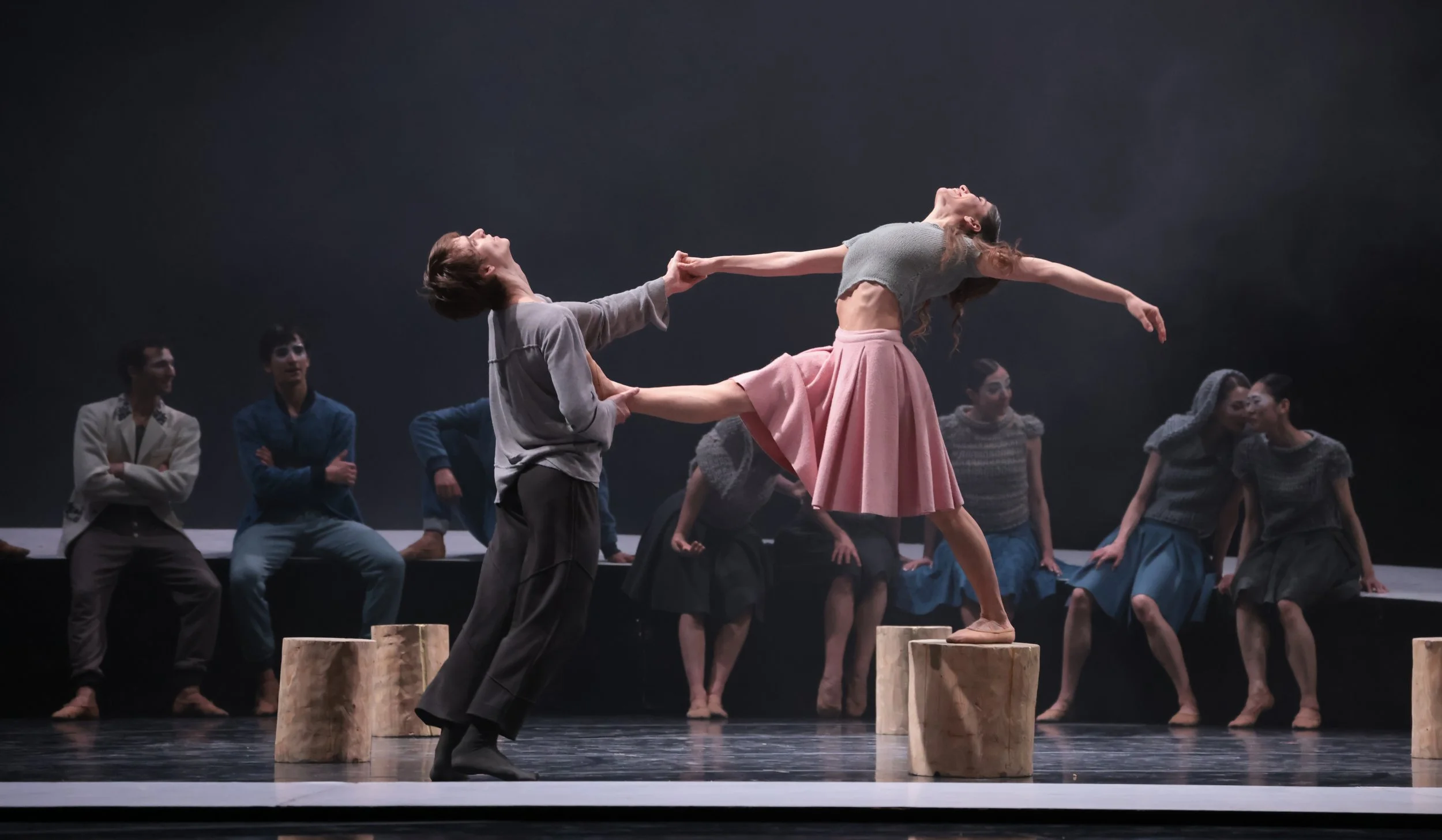
Navrin Turnbull as Peer Gynt and Alice Mariani as Solveig perform in Edward Clug's Peer Gynt at Teatro alla Scala in Milan.
Photo credit: Brescia e Amisano / © Teatro alla Scala
A simple set with extraordinary possibilities
Set designer Marko Japelj builds much of the action around the oval walkway and a substantial three-dimensional cave. The cave acts as an entrance and exit, but dancers also move around and over it. Tree stumps and other props come and go, becoming part of the movement itself. It is a spare arrangement with a surprising capacity to accommodate the story's changing locations and moods.
One of the strongest images arrives in the second act, when Peer, stripped of his wealth and apparently at his lowest point, retreats into the cave, now closer to centre stage. Backlighting gives him the outline of a halo, while fistfuls of white powder are thrown and sprayed into the air around him. The powder hangs in the light before settling on his body, leaving him grey and almost ghostly. It may be intended to suggest age, dirt or exhaustion; whatever the precise meaning, the contrast between his despair and the beauty of the image is striking.
Tomaž Premzl's lighting is crucial to moments like this. It changes the character of the stage without requiring a new set, making the same space seem at one moment mischievous and at another threatening. The visual atmosphere is one of the production's greatest strengths.
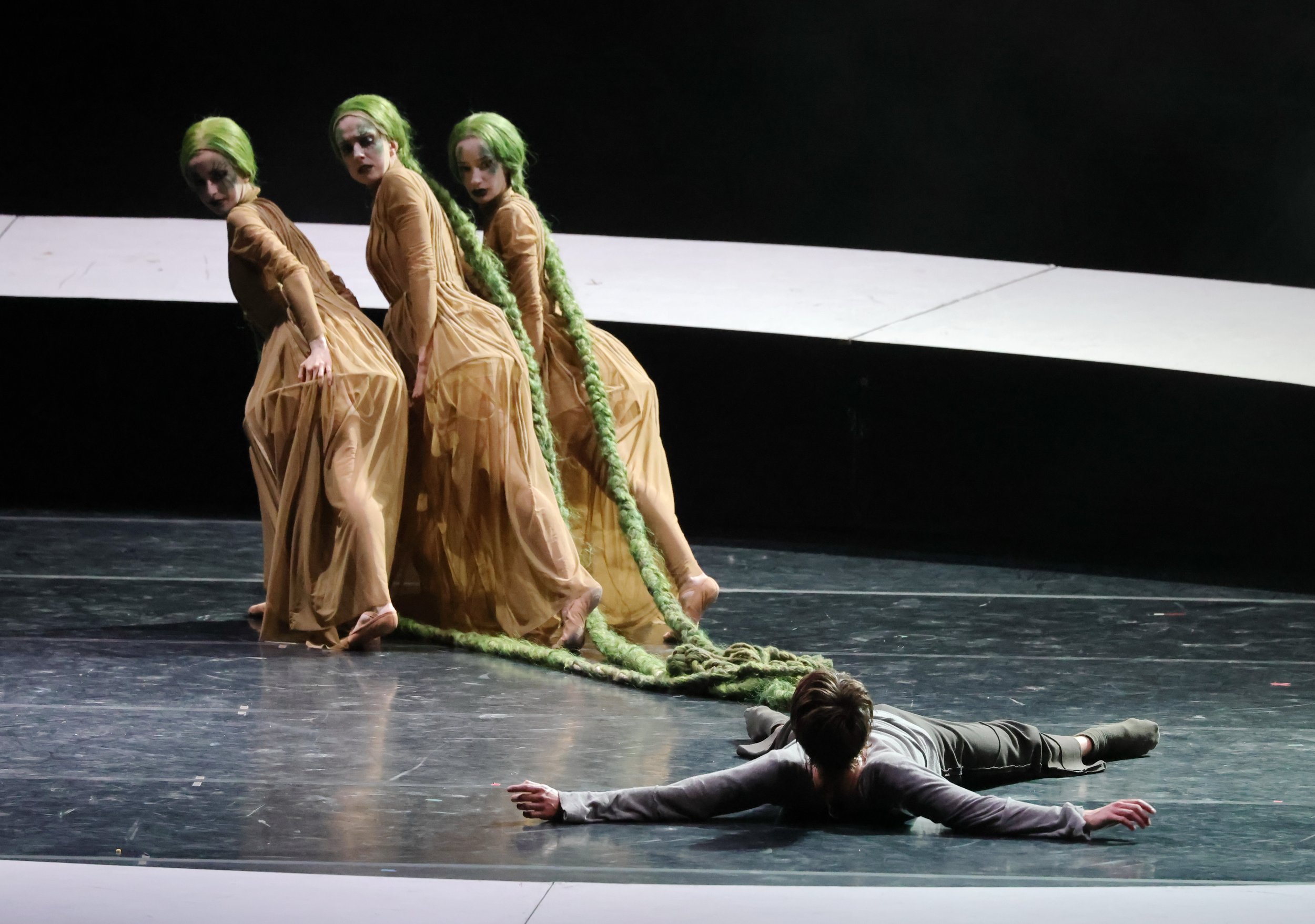
Martina Valentini, Giorgia Sacher and Chiara Ferrara as the three dairymaids, with Navrin Turnbull as Peer Gynt, in Edward Clug's Peer Gynt at Teatro alla Scala in Milan.
Photo credit: Brescia e Amisano / © Teatro alla Scala
Death and a watchful deer
McKinlay was my standout performer. A longtime Alberta Ballet dancer returning as a guest principal, he makes Death compelling whether the character is actively confronting Peer or simply standing nearby. During the 6:30 p.m. pre-performance discussion, Clug's longtime collaborator Miloš Isailović said that performers in this ballet needed to be "equally good actors and dancers." McKinlay's interpretation makes the point: his control of gesture and expression gives Death personality without softening the character's unsettling presence.
McKinlay received some of the loudest cheers of the evening at the curtain call. The response was especially pleasing to witness given his lengthy association with Alberta Ballet, although the applause itself needs no explanation. His appearance in Åse's funeral procession was the moment I kept returning to afterward.
The Deer (Yaroslav Khudych, originally from Ukraine and raised in Calgary) is another recurring presence. At the pre-performance discussion, Isailović explained that Clug had expanded the animal's comparatively small role in Ibsen's story, turning it into a companion who seems to watch over Peer and sometimes protect him. Once that connection was pointed out, the antler imagery in the choreography became particularly interesting. In one scene, Peer spreads his fingers beside his head like antlers, a gesture that echoes the animal following him through the story.
Familiar music in an unfamiliar world
There is another kind of recognition running through Peer Gynt: Grieg's music has travelled far beyond the play that inspired it. "In the Hall of the Mountain King," with its insistent, gathering rhythm, is familiar from film and popular culture. It features in Fritz Lang's M, while Trent Reznor and Atticus Ross created an adaptation for David Fincher's The Social Network. It is the sort of tune that can sound instantly familiar even when you cannot place where you first heard it.
"Morning Mood," widely used to suggest sunrise or a peaceful morning in screen comedy and animation, is similarly recognizable. "Anitra's Dance" and "The Death of Åse" have their own distinct pull. Clug draws on Grieg's Peer Gynt music as well as other compositions, and the score is particularly effective against the production's unsettling or absurd images. The tunes might be familiar, but the scenes unfolding around them rarely are.
An aeroplane, stolen clothes and an asylum
The second act opens with one of the night's best laughs. Peer arrives in a miniature, old-fashioned aeroplane, resembling a coin-operated children's ride crossed with an early flying machine, and the Edmonton audience roars with laughter. The prop is wheeled away quickly, having done its job, and Peer is off into another adventure.
In Morocco, dancers appear wrapped in rugs, and the action turns toward wealth, indulgence and eventual humiliation. Peer encounters Anitra (Hotaru Maruyama, originally from Japan), who takes his fortune and even his clothes. The increasingly outrageous sequence leaves him dancing without trousers, a particularly funny indignity for someone so determined to become important.
The asylum scene pushes the comedy into stranger territory. Dr. Begriffenfeldt (Lang Ma, from Harbin, China) presides over characters whose unpredictable movements demand as much acting as dancing. Among the four lunatics, Jolie Rose Lombardo (from Tyler, Texas) particularly stood out. Lombardo joined Alberta Ballet in 2024 after dancing with Germany's Stuttgart Ballet, where her repertoire included works by Clug; earlier in 2026, she also danced Odette/Odile in Alberta Ballet's Swan Lake. Her expressive performance was a highlight of the sequence.
Across both acts, Anker carries Peer from youthful bravado and comic foolishness to humiliation and despair. The silent scream beside Åse's body and the backlit scene inside the cave are especially effective because they give him room to communicate through his entire body rather than through elaborate steps alone.
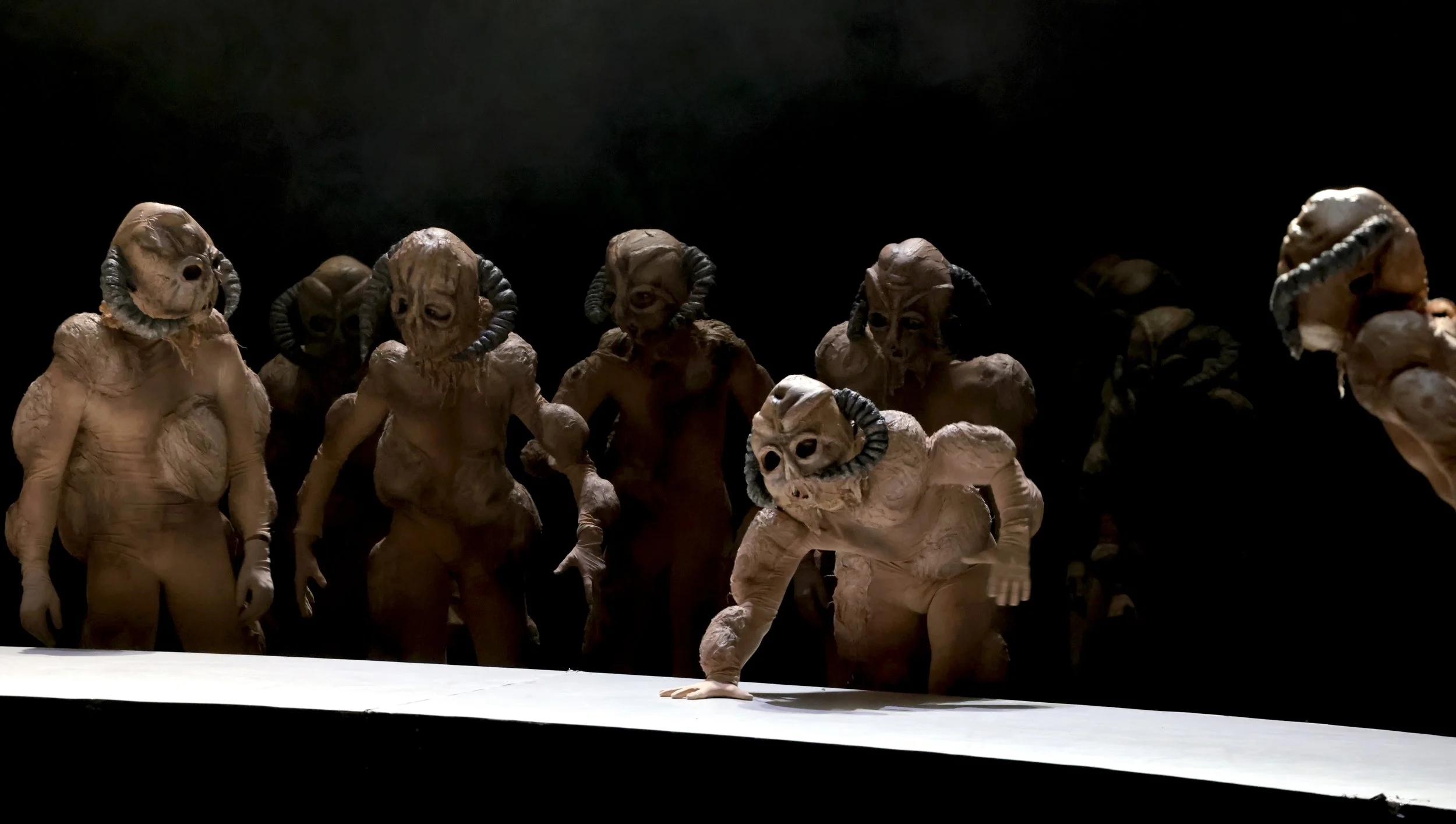
Trolls gather in Edward Clug's Peer Gynt, performed by Teatro alla Scala Ballet Company in Milan.
Photo credit: Brescia e Amisano / © Teatro alla Scala
A Canadian premiere with international roots
Before the performance, Alberta Ballet artistic director Francesco Ventriglia connected Peer Gynt with the company's 60th anniversary and his plans to bring major international choreography to Canadian audiences. Clug's ballet premiered in Slovenia in 2015 and has since been staged by prominent European companies. For Alberta Ballet, taking it on meant learning and performing an existing production rather than creating one from the ground up.
When asked whether the scenery and costumes had been produced locally. Ventriglia explained that the original materials came from the Slovenian National Theatre in Maribor, where the work premiered, and had been shipped to Canada for the performances. They would be packed up and returned afterward. "We can't produce everything," he said, noting they produce a lot ballets in their repertoire. The exchange offered an unusually practical glimpse of how a large international production enters another company's repertoire.
Isailović and fellow restager Mirjana Šrot worked with Alberta Ballet's dancers on the staging. Isailović also described the importance of allowing individual dancers to bring something of themselves to the roles while preserving Clug's choreography. That balance is visible in a production that asks its cast to move readily between comic exaggeration and vulnerable, serious moments.
I left the theatre still thinking about the deer, about the uneasy companionship of Peer and Death, and about how much of Grieg's music I had known without knowing the story. Having a programme to consult afterward helped me make connections, but part of the pleasure was being surprised in the first place. The evening gave me plenty to think about on the way home, especially McKinlay's long, unhurried walk around that white oval.
Alberta Ballet performed Peer Gynt at Edmonton's Northern Alberta Jubilee Auditorium October 23–24, 2026. The production continues at Calgary's Southern Alberta Jubilee Auditorium October 29–31.