Tai Amy Grauman brings Callihoo family history into Western Canadian classrooms
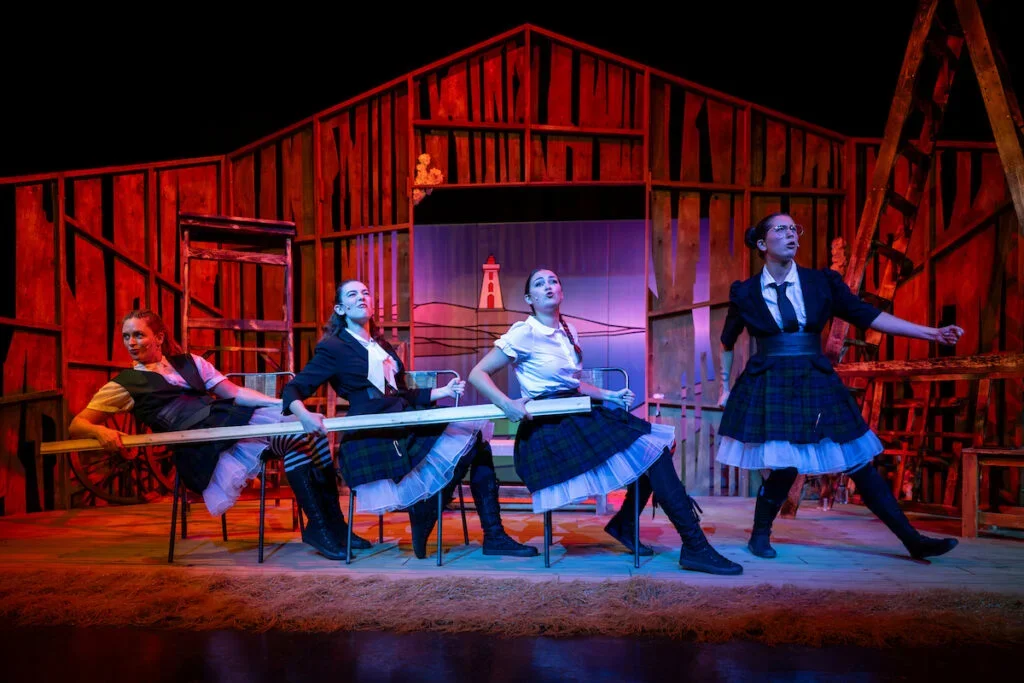
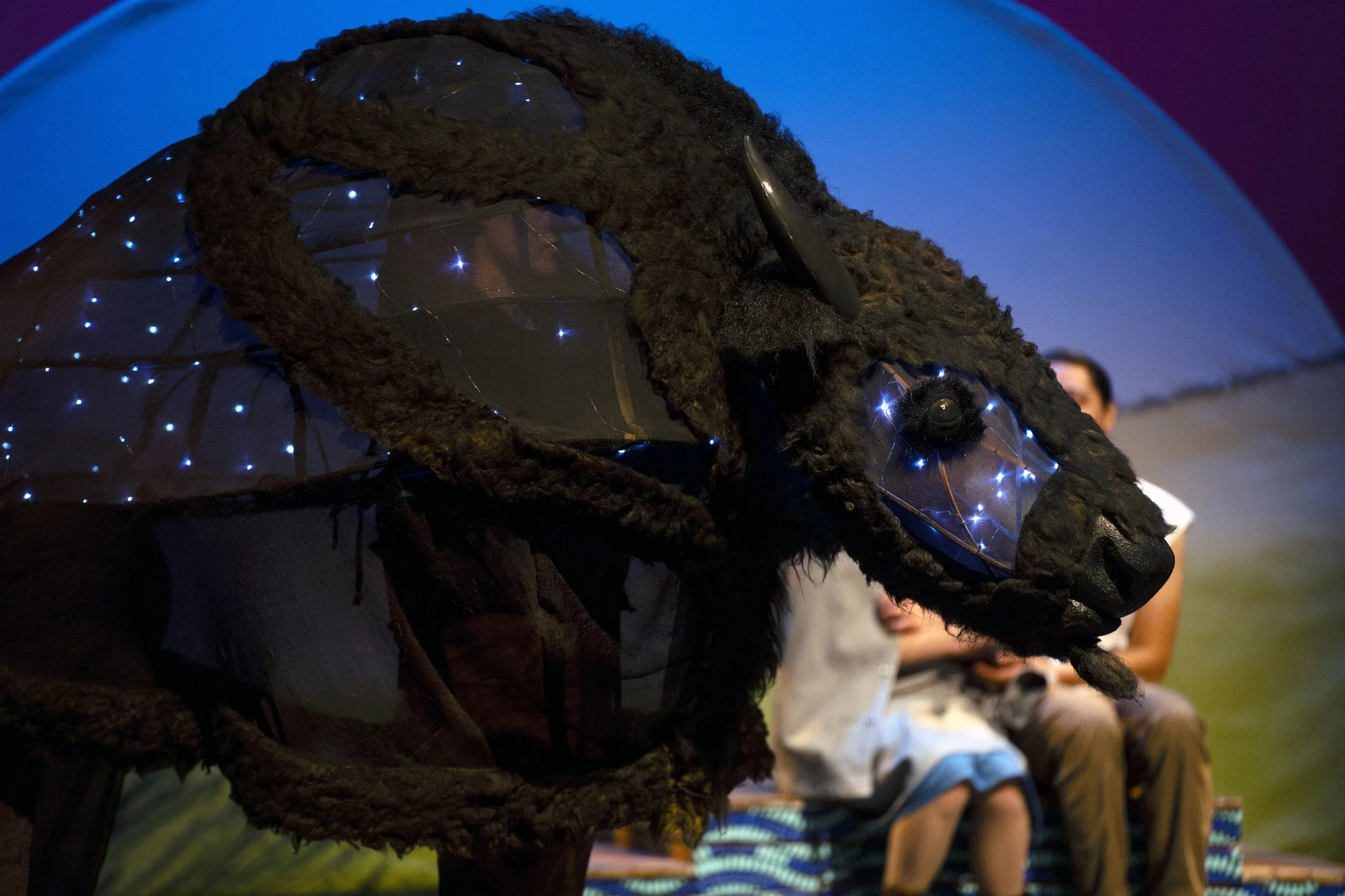
Axis Theatre’s life-like buffalo puppet in Where Have All the Buffalo Gone?, Tai Amy Grauman’s play drawing on Callihoo family stories and seven periods of Métis history. Axis identifies fiddle music, jigging and the puppet as part of the production.
Photo credit: Javier Sotres Photography / courtesy Axis Theatre
In Tai Amy Grauman’s Where Have All the Buffalo Gone?, two Métis souls and Buffalo encounter one another across seven periods of history. They begin among the stars, move through the fur trade and the Battle of Batoche, and eventually reach the present. Axis Theatre’s production uses recorded fiddle music, Métis jigging and a life-like buffalo puppet as the characters move through stories informed by Grauman’s Callihoo family history.
The production is now touring Western Canada, with B.C. school performances underway and dates in Alberta and Saskatchewan to follow. Its Saskatchewan leg runs through the Organization of Saskatchewan Arts Councils from Oct. 15 to Nov. 3, with 17 schools currently listed on Axis Theatre’s itinerary.
For Grauman, taking the work into classrooms connects directly with the histories she has been trying to recover through her writing. In a program note published by Gateway Theatre earlier this year, she wrote that the family stories contained in the play “do not exist in Canadian Curriculums, or they haven’t so far.”
Grauman is Métis from Ardrossan, Alta.; her current Gateway Theatre biography identifies her as Métis Cree. She traces her paternal family through the Callihoo and Beauregard lines from St. Paul des Métis and her maternal family through the Turner family of Cutknife, Sask. Her own site describes much of her work as focused on Métis women’s stories.
The Callihoo family also runs through her larger play You Used to Call Me Marie…, which follows generations of Callihoo women. Grauman identifies Marie Callihoo as her six-times-great-grandmother and has written about the difficulty of tracing her through archival records, where Marie appears under several surnames and birth dates. Grauman found that the history of Marie’s husband, a well-documented voyageur, was much easier to locate. She has described Marie as part of her effort to rewrite Métis women’s histories in Alberta.
Where Have All the Buffalo Gone? draws from some of the same family material in a work created for younger audiences. Axis describes the production as sharing scenarios from Callihoo family stories, and its educational material makes clear that the recurring Marie and Louis figures are fictional characters inspired by Grauman’s ancestors rather than a literal genealogy carried intact through every period.
The play begins with a creation story among the stars before moving into an 1830 fur-trade setting. Its 1885 section includes the Battle of Batoche during the North-West Resistance, while later scenes move through the First World War era, residential schools, Depression-era Métis political organizing and contemporary Métis life.
Grauman has said the idea for the play emerged during a fireside discussion in Jasper, where a child listening to a conversation about the disappearance of the buffalo asked what happened to the people afterward. In an interview with Apartment613, Grauman described the play that grew from that question as a love story and historical epic following its people and Buffalo through time.
The family history behind the work reaches into several strands of Western Canadian history. Musée Héritage Museum material developed with members of the Michel Band Council traces the Callihoo line to Louis Kwarakwante, also known as Louis Callihoo, a Mohawk man from Kahnawake who travelled west through the fur trade and eventually settled with his extended family in what is now Alberta.
His son Michel Callihoo worked for the Hudson’s Bay Company and later settled at Lac Ste. Anne. In 1878, Chief Michel and two headmen signed an adhesion to Treaty 6. A reserve for the Michel Band was surveyed northwest of Edmonton in 1880 and formally confirmed by Order in Council in 1889.
Treaty 6 was an agreement between the Crown and First Nations, and the Callihoo family’s history intersects with both that treaty history and later Métis political organizing in Alberta. Felix Callihoo was among the early executive members of the Métis Association of Alberta in 1932, serving as a vice-president alongside Malcolm Norris and Pete Tomkins under president Joe Dion. The association pressed the Alberta government over poverty and the need for a secure Métis land base, work that preceded the Ewing Commission and Alberta’s Métis Betterment Act.
The production carries those histories through its design and performance language. Dusty Hagerüd designed the set, props and buffalo puppet; Kathleen Nisbet created the fiddle recordings; Eloi Homier choreographed the jigging; Alaia Hamer designed the costumes and Jack Goodison the lighting. Axis artistic director Chris McGregor co-directs with Amanda Testini and also designed the sound, while Andrea Menard is credited as cultural consultant.
Buffalo has a dedicated performer in the current touring company. Axis’s content advisory also describes Marie hunting a buffalo in the 1830 section, gunfire during the Battle of Batoche sequence and Marie and Louis fleeing residential school in the 1925 section.
Public descriptions of the production have expanded since its 2024 Vancouver presentation with Chutzpah PLUS. That program described four love stories in four historical periods and credited Kathleen Nisbet as fiddle player and Sofi Munson as Buffalo/Fiddler. Axis now describes a seven-period version, with Nisbet credited for recorded fiddle music.
The production received 2025 Jessie Richardson Theatre Award nominations for Outstanding TYA Production, Grauman’s original script and Hagerüd’s puppet, props and set design. Grauman currently describes Where Have All the Buffalo Gone? as being in its second year of touring Canada.
Testini has called Buffalo the “little sister” of You Used to Call Me Marie… and has linked its development to earlier work on Grauman’s Callihoo stories and to presentations of Marie in Métis communities in Alberta and Saskatchewan.
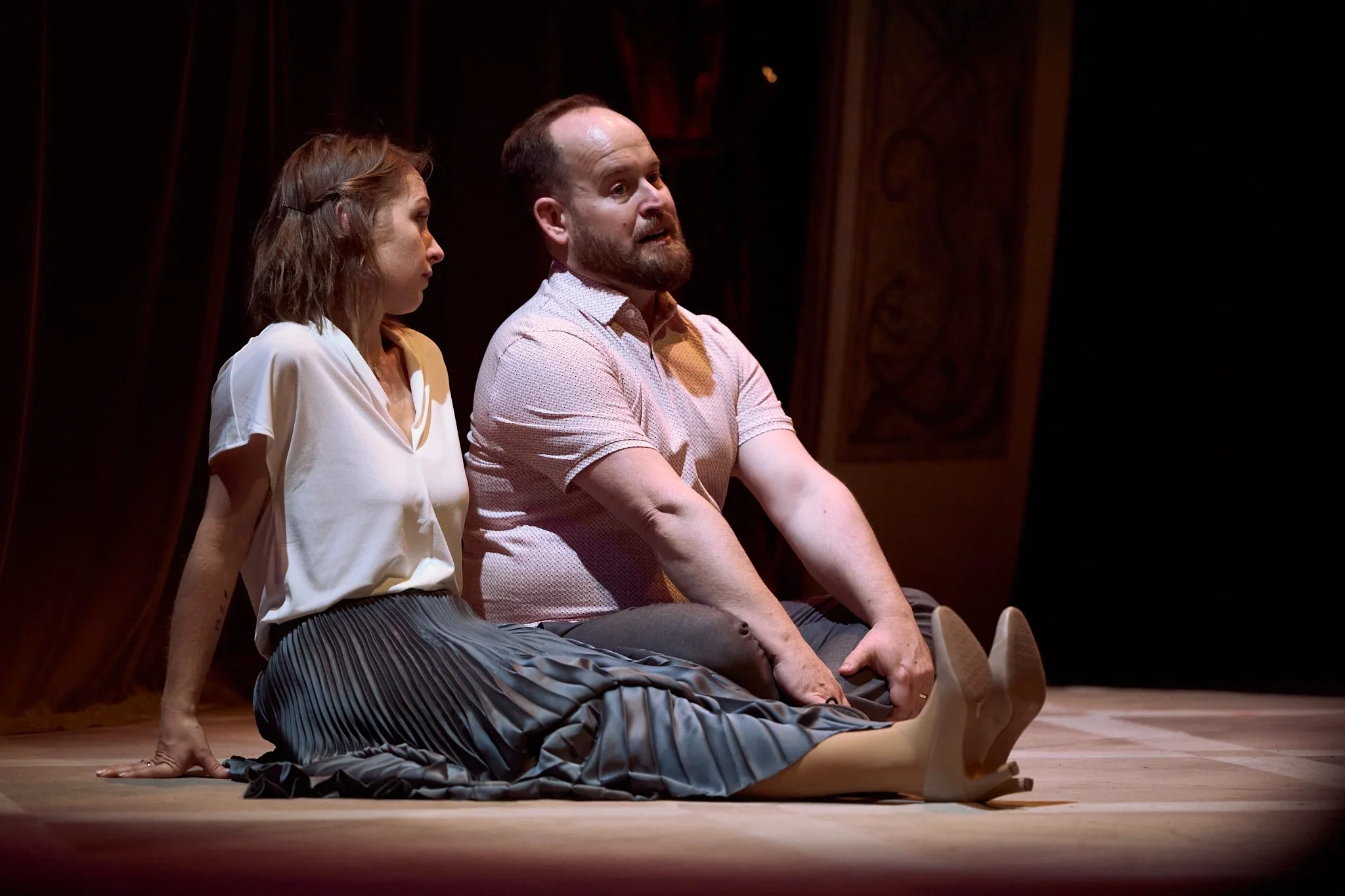
For the current fall tour, Kassandra Sison plays Marie, Dustyn Forbes plays Jean and Secwépemc multidisciplinary artist Glitter Esquivias performs Buffalo, with Alexis Wilson as stage manager. Axis began its B.C. school dates Sept. 21 and has a free Sept. 30 performance scheduled at UBC’s Frederic Wood Theatre for the National Day for Truth and Reconciliation. Alberta dates follow in Calgary, at Métis Crossing in Smoky Lake and in Bonnyville.
OSAC has programmed Where Have All the Buffalo Gone? for students in Grades 4 through 12. The Saskatchewan route begins at Macklin School on Oct. 15 and continues through Biggar, Perdue, Viscount, Warman, Stanley Mission, La Ronge, Prince Albert, Hudson Bay, Norquay, Yorkton, Fort Qu’Appelle, Indian Head, Weyburn, Arcola and Coronach before reaching Swift Current on Nov. 3.
The tour will take family histories Grauman has also explored in You Used to Call Me Marie… into classrooms across the province, with Marie, Jean and Buffalo moving through the fur trade, Batoche, residential schools and Métis political organizing before the story reaches the present.