At Edmonton's Gateway Theatre, the veteran playwright revisits his childhood losses and the people who helped him find his way.
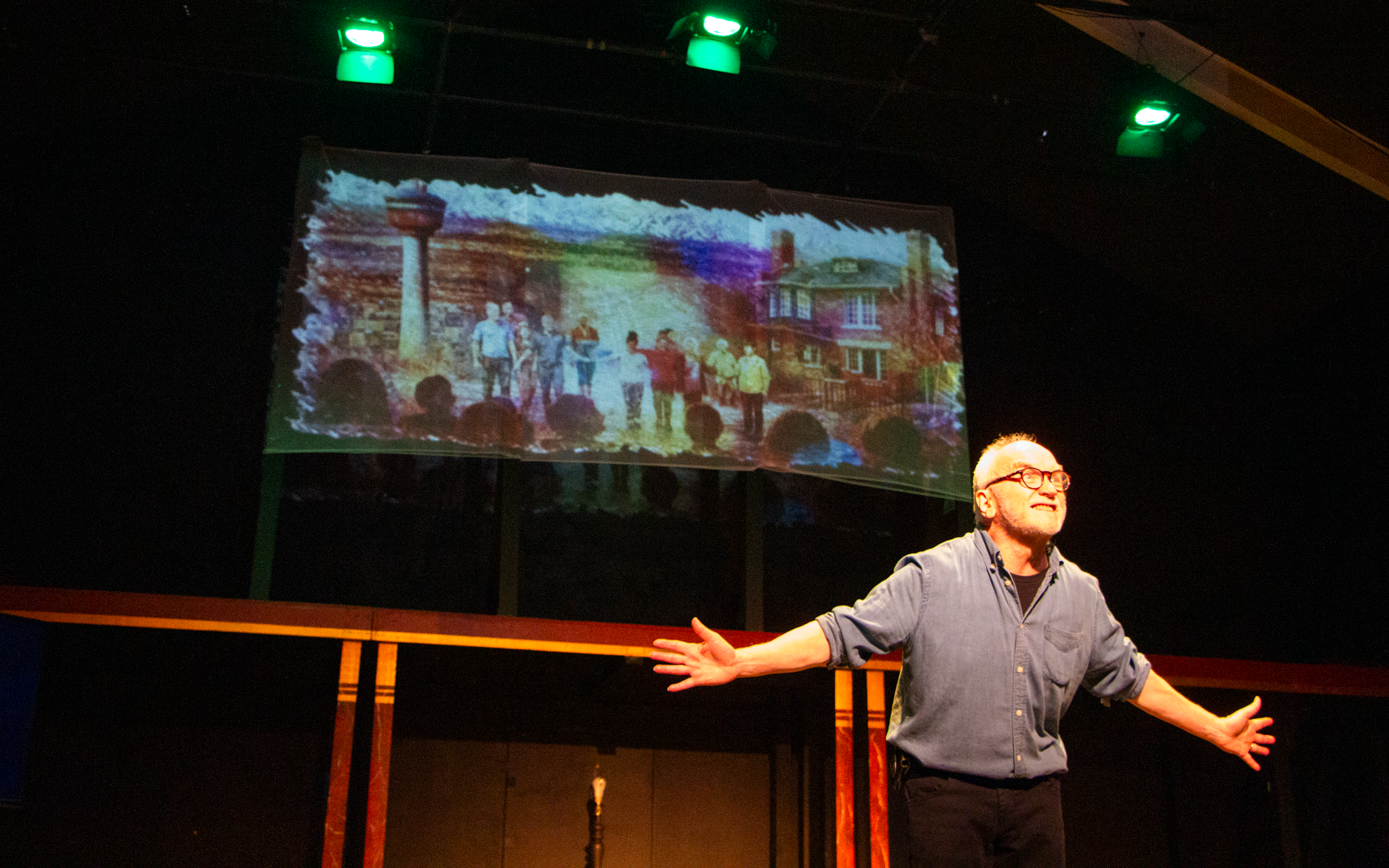
Frank Moher in Boy Player, presented by Workshop West Playwrights’ Theatre at Edmonton’s Gateway Theatre, November 4–15, 2026.
Photo credit: Courtesy of Workshop West Playwrights’ Theatre.
It takes a certain confidence to interrupt a one-person show and offer to buy all 200 audience members a drink and perhaps a cookie, especially when there are only about 20 people in the room. Frank Moher does just that in Boy Player, acknowledging the absence of an intermission and proposing a visit to a café at some mutually agreeable time. The joke is typical of his approach to an evening that includes some painful memories. He has a delightful way of engaging an audience, making room for laughter while taking his story seriously.
Moher was energetic and thoroughly at ease onstage at Edmonton's Gateway Theatre on November 7. The veteran playwright has spent most of his life in theatre, and it shows in the way he speaks to the people in front of him, rather than seeming to perform at them. The small room adds to that impression. He stands on the floor, without a raised stage separating him from the audience, so the experience feels unusually close and personal. The set is minimal, the lighting effective, and there is little to distract from the story he has come to tell.
Written and performed by Moher, directed by Jonathan Greenway and presented by Workshop West Playwrights' Theatre, Boy Player follows his life from Edmonton through New York and Calgary, then back to Alberta. He was 12 when he made his first appearance onstage in the 1967 Edmonton musical Jackpot. He has considerable fun comparing it with Oklahoma!, recalling its rural setting and chorus of farm folk, then lip-syncing to recordings of the songs because, as he readily admits, singing has never been his strength. His affection for musical theatre supplies some of the evening's best comedy, particularly when he wanders into a bit of theatre trivia before bringing himself back to the story.
The reason that first production means so much to him soon becomes clear. His father had died, his mother was seriously ill, and theatre gave him something he could do when much of the rest of his life felt beyond his control. One of his memories of Jackpot is looking into the audience and seeing his mother happy. She died shortly after the production ended. At 12, Moher had lost both parents, and the relatives who took him in could offer care without being able to replace the people he had known all his life.
The subsequent New York stories are often very funny. Moher arrived with an idea of the city borrowed largely from television crime dramas and with some enthusiasm for its musicals. His account of trying to fit into an American Catholic school, and of discovering that he could get laughs in a school play by delivering his lines at excessive volume, is especially entertaining. He can recreate the certainty of his younger self without asking the audience to share it. Much of the humour comes from the distance between the boy who thought he understood the world and the older man who can now see how little he knew.
That perspective becomes more affecting when he recounts a conversation with Brother Thomas, the religious brother who directed the school play. After Moher confided in him, Brother Thomas described the boy players of Shakespeare's time: young performers, sometimes orphans, who were taken into theatre companies and raised among the actors. He suggested that Moher might become a boy player himself. I found the exchange particularly touching. Here was a boy whose parents were gone, living in a different country and trying to decide what kind of life he could have. He needed someone to point him in a direction. Brother Thomas gave him an idea to hold onto.
For years, Moher sought out theatre companies and the people in them, finding friendships that gave him a sense of family. Those connections also had an unsettling habit of ending when a production closed or a company dispersed. His recollections of depression and isolation are among the harder passages in the play, and he speaks of them with a candour that makes the humour elsewhere feel earned. There is also generosity in his account of his older sister Patty. He remembers how difficult their relationship could be, while recognizing now how much she had been asked to take on as a young woman raising her own children after losing both parents herself.
Speaking about the decision to share such personal experiences onstage, Moher told SCENE 49, “I’ve tried to treat my own experiences candidly and with vulnerability.”
Moher's timing is very good, even if every beat isn't perfectly judged. He is at his best when he can move from a joke into a more difficult recollection without announcing the change. The lip-synced musical numbers and occasional digressions provide relief, and the performance retains a conversational quality despite the amount of personal history it covers. Moher said he and director Jonathan Greenway agreed on one principle early in rehearsals: “Jonathan and I agreed early on that we weren’t there to do therapy. We were there to put on a show.”
The sparse staging suits that approach; watching him from only a short distance away, I was more aware of his comfort with an audience than of any effort to impress one.
Alongside his own life, Moher tells the story of Diana Hart, who lost her mother as a child and whose family was disrupted again when her father disappeared. She eventually lived with relatives on a farm near Smoky Lake, Alberta. At first, her story seems to belong to a different play, but Moher returns to it as their separate lives move toward Edmonton's theatre community and an eventual meeting through Northern Light Theatre.
That meeting has an almost improbable quality. Moher talks about how rare it is for a child in North America to lose both parents, but his account makes the emotional isolation easier to grasp than the numbers do. He had spent years among friends, relatives and fellow performers who could care about him without necessarily understanding what he had lived through. When he and Diana began talking about their childhoods, he found someone who understood that experience firsthand. Their relationship develops into a love story with the sort of coincidences that might seem too neatly arranged if Moher hadn't lived them.
As Moher explained in our interview, “It is, however, a love story, in addition to being an orphan’s adventure, and that’s the part that in the end, I hope, makes it worth telling.”
By the end, the gratitude in his storytelling is unmistakable. He speaks with clarity about how lost he felt as a boy and about the people who offered him kindness, while acknowledging that finding love did not erase every difficulty. The final account of the family he and Diana built is heartfelt without losing the humour that has carried the performance. After spending so much of the evening following a child in search of somewhere to belong, it is moving to hear Moher describe the life he eventually made.
I don't know whether Diana was in the room on November 7. As Moher spoke about her near the end, though, it felt as if she were present, and I suspect that, for him, she is there at every performance.
Boy Player, written and performed by Frank Moher and directed by Jonathan Greenway, runs November 4–15, 2026, at Gateway Theatre, 8529 Gateway Boulevard NW, Edmonton. Presented by Workshop West Playwrights' Theatre. SCENE 49 attended the November 7 performance.
Boy Player concludes its Edmonton engagement at the Gateway Theatre on Sunday, November 15, 2026, with a 1:30 p.m. performance. The production premiered at the Gabriola Theatre Festival in 2025 and was subsequently presented by Western Edge Theatre in Nanaimo in April 2026. No further performance dates have been publicly confirmed. Information about the Edmonton production and tickets is available at workshopwest.org.