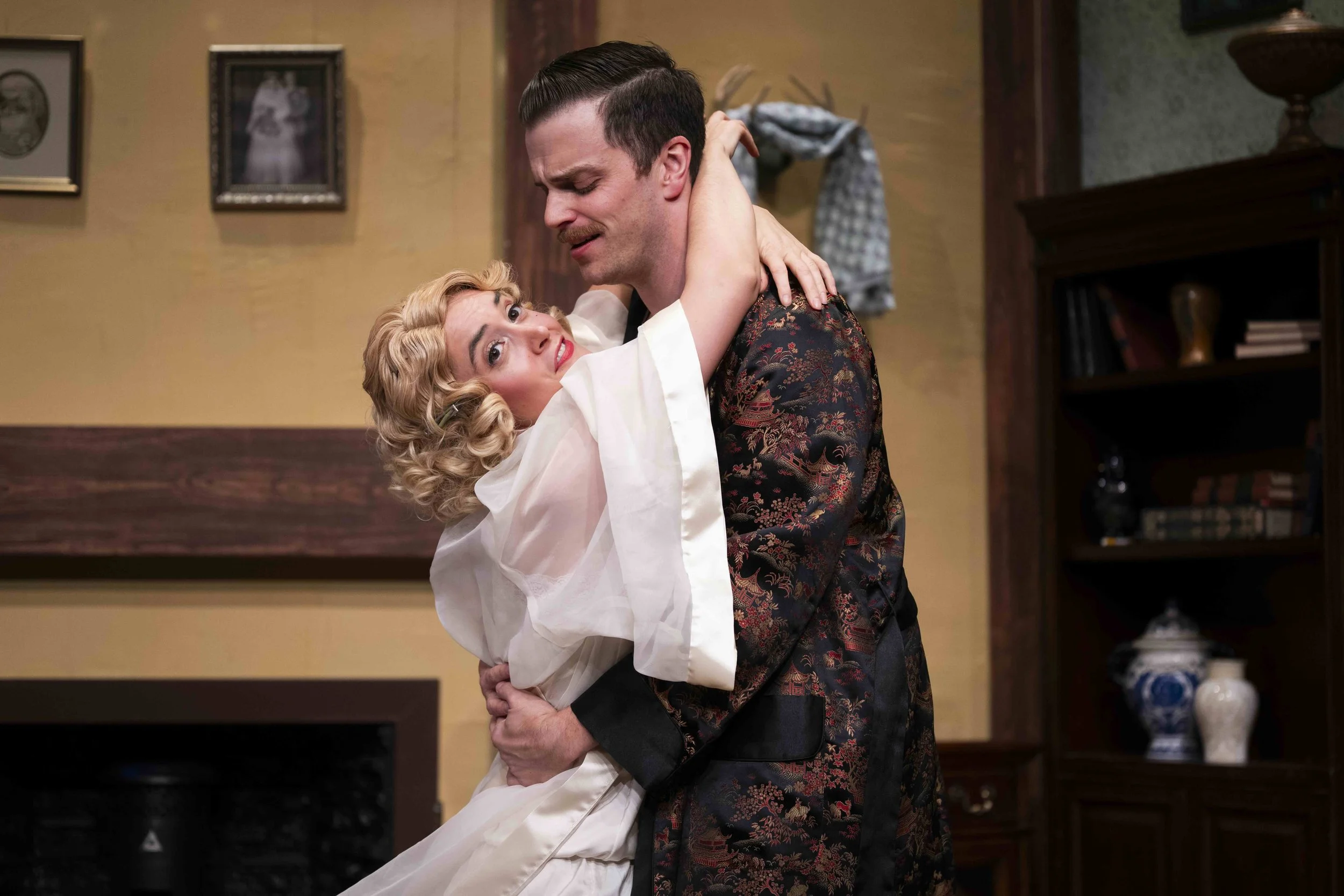
Jill Agopsowicz’s expressive Sylvia leads a six-member cast in Sandy Rustin’s farce at Edmonton’s Varscona Theatre.
Jill Agopsowicz as Sylvia and Mathew Hulshof as Beau in Teatro Live’s production of The Cottage at Edmonton’s Varscona Theatre.
Photo credit: Marc J Chalifoux Photography
Sylvia has spent seven summers meeting her lover Beau for one night at a time, and she has decided that this year should be different. She intends to leave her husband, marry Beau and spend the rest of her life with him at the family cottage. There are complications: Beau is her brother-in-law, and she has already informed their spouses of the affair by telegram before explaining her plans to him.
Teatro Live’s production of Sandy Rustin’s The Cottage takes that disastrous bit of communication and runs with it. Set in England in 1923, the play follows a morning in which nearly everyone who enters the cottage has a reason to be unhappy with somebody already inside it. Directed by Farren Timoteo at Edmonton’s Varscona Theatre, the farce has an appealingly colourful look and a six-member cast with a good feel for the humour.
Beau (Mathew Hulshof) has a rather different understanding of his relationship with Sylvia (Jill Agopsowicz). He seems perfectly satisfied with their annual arrangement, while she has already imagined a permanent future together. Their opposing expectations make the first exchanges entertaining, and things become much less manageable once Beau’s wife, Marjorie (Lauren Boyd), and Sylvia’s husband, Clarke (Brennan Campbell), arrive. Their own secrets soon complicate the question of who has deceived whom.
Jill Agopsowicz at the centre of the farce
Agopsowicz is particularly enjoyable as Sylvia, giving her the exuberance of a woman convinced she has finally found a solution to her problems. Her face and gestures are wonderfully expressive, and she is comfortable with the exaggerated reactions the material calls for. The performance is theatrical in the best sense, with comic timing that allows the character’s enthusiasm, indignation and confusion to be funny in different ways.
Sylvia’s confidence is part of the joke. She expects everyone to adjust to her decision because it makes such perfect sense to her, but each arrival forces her to reconsider what she believes about her marriage and her lover. Agopsowicz makes those changes entertaining to watch, and Sylvia remains an engaging presence even when she is being unreasonable or thoroughly absorbed in her own romantic predicament.
Hulshof’s Beau provides a good counterweight. His easy charm looks increasingly inadequate once private promises become public business, and his reluctance to commit gives Agopsowicz plenty to play against. Their scenes establish the comic rhythm of a production in which the characters are continually forced to explain themselves, often while learning something new and unwelcome.
The rest of the cast joins in with equal enthusiasm. Boyd and Campbell have their own romantic complications to reveal, while Cynthia Jimenez-Hicks as Dierdre and Jake Tkaczyk as Richard bring further surprises, including talk of a dangerous husband. As the relationships become more tangled, the performers keep the exchanges clear and find laughs in the reactions as well as the dialogue. It is a strong ensemble, and the escalating confusion is consistently entertaining.
A cottage dressed for comedy
The visual design adds considerably to the production’s appeal. Ami Farrow’s set makes the cottage an inviting place to spend the evening, even when its occupants can barely stand being in the same room. Brian Bast’s costumes are especially good. The period clothing and vibrant colour give the stage a buoyant appearance that suits the play’s playful attitude, while Victor Snaith Hernandez’s lighting complements the overall design.
Those attractive surroundings provide a fitting backdrop for people determined to preserve their manners while discussing subjects that would scandalize their neighbours. They remain carefully dressed and outwardly respectable through conversations about adultery, divorce, pregnancy and the possibility of murder. Rustin finds a great deal of comedy in the distance between how these characters expect to behave and what they actually do.
Timoteo keeps the action moving as additional revelations change the balance among the characters. The dialogue is full of affectionate nicknames, barbed remarks and misunderstandings, and the cast has the energy to keep the exchanges lively. Even as the situation becomes increasingly ridiculous, it remains easy to follow the shifting loyalties and competing plans.
A change of plans for Sylvia
Behind the romantic complications is an interest in women’s choices and the expectations of marriage in the early 20th century. The family’s older generation has its own ideas about independence, and Sylvia’s determination to make a new life gradually begins to mean something different from what she intended when she sent those telegrams.
At first, Sylvia believes she knows exactly what happiness requires: she needs to exchange an unhappy marriage for a happy one with Beau. By the time the cottage has yielded its secrets, she has reasons to question whether choosing another husband is the answer at all. Rustin gives the character an enjoyable progression without abandoning the comedy that brought everyone together.
The ensemble handles the tangled relationships with ease, while the colourful design gives the play an appealing look. Agopsowicz is the performer who stands out, bringing enough expression and comic assurance to make Sylvia a pleasure to follow through every new disaster. Teatro Live’s The Cottage is a lively, genuinely funny evening at the Varscona Theatre.
The Cottage runs at the Varscona Theatre in Edmonton through November 29, 2026. Tickets and performance information are available at TeatroLive.com.