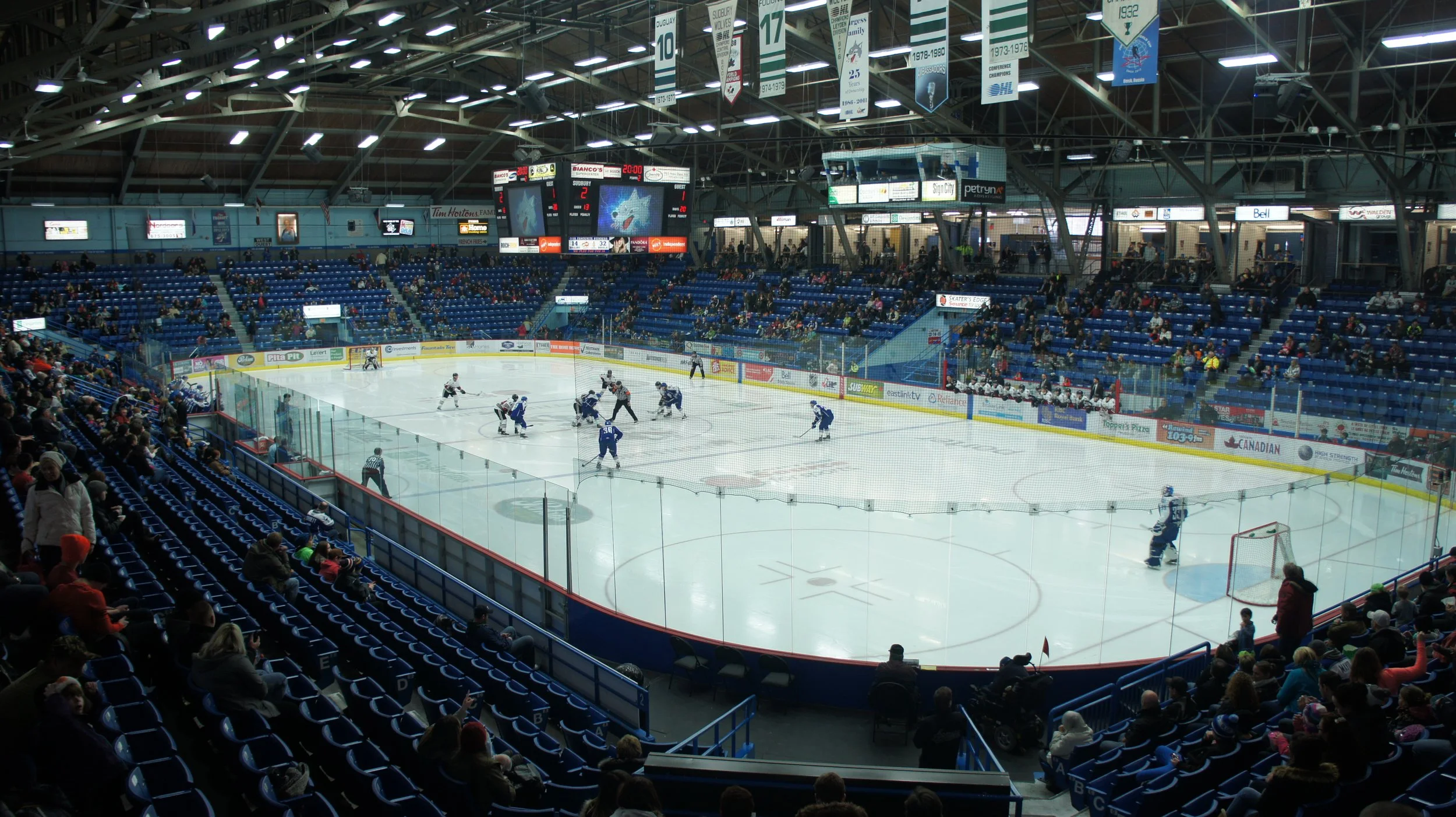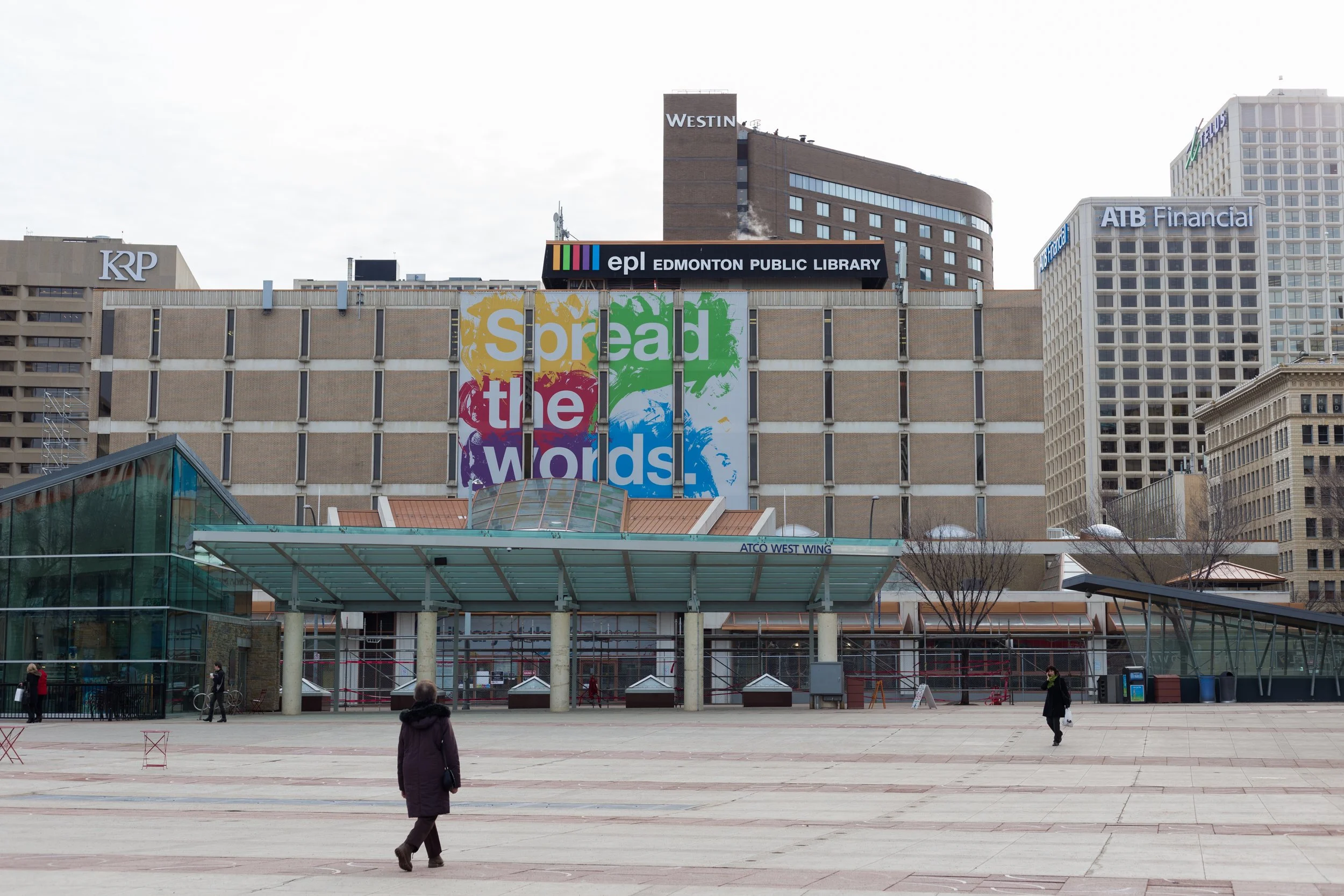
Stanley A. Milner Library in Edmonton, photographed in January 2017. Opened as the Centennial Library in 1967, the building housed the theatre where Edmonton Theatre Associates presented Jackpot that November. The photograph was taken decades after the production.
Photo credit: Mack Male
From November 13 to 18, 1967, Edmonton Theatre Associates presented Jackpot at the newly opened Centennial Library Theatre. Its writers, Chet Lambertson and Jim Richardson, had an older musical called Bonanza behind them: an Alberta oil-country comedy first staged in Halifax in 1952 and subsequently performed in Vancouver and adapted for broadcasting. In Canada's centennial year, the Edmonton company brought the musical to a stage in the city where both creators had earlier connections.
The production appears in two histories of the company now known as Walterdale Theatre. Its own archive lists Jackpot as an original Canadian musical by “Chet Lamberton & Jimmy Richardson,” directed by Frank Glenfield. Robin C. Whittaker's premiere register, published by Athabasca University Press, instead names Dr. Norman Ibsen as director and gives Glenfield a music credit. The register also spells the composer's surname Lambertson, the form used in contemporary accounts of Bonanza. These contradictory credits complicate any definitive description of who directed the 1967 staging.
A new theatre in a centennial city
The Centennial Library had opened on May 27, 1967, less than six months before Jackpot's engagement. Built at a cost of approximately $4 million, the seven-storey civic library included an auditorium. The city's centennial program also advertised theatre and music activities intended to make use of new public spaces. Its planning brochure said Theatre Associates intended to mount a special centennial production and an original Klondike Days melodrama, although it did not identify Jackpot as the proposed centennial show.
For Theatre Associates, the library engagement was one of several ventures beyond its own small stage. The organization had been established in 1958 and had occupied a converted schoolhouse on Walterdale Flats from 1961 until the city reclaimed the site in 1966. It then moved into the former Legion of Frontiersmen Hall near Kingsway. In a 2001 University of Alberta thesis, Mary Ross Glenfield, who helped establish the company with her husband Frank, wrote that the troupe purchased the hall building for $11,000 in 1967 while the city retained ownership of the land.
The new hall held roughly 100 people, compared with about 70 at the schoolhouse. Volunteers converted it for performances, and the company's first production there, A Thousand Clowns, had opened in October 1966. Theatre Associates could therefore use its regular Kingsway home while also presenting work on larger or different stages. Its annual Klondike Days melodrama moved to the professional Citadel Theatre's mainstage in July 1967; Jackpot followed at the Centennial Library Theatre in November.
The choice of venues reflects a period when Edmonton's theatre companies were defining their roles. The Citadel had opened as a professional company in 1965. Theatre Associates members Ron Wigmore and Frank Glenfield had earlier considered acquiring the former Salvation Army building that became its home. Theatre historian Robin C. Whittaker records that Theatre Associates ultimately declined founder Joseph Shoctor's invitation to join the professional venture, but supplied a mailing list of local supporters to help the Citadel begin promoting itself.
In September 1967, incoming Theatre Associates artistic director Ron Wigmore said the company had “a definite function to perform,” according to an Edmonton Journal article quoted in Whittaker's doctoral research. Critic Barry Westgate wrote that Theatre Associates and the University of Alberta's Studio Theatre offered an alternative to the professional company. The same centennial period saw Theatre Associates premiere George Ryga's Nothing But a Man, Wilfred Watson's The Canadian Fact, Warren Graves's Yes, Dear and Watson's Two Teardrops Frozen on a Rearview Mirror. Whittaker includes Jackpot among five company premieres between March 1967 and March 1968.
Before Jackpot, there was Bonanza
Lambertson and Richardson's musical had been conceived around an Alberta farm family's encounter with the oil business. A Canadian Press report published in February 1952 described the storyline as inspired by an unidentified western Canadian family whose fortunes supposedly changed after an oil strike. Later accounts described the family's interactions with opportunists from Edmonton. The February report identified the writers as working from opposite sides of Canada: Lambertson, an English professor at King's College in Halifax, supplied music and lyrics, and Richardson developed the story from Vancouver.
The Halifax production required a substantial local effort. Canadian Broadcaster & Telescreen reported that radio station CJCH supplied the roughly $10,000 needed to mount the musical, with about 60 performers recruited from regional theatre, opera, ballet and music groups. The show was advertised with 17 original songs, four ballet numbers and three overtures. Len Chapple produced, Robert Alban directed and Lucio Agostini was musical director. Bonanza opened at the Capitol Theatre on June 23, 1952, before an audience the trade publication put at nearly 2,000.
The musical's numbers included “Plain and Fancy Nancy,” identified in a contemporary trade report. The July 1952 trade coverage reported favourable remarks by Halifax Chronicle-Herald critic Marion Moore and noted that BMI Canada had published a folio containing seven songs from the score. The reported success generated further attention for a show whose Alberta premise had first been mounted on the Atlantic coast.
Bonanza subsequently reached the University of British Columbia's Musical Society in February 1955. A contemporary Dalhousie Gazette account of that production describes an apparent oil discovery that proves false, an ending different from the promise of sudden riches emphasized in the 1952 publicity. Those accounts establish details of the earlier stagings; they do not determine which scenes or songs were retained for Edmonton twelve years later.
The musical also crossed into broadcasting. It received a CBC radio treatment, and a copy of a CBC recording was documented in Len Chapple's Victoria collection by theatre historian Mary Lois Esau in 1993. In February 1957, British commercial television broadcast a version produced by Michael Mills, with music performed by Geraldo's orchestra. A contemporary Canadian broadcasting report characterized it as British commercial television's first full-scale musical venture. The television production preceded the Edmonton staging by a decade.
A composer with earlier Alberta credits
Lambertson's work in Alberta extended beyond Bonanza. The University of Alberta credits him and Bob Michaels with the words to a university cheer song in 1935, while Down Beat reported in 1937 that his orchestra was performing regularly at Edmonton's Silver Glade cabaret. He also wrote the music for Gwen Pharis Ringwood's historical play Look Behind You, Neighbor!, commissioned for Edson's fiftieth anniversary in 1961. That production was presented in Edmonton in 1962 during the Second Commonwealth Study Conference.
When Theatre Associates scheduled Jackpot in November 1967, it was taking up a work with a fifteen-year Canadian performance and broadcast history rather than introducing an entirely new score. The different titles and overlapping creators establish a connection between Bonanza and Jackpot, while the two Edmonton histories provide conflicting production credits. The 1967 run belongs alongside the company's other premieres as an Edmonton Theatre Associates production of an existing musical, staged during the city's centennial season at a new civic theatre.