Edmonton film editor Sarah Taylor was almost two decades into her career when she encountered an online exercise asking people to imagine a red star. She knew what a star looked like, but when she tried to picture one, there was no image. Her husband described seeing a bright red star. Taylor learned that her experience had a name: aphantasia, the absence of voluntary visual imagery. She began to reconsider something she had taken for granted about the way other people imagined.
Her discovery is the starting point for Invisible Imagination, a 70-minute Canadian documentary co-directed by Taylor and Calgary filmmaker Anna Cooley. The film had its Edmonton premiere at Metro Cinema on November 14, 2026, as part of the Broad View International Film Festival. Both directors took part in a post-screening discussion about the production and the questions it raised.
An editor who cannot picture the edit
Taylor initially hesitated to tell people in the film industry about her aphantasia. She had edited work that screened at festivals and had won awards, but she worried colleagues might question her competence once they knew she could not visualize. In the documentary, she asks other editors about their methods. When reading a script, she says, she concentrates on dialogue to understand the characters; she makes editing decisions once she has the recorded footage in front of her.
Cooley describes an experience at the other end of the mental-imagery spectrum. She has hyperphantasia and can construct detailed images and moving sequences in her mind. She sometimes becomes absorbed in those sequences, while Taylor describes knowing where objects are in an imagined space without seeing a picture of them. As the two compare their experiences, they discover how much familiar language about imagination depends on assumptions they had never needed to question.
The differences extend beyond their work. Cooley describes vivid recollections that can be difficult to set aside, including distressing memories. Taylor recalls being asked during therapy to imagine a calming location or a waterfall when she was dealing with anxiety. Instructions built around visualizing a scene left her unable to follow the exercise as intended. The film includes a discussion of other approaches, such as focusing on physical sensations or the immediate surroundings.
Working without an internal picture
A performer in the documentary recalls a rehearsal in which she was meant to mime driving a car. The director told her to picture the steering wheel, an instruction she could understand in principle but could not follow literally. The rehearsal stopped while they talked through what that meant. It is one of several examples in which a familiar artistic instruction turns out to mean something different to the person receiving it.
A playwright says a colleague noticed the unusually detailed stage directions in her scripts. She explains that writing out the spatial relationships helps her work through the action. An improviser describes relying on a scene partner and building the setting through their interaction; mimed objects can still present difficulties. Other artists speak about drawing, writing and making objects, including the gap between what they anticipate and what they produce.
Reading offers another point of comparison. The film includes a spoken passage followed by questions about what listeners experienced. Some describe a visual scene developing as the words were read aloud. Others follow the events and understand the setting without seeing it. The exercise places everyday differences in imagination beside the experiences of working artists, who may have developed useful methods without having a name for how their minds operate.
Testing what imagery means
Taylor and Cooley visit researchers at Western University for functional MRI testing. Inside the scanner they look at images of faces and places, then attempt to imagine them. A researcher walks them through the brain-activity patterns recorded during the tasks, including the limits of what those measurements can establish. Taylor describes being aware of direction, arrangement and space even when she cannot summon a picture, a distinction that leads to questions about visual and spatial imagery.
A separate cognitive assessment raises a practical problem for Taylor: an entire complex shape pattern is difficult for her to work through at once, while concentrating on smaller sections makes the task more manageable. At the Edmonton Q&A, Taylor explained that the actual test could not be shown in the documentary because it was proprietary. She described covering parts of a diagram and discovering that she could work out the arrangement once the visual information was broken into pieces.
Researchers introduced the term aphantasia in 2015 to describe the absence of voluntary visual imagery. The documentary presents a range of individual experiences and leaves several scientific questions open, especially around the relationship between mental pictures, spatial understanding and memory. Its participants describe what they experience internally, while the testing offers another way to investigate those descriptions.
Memory, family and the filmmakers' friendship
Taylor's questions about imagination become particularly personal when she considers her children. She worries about being unable to picture their faces when they are away from her, even though she knows their faces and remembers them. Elsewhere in the film, she talks about keeping objects from childhood because they prompt stories she might otherwise have trouble retrieving. Photographs and keepsakes are part of how some participants revisit experiences that do not return to them as images.
The film also follows conversations about grief and attachment. One participant can recall a loved one's embrace with vivid sensory detail, while others describe retaining facts, feelings and memories without being able to replay a scene visually. The accounts are presented as experiences belonging to particular people, and they give the question of mental imagery a place in ordinary family life.
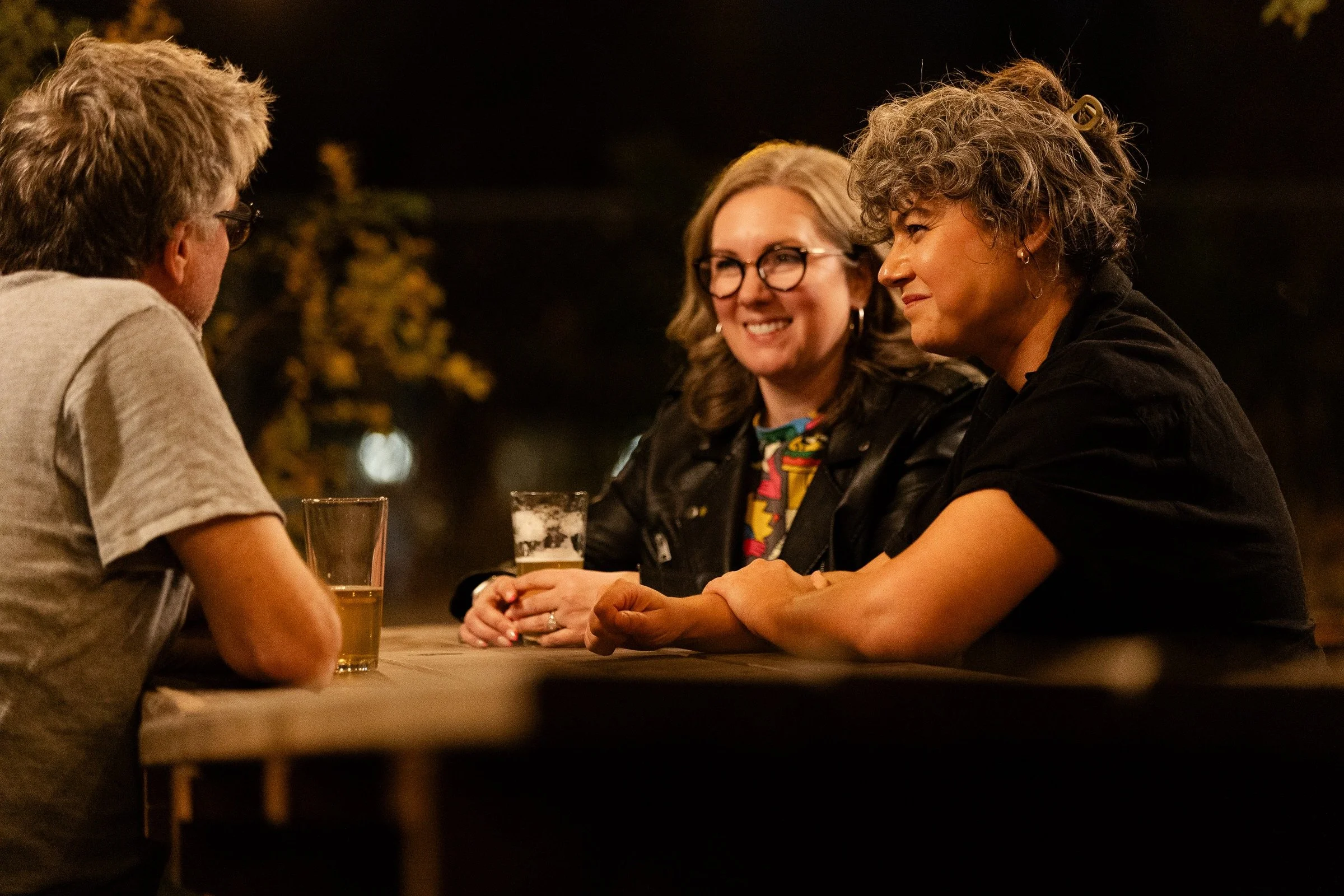
During the discussion at Metro Cinema, Taylor and Cooley explained that their friendship developed while they made the film. They had worked together previously but were not close friends when the project began. Their roles in front of the camera also developed during production, as Cooley's experience of hyperphantasia became an important part of the documentary alongside Taylor's experience of aphantasia.
An audience question about teaching returned to Taylor's experience with visual-spatial tasks. She suggested that awareness of aphantasia could help educators recognize when instructions based on picturing something are difficult for a student to use. The filmmakers discussed trying another explanation or breaking a problem into parts. Those were possibilities raised in the Q&A, rather than conclusions that any one learning method works for everyone.
Invisible Imagination premiered at the Calgary International Film Festival on September 29, 2026. Edmonton Screen reports that a shorter, 44-minute version is planned for CBC and CBC Gem in early 2027.