Why Are So Many American Movies and TV Shows Filmed in Canada?
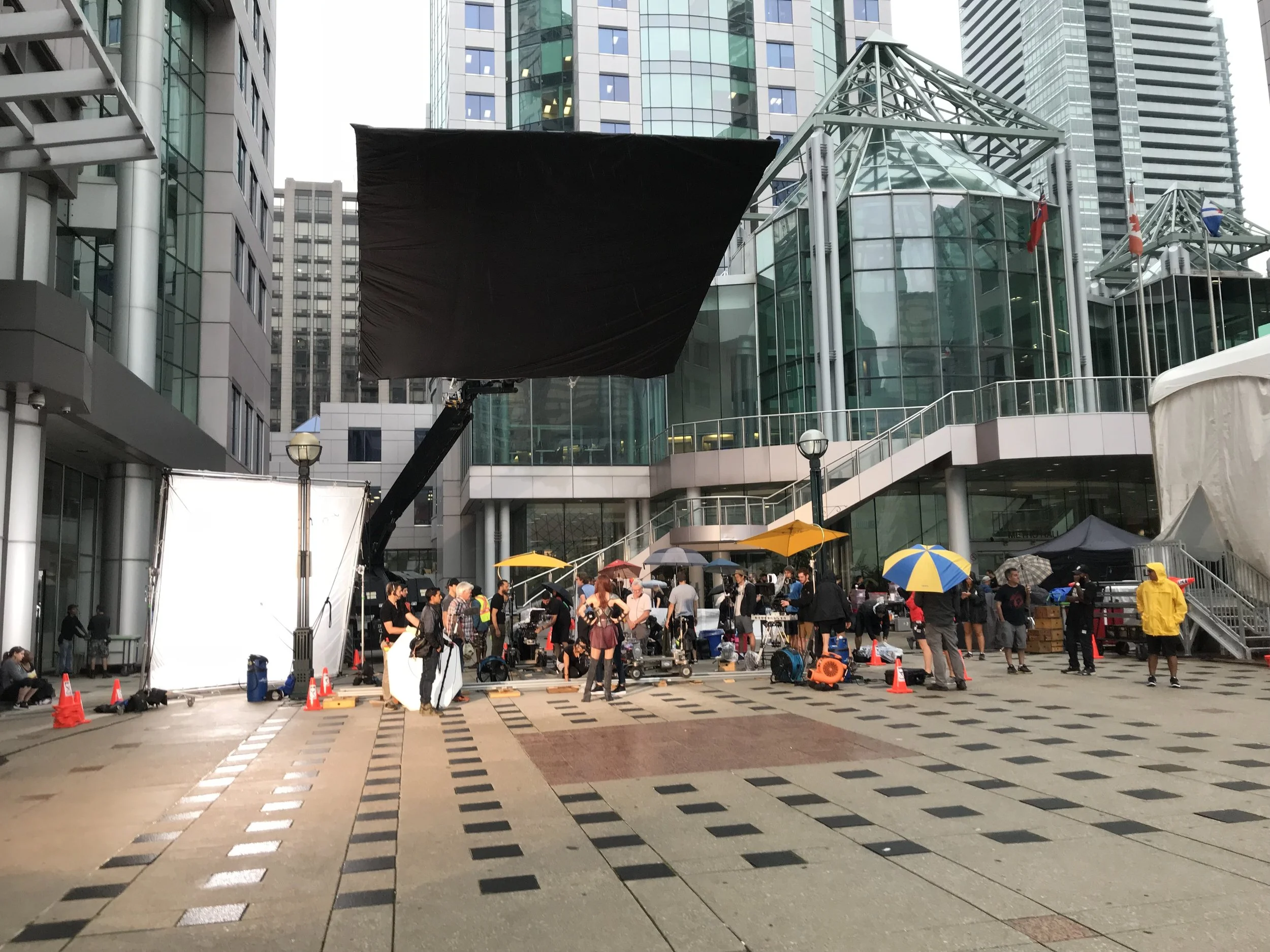
Filming for the American television series The Boys in Toronto, Ontario, on Aug. 27, 2018.
Photo credit: PvOberstein
In HBO’s The Last of Us, downtown Calgary stands in for part of post-apocalyptic Boston, Fort Macleod represents Austin, Texas, and the Alberta Legislature Building becomes the Massachusetts State House. The first season used locations across Alberta to portray different places in the United States, while employing Canadian workers and production services.
American producers choose Canada for a combination of production tax credits, experienced crews, soundstages and technical facilities, varied locations and, when the exchange rate is favourable, lower costs in U.S. dollars. A project can hire Canadian workers, occupy Canadian studios and spend millions with local businesses while its ownership and creative control remain with an American company. Its Canadian production footprint therefore tells only part of the story.
How tax credits reduce production costs
The federal Film or Video Production Services Tax Credit is central to the arrangement. It provides eligible corporations with a refundable credit equal to 16 per cent of qualified Canadian labour expenditures. The program is open to eligible Canadian and foreign-owned corporations carrying on the required production business through a permanent establishment in Canada. For a production-services company working on an American series, that can mean eligible wages paid for Canadian work qualify even though the underlying show is foreign-controlled.
Provincial incentives add another layer, although they work differently. British Columbia’s basic production-services credit is 36 per cent of qualified B.C. labour for productions beginning principal photography after December 31, 2024, up from 28 per cent for earlier productions. Ontario offers a 21.5 per cent production-services credit based on eligible provincial expenditures, which can include labour, service contracts, equipment and studio rentals. Quebec increased its basic production-services rate to 25 per cent of eligible production expenditures in 2024. Alberta offers two levels, 22 and 30 per cent of eligible production costs, with additional conditions for the higher rate.
The percentages can be misleading when removed from their rules. Federal and provincial credits use different definitions of eligible spending, and certain assistance reduces the amount on which a credit is calculated. Provincial eligibility can depend on corporate registration, where workers are based, where filming takes place and other requirements. Producers also need to finance the production while expenses are being incurred; a refundable tax credit is claimed through a tax process rather than arriving as an unrestricted cheque before filming begins.
Canada’s crews and studios are part of the deal
A lower budget is useful only if a production can find the people and facilities to deliver what is on the page. Toronto and Vancouver have substantial screen-production operations, while Montreal, Calgary, Edmonton and other regional centres provide their own combinations of crews, studios, locations and specialized services.
Amazon MGM Studios provided a concrete example of the Toronto infrastructure in January 2024, when it announced a multiyear agreement for exclusive use of five new soundstages and accompanying workshops and offices at Pinewood Toronto Studios. The facilities total approximately 160,000 square feet. In the same announcement, Amazon identified The Boys, Gen V, Reacher and The Handmaid’s Tale among productions shot in Ontario, along with Fargo in Alberta, Upload in British Columbia and parts of Tom Clancy’s Jack Ryan in Quebec.
A recurring production requires experienced people beyond the actors audiences see. Canadian workers build sets, rig lighting, operate cameras, manage locations, handle costumes and makeup, coordinate transportation and provide sound, editing and visual effects. Nearby suppliers rent equipment, supply materials, deliver meals and accommodate visiting cast and crew. Those services make it feasible for a large series to work in Canada repeatedly rather than assemble an entirely new local operation each season.
Canadian locations can play American cities
Alberta’s tourism agency identifies more than 180 locations used for the first season of The Last of Us, spanning city streets, government buildings and mountain communities. In Canmore, a historic bridge stood in for a crossing near Jackson, Wyoming, while Calgary’s Mount Royal University and Southern Alberta Institute of Technology represented a fictional university in eastern Colorado. Those choices illustrate the different kinds of locations one production can use within the same province.
Toronto’s streets and neighbourhoods, Montreal’s architecture and the range of settings available in British Columbia give producers additional options. Film commissions help productions find suitable locations and navigate practical issues, but each project makes its own choices about where to shoot and how much work to undertake locally.
Production can also be divided among regions and countries. A film might shoot principal photography in one province, use a second jurisdiction for additional scenes and hire a Canadian visual-effects studio for work on material filmed abroad. Those activities are relevant to Canada’s screen economy even when very little Canadian scenery remains visible in the finished production.
The scale of foreign production in Canada
The Canadian Media Producers Association’s Profile 2025 report puts foreign location and service production volume at $5.3 billion for the 2024/25 fiscal year, a 9.5 per cent increase over the previous year. Total Canadian film and television production volume was $10.17 billion, meaning the foreign location and service category represented roughly half of the sector’s combined production budgets.
The CMPA category includes foreign films and television programs made in Canada as well as visual-effects work undertaken by Canadian studios for foreign productions. Its $5.3-billion figure therefore represents more than the budgets of American shoots taking place on Canadian streets. It is also production volume, measured as the sum of budgets, rather than government revenue or industry profit.
The report estimates that foreign location and service production supported 97,920 direct and spin-off jobs in 2024/25. Its estimates of refundable federal and provincial production-services tax credits totalled $2.15 billion, including $560 million federally and $1.59 billion provincially. Those are different measures, and a full assessment of the public return on incentives requires more than comparing production volume with credit totals.
Individual productions show where some of that money goes. According to figures released by the Motion Picture Association–Canada in 2016, X-Men: Apocalypse spent more than $105 million in Quebec during a 94-day filming period, including $40 million on labour. The association reported more than $10 million in construction spending, over $2.3 million in catering and restaurant expenses, and more than $2.5 million in hotel expenditures. Those figures come from the industry association representing major studios and are best understood as reported expenditures, rather than an independent calculation of net economic benefit.
Statistics Canada reported in October 2026 that operating revenue in the film, television and video post-production industry fell to $2.4 billion in 2025, down 14.7 per cent from 2023. Its survey uses a different measure from the CMPA production-volume figures, and the decline indicates that demand for technical services does not move steadily upward from year to year.
Does filming in Canada make a show Canadian?
Where a production films does not settle which country can certify it. For the federal Canadian Film or Video Production Tax Credit, the Canadian Audio-Visual Certification Office (CAVCO) applies detailed requirements involving the Canadian production company, producer authority, key creative personnel, eligible Canadian costs and control of copyright. Apart from qualifying treaty coproductions, copyright must remain with the Canadian production company or another permitted owner for a 25-year period. A foreign studio can employ Canadian workers without meeting those domestic-production requirements.
The federal Canadian Film or Video Production Tax Credit offers eligible Canadian productions a refundable credit of 25 per cent of qualified labour expenditures. It is governed by different rules from the 16 per cent federal Production Services Tax Credit used by eligible service productions, and both cannot be claimed for the same film or television production. Official treaty coproductions have their own criteria for obtaining Canadian national status; hiring a Canadian crew or renting a studio does not in itself create an official coproduction.
For Canadian broadcasting, the Canadian Radio-television and Telecommunications Commission (CRTC) administers a separate Canadian-program certification framework. In November 2025, it adopted a policy to modernize the rules, including a minimum Canadian copyright interest and different creative-personnel requirements according to the Canadian ownership share. The CRTC said new regulations were needed to implement those criteria. A show set entirely in an American city can involve substantial Canadian work without qualifying under either certification system.
Read more: “What actually makes a TV show or movie Canadian?”
Why exchange rates and location choices still matter
An American production paying some of its expenses in Canadian dollars may gain purchasing power when the Canadian dollar is weaker than the U.S. dollar. Educational materials from the Bank of Canada Museum use American film production in Canada as an example of how lower Canadian-dollar labour and materials costs can attract foreign buyers. The savings available to any particular production depend on contracts, exchange rates when payments are made and which expenses are actually incurred in Canadian dollars.
Foreign production activity depends in part on decisions by studios and broadcasters outside Canada. Commissioning reductions, postponed projects or a decision to film in another jurisdiction can affect the work available to Canadian crews. Tax credits and established facilities can make a Canadian location competitive, although neither guarantees that a production will be commissioned or that employment will remain steady.
An American production filmed in Canada can provide substantial paid work to Canadian crews and contracts to local suppliers, while its ownership and commercial rights remain determined by the production’s agreements. The filming location establishes where some of the work took place; it cannot, by itself, establish who owns or controls the finished film or television series.