
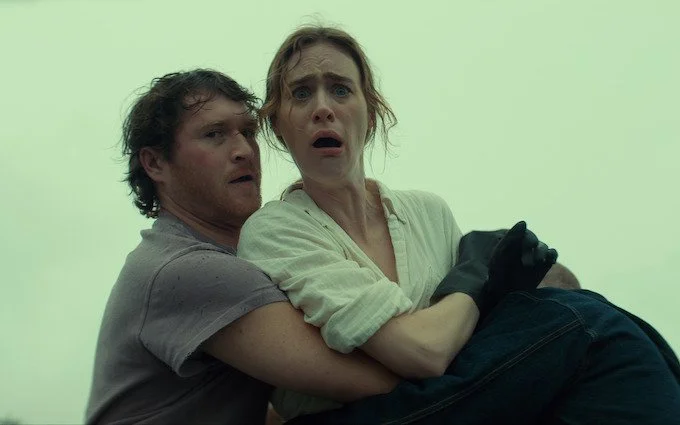
Emily Lê as Sonny and Dan Beirne as Chester in Sook-Yin Lee’s Paying for It, whose producers organized a Canadian theatrical release through direct cinema bookings and local promotion.
Photo credit: Gayle Ye / LOCO Films
Denis Villeneuve's Incendies had one distributor in Canada and another in the United States. Films Séville handled the Canadian release of the 2010 film; Sony Pictures Classics opened it in New York and Los Angeles on April 22, 2011. The Hollywood-owned distributor was bringing an already-produced Canadian film to American screens.
The producers were Luc Déry and Kim McCraw of Quebec's micro_scope, with France's TS Productions among the coproduction partners. Villeneuve adapted Wajdi Mouawad's stage play, and Sony's own American press kit described micro_scope as an independent production company. Sony's involvement came on the distribution side.
The distinction lies in who developed and produced the film, and who came aboard to release it. Independent production companies can finance their work with public and private backing, then sell rights to distributors with far greater reach. The detailed division of ownership and approval authority depends on agreements that are rarely public.
International partners, separate releases
The 2015 drama Room followed another route. Screen Ireland credits Element Pictures and Canada's No Trace Camping as its production companies, with Ed Guiney and David Gross producing. It was filmed at Pinewood Toronto Studios and elsewhere in the city, then completed post-production in Dublin.
Elevation Pictures released Room in Canada, while the independent American company A24 distributed it in the United States. The film starred Brie Larson and Canadian actor Jacob Tremblay. Larson later won the Academy Award for Best Actress.
The Irish Film Board, Telefilm Canada and Film4 were associated with Room, alongside its Canadian and Irish producers. Those arrangements brought together public and commercial partners; the film had separate distributors in Canada and the United States.
Canadian rules, different definitions
The term independent is not itself a federal production certificate. Canadian Heritage's Canadian Audio-Visual Certification Office (CAVCO) decides whether films meet requirements for the Canadian Film or Video Production Tax Credit, including Canadian company control, copyright and the producer's responsibilities. The credit is worth 25 per cent of qualified labour expenditures, subject to a cap on those expenditures. Provincial incentives and Telefilm Canada programs provide other routes to support.
CAVCO also applies Canadian creative requirements. For ordinary live-action productions, a director or screenwriter must be Canadian, as must at least one of the two highest-paid lead performers, alongside enough other qualifying creative positions. Official treaty coproductions such as Room are assessed under their international agreements instead. Those distinctions concern eligibility for Canadian incentives; a film's marketing as independent may reflect a different industry usage.
Broadcasting regulations apply another test. Under a May 2026 CRTC policy, a Canadian independent producer is a Canadian-owned and -controlled company in which the relevant broadcaster and related companies hold less than 30 per cent of the equity. The regulator also requires Canadians to hold a majority copyright stake in specified broadcasting partnerships. These rules address particular programs and ownership relationships rather than assigning one definition of independence to every Canadian film.
The Canadian crew on a foreign production
The Canadian Media Producers Association estimated $5.3 billion in foreign location and services production during the 2024–25 fiscal year, covering film and television work undertaken in Canada for producers based elsewhere.
Canadian businesses may supply crews, locations, equipment or production management while a foreign studio holds the principal rights and production authority. The federal Film or Video Production Services Tax Credit supports qualifying work at 16 per cent of qualified Canadian labour expenditures.
The Canadian Film or Video Production Tax Credit operates separately, with its own Canadian-ownership and creative-control conditions. The two federal credits cannot be claimed for the same production. Some Canadian companies produce their own films while also taking on service work for other producers.
Getting a film into theatres
When Sook-Yin Lee’s Paying for It was ready for Canadian cinemas, its producers were already pursuing a release plan that relied on direct bookings and local promotion. Aeschylus Poulos, a producer with Hawkeye Pictures, described the approach in a June 2025 interview published by the Canada Media Fund. The team also included Sonya Di Rienzo, a co-founder of Hawkeye Pictures, and Matt Code of Wildling Pictures.
The film opened at Cineplex’s Scotiabank Theatre in Toronto and was held over for four weeks. Poulos said that was its only Cineplex booking; the team worked with independent cinemas, festival venues and other exhibitors elsewhere. The Network of Independent Canadian Exhibitors helped connect the producers with more than two dozen theatres across the country. Landmark Cinemas added screenings after the release was underway.
Telefilm Canada and Ontario Creates supported the film’s marketing, while Film Movement acquired American distribution. The Canadian rollout nevertheless involved the producers themselves contacting theatres, arranging appearances and building local publicity. Poulos recalled a February weekend with screenings in Victoria, Prince Edward Island and Yukon, all requiring their own arrangements. The team had begun planning that work while the film was still in post-production.





Ontario alternative pop-rock duo Little White Lies released “String Me Along” on October 2, a song that Katie Rose Campbell says grew out of a difficult U.S. tour and a change in how the band approaches its career