
Calvin finds Wade in the community their family left decades ago, while Fonda's iceberg samples reveal a new danger and Snooks Arm waits for news of the missing research vessel.
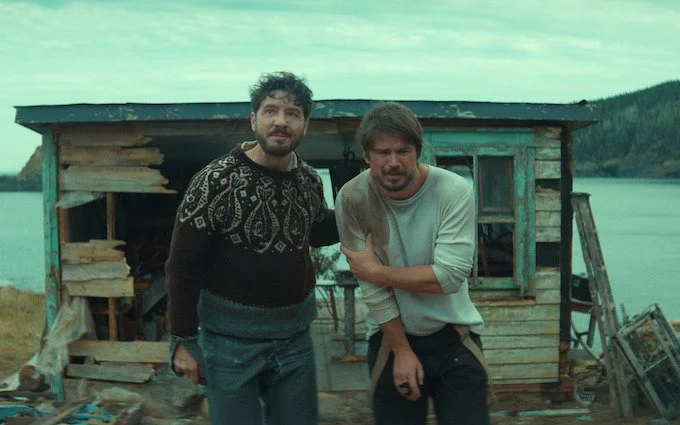
Walton Budgell (Shawn Doyle, left) and Calvin Penney (Josh Hartnett) in “Little Pot Rock,” Episode 5 of Netflix's Below.
Photo credit: Netflix
Spoiler warning: This recap contains spoilers for Episode 5 of Below, “Little Pot Rock.”
Below opens on a beautiful, peaceful sunrise, with Calvin Penney apparently waking from a dream about being underwater. His hands are injured, he's in considerable pain, and at first I couldn't work out where he was.
The house looks familiar. There are children's height marks on the wall, an old tea box and wallpaper that made me think of the Penney family home that sank when Calvin was young. For a moment, I wondered whether he was dead, dreaming or somewhere like the Upside Down in Stranger Things. The explanation is stranger in its own way: Calvin has washed ashore at Little Pot Rock, the community his family left forty years earlier.
Then Wade appears, alive and delighted to see him. He's been staying with a young woman named Maggie, whom he identifies as the figure he thought was the Old Hag. He has also met her dog, Moose, and her family. Calvin is relieved to see his son, but the idea that anyone still lives here makes no sense to him.
Walton Budgell arrives and welcomes Calvin home. Walton seems genuinely pleased to see him and diagnoses his pain as the bends, although his advice to walk it off hardly inspires confidence. I still love Josh Hartnett in this role. Calvin can be infuriatingly stubborn, but Hartnett is very good at making his desperation to protect Wade understandable.
The outport that never left
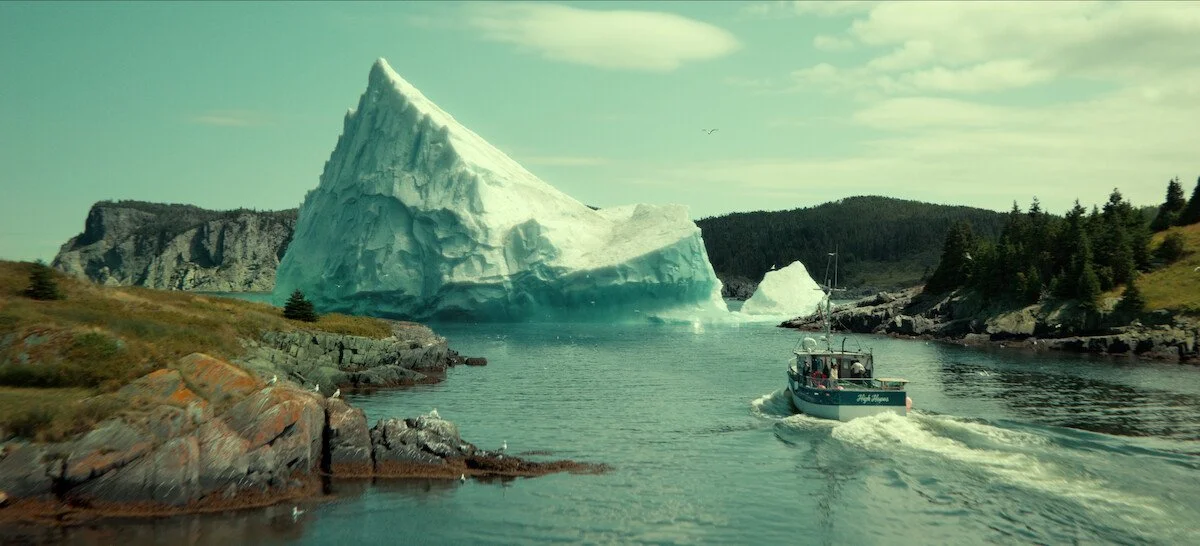
Walton takes Calvin around the remains of the settlement. The wharf has collapsed, and the place looks as though it has been left to deteriorate for decades. Calvin remembers waiting there for his father Leo to return with the day's catch. Walton explains that his family pretended to join the resettlement, then stayed. They kept fishing and refused to surrender their home.
Newfoundland's government began offering payments for outport resettlement in 1954, hoping to concentrate people where services could be provided more easily. Later federal-provincial programs encouraged moves to designated growth communities. The changes divided families, and some people mourned the places they lost. Little Pot Rock and the Crockers' role in its disappearance are fictional.
I did wonder why Calvin, who spends so much of his life on the water, had never returned to this stretch of coast or noticed that anyone was living here. But Walton's explanation also appeals directly to him. The residents are still doing what Calvin believes he was meant to do: fishing from their own community, away from the politicians and business interests he blames for its decline.
That feeling doesn't survive a visit to the graveyard. Walton tells Calvin that the community once had a dozen residents. Some died of natural causes, but his account of his wife Geraldine is considerably more disturbing. When she became ill with cancer, he says, she decided she was consuming resources the others needed and offered herself to the ocean.
Calvin is surprised to find Leo's grave among the crosses. Walton says the residents recovered enough of Leo's remains to give him a proper burial. Calvin admits that he cut the rope during the accident that killed his father. Walton insists that the decision saved the others who would otherwise have died with Leo. It's an emotional moment, though I'm increasingly suspicious of anything Walton says.
Mudder gives and takes
The other residents begin to explain why Little Pot Rock has survived. They call the sea creature “Mudder” and believe it protects them. Maggie gives Wade something made from local plants and berries, with an ingredient she says comes from Mudder. Wade seems increasingly attached to Maggie, and the affection appears mutual.
Walton takes Calvin out fishing at night, accompanied by his father. The old man's presence is odd enough; the trip becomes stranger when Walton offers Calvin a substance he claims will help his decompression symptoms and allow Mudder to recognize him. He uses Leo's old make-and-break engine to attract the creature.
And there she is. Instead of attacking, the enormous animal moves beneath the boat, driving fish into their nets. Walton is delighted with the catch and explains that the creature comes when the ocean is lean and the settlement needs food. He accepts that people die as part of the arrangement. It's a deeply unsettling bargain, particularly after what he said about Geraldine.
There's a real Newfoundland fishing tradition beneath the fictional ritual. Inshore fishing families preserved cod with salt, spreading the split fish on wooden platforms called flakes to dry. The work was often shared across households and helped sustain isolated coastal communities. Walton's people have retained some of that practical knowledge, even as their relationship with the sea has become horrifying.
At this point I was wondering whether Mudder was literally a mother, or whether the name was part of a belief system Walton had built around her. His language about the creature providing fish while also taking lives reminded me of the familiar idea of the sea as something that sustains communities and can kill the people who depend on it. I like that the episode allows both readings for a while.
Trouble back in Snooks Arm
Meanwhile, Snooks Arm is still dealing with the illness linked to the iceberg. Fonda believes the symptoms may subside within about forty-eight hours if everyone stays out of the water, but she needs a working radio and wants to recover her samples from the Ocean Science Centre. Mary insists on going with her, hoping to learn what has happened to Calvin and Wade.
The Coast Guard finally answers a call, but the news is terrible. The Sir John Franklin issued a mayday, and the search has found no survivors so far. Mary is devastated, although that report doesn't establish what happened to everyone who was aboard.
Jay has a more immediate problem. The men pursuing his debt find him with a flat tire and offer a ride. Their confrontation turns violent, and the vehicle ends up underwater as the creature attacks. Jay escapes, but he also goes back to help one of the men. Later, when he suggests that man would have done the same for him, I wasn't convinced.
Later, a reference to a mutual acquaintance in Fort Mac made me smile. Newfoundland and Labrador workers have travelled to Alberta for employment for decades, particularly to the oil sands around Fort McMurray. A House of Commons committee documented that migration in the 2000s, so the offhand mention fits this story.
Back at the research centre, Fonda discovers that something in her thawing iceberg sample is alive. It looks like a small squid, and suddenly the pieces begin falling into place: the iceberg may have been carrying a nest. I started wondering whether the residents of Snooks Arm had been putting more than contaminated ice in their drinks, and whether the enormous creature was trying to protect her young. Those questions haven't been settled yet.
There's another complication when Jim Crocker arrives by helicopter. The connection between the Crockers, the resettlement plans and the people still living at Little Pot Rock is becoming harder to ignore.
The price of living Calvin's dream
While helping with the catch, Calvin discovers an old mine shaft. Walton claims the Crockers found cobalt and copper deposits running beneath the area, possibly as far as Snooks Arm, and used resettlement to clear people from valuable land. The claim is part of the series' fictional conspiracy. Calvin believes it may explain what happened to his family and why the current resettlement vote matters.
Walton wants Calvin and Wade to stay. He imagines Wade marrying Maggie and the Penney and Budgell families carrying on the fishery together. It's the life Calvin has been longing for, but Walton's proposal comes with an appalling condition: the injured Portuguese fisherman Phil, whose leg is badly infected, is to be given to Mudder rather than taken to a hospital.
Calvin realizes that Wade is being drawn into the same arrangement. He tells his son to retrieve the crank handle and meet him at the boat at midnight. Wade refuses. Maggie has made him feel wanted in a way Calvin hasn't managed, and he doesn't want to return to the life he left behind. Charlie Heaton is so convincing here that I kept forgetting I was watching Charlie Heaton.
As preparations for Phil's sacrifice begin, Calvin tries to help him escape. Walton intervenes violently, and Wade finally comes to his father's aid. They struggle toward the boat while Maggie calls after Wade and the house catches fire.
That last image brought me back to the beginning. We opened on a peaceful sunrise over the water; now the same community is lit by a burning house. Calvin came to Little Pot Rock thinking he might have found the life his family lost. After what Walton and his people have done, I can't imagine him looking at that place quite the same way again.




Ontario alternative pop-rock duo Little White Lies released “String Me Along” on October 2, a song that Katie Rose Campbell says grew out of a difficult U.S. tour and a change in how the band approaches its career