
The retired RCMP chief superintendent discusses what international kidnapping cases taught him, what must stay out of his novels, and why he chose to publish independently.
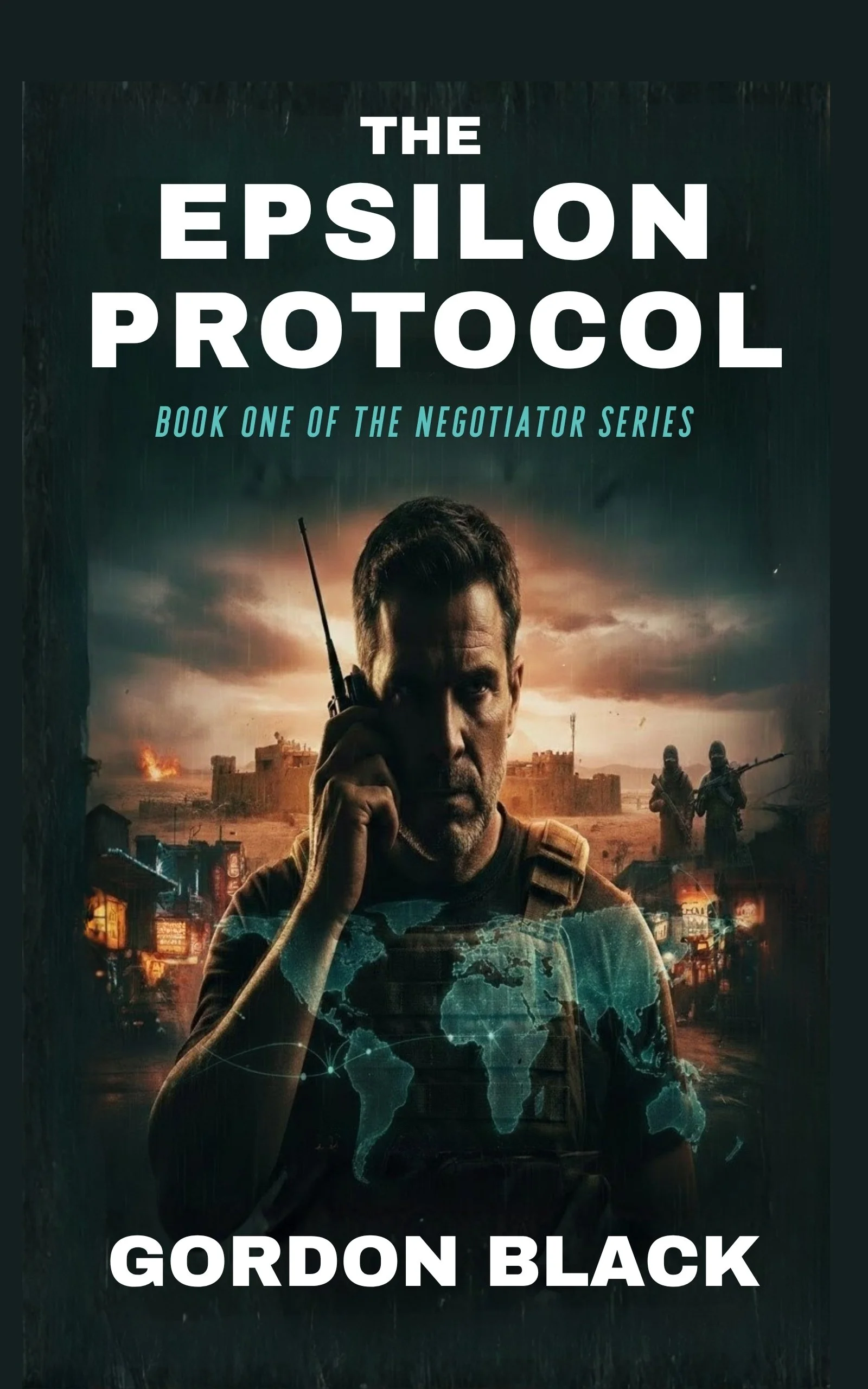
The Epsilon Protocol, Book One of The Negotiator Series, by British Columbia author Gordon Black. The geopolitical thriller was published September 7, 2026.
Photo credit: Courtesy of Gordon Black / Mildview Publishing
In September 1999, seven Canadians and one American were kidnapped in Ecuador. Inspector Gordon Black, a Royal Canadian Mounted Police negotiator, maintained contact with the kidnappers and advised Canada's ambassador while Ecuadorian authorities investigated. Black and RCMP colleague Jaime Victor Sebastian were subsequently awarded Meritorious Service Medals for their roles in the response. The Governor General's official citation documents both officers' contributions.
Black went on to retire as an RCMP chief superintendent after a career he says spanned three decades. Now based in Delta, British Columbia, he has turned experiences from international hostage negotiations into fiction. His debut geopolitical thriller, The Epsilon Protocol, follows Landon Holt, a retired RCMP inspector recalled to manage the kidnapping of a humanitarian team in the Middle East.
The resemblance between the author's former occupation and his protagonist's job is deliberate. Black says Holt draws on several people he worked with and that his fiction takes inspiration from his wider professional experience. In the interview, he did not identify the documented Ecuador kidnapping as the basis of this particular novel. He also wanted to acknowledge colleagues whose judgment and courage stayed with him.
Black has read thrillers throughout his life, but he thought their depictions of hostage situations often gave the most attention to armed intervention. "I think movies and television have given people a somewhat distorted picture of hostage negotiation," he said. In his experience, the negotiator's work carries enormous responsibility well before a decision about a rescue is made.
"A negotiator has to prepare for a range of possible outcomes, including developments nobody wants to contemplate," he said. "You have to think beyond the immediate exchange, consider how the other side might react, and be ready to adjust your approach as circumstances change." The risks extend to the captives and, potentially, the personnel who might be ordered into a rescue.
He also wanted to distinguish domestic hostage incidents from international cases involving terrorist or insurgent groups. Their objectives and ways of thinking, he said, can make conventional crisis-negotiation approaches inappropriate. This difference is central to The Epsilon Protocol, although Black deliberately leaves real operational tactics out of the novel.
Holt is a retired officer for a reason. Black wanted a negotiator with extensive experience who would have somewhat more freedom than an active member of a government agency. That makes it possible to examine disagreements between what people directly responsible for hostages believe should happen and what governments will authorize. It also allows Holt to assemble a group of former counterparts from Canada, the United States, Britain and Australia. Black worked alongside international negotiators during his own overseas assignments and wanted those relationships reflected in the fictional team.
The plot extends beyond the exchange between captors and negotiators. According to the publisher's synopsis, intelligence activity, diplomatic pressure and media manipulation complicate an already dangerous situation, while a classified multinational response brings military forces into the picture. Black organized these strands as separate subplots, bringing them together as developments affected other parts of the crisis.
He did not want readers to possess all the answers while Holt's team struggled, or to be so far behind the characters that the story became confusing. The intention, he explained, was for information to arrive in stages, with a discovery in one part of the operation sometimes overturning assumptions elsewhere.
In a scene Black discussed, the kidnappers take what he describes as “horrendous actions” intended to pressure the negotiators and the governments whose citizens are held captive. Holt must then decide how to proceed. Black said he wanted that choice to come from an assessment of the changed circumstances rather than anger or revenge. "I wanted the negotiation to carry its own tension, with decisions and their consequences driving the story, rather than treating it simply as a prelude to the action," he said.
Experience, secrecy and the work of invention
The knowledge Black brought to this material came with restrictions. He says aspects of his former work are covered by lifelong legal obligations of secrecy, and that he would not disclose sensitive counter-terror negotiation methods even where he was otherwise free to discuss them.
That meant rewriting scenes when a more direct description of a procedure was unsuitable. Black had to find other ways for a character's decision to feel plausible, or for a sequence to work dramatically, without reproducing protected practices. He said the number of revisions required was considerable.
"The authenticity comes from an understanding of the people, the pressures and the decisions involved, not from reproducing actual operations," he said. The characters, crises and incidents remain inventions. He wanted readers familiar with the profession to recognize the pressures of the job while allowing himself the scope to write a thriller.
His research was also practical. Black used satellite imagery to study prospective locations for the novel's Middle Eastern setting, considering the terrain, the distances between places and how people could move through them. Those geographical details helped him decide which events could credibly happen and how the operation might develop.
He drew on his experience working abroad when approaching cultural differences within the story. "During my overseas deployments, I never lost sight of the fact that I was a guest in the countries where I had been sent to work," he said. He made a point of learning about local customs and communities. For Black, understanding an opponent's beliefs and motivations also helps a negotiator anticipate decisions, even when those beliefs are rejected.
Writing convincing professional situations did not solve every problem of characterization. Black found that describing Holt's personality directly could only take a reader so far. He introduced Surf, a retired special forces operator and Holt's longtime friend, to reveal aspects of the protagonist through conversation, shared experience and their reactions to one another.
Surf became more important than Black initially expected. His friendship with Holt gave Black opportunities to suggest personal history and temperament that would have been awkward to deliver as explanation. The change came through drafting rather than from a detailed character plan established at the outset. It was one of the ways Black had to learn the methods of fiction after years working in a field where the details he knew were often precisely the details he could not put on the page.
Keeping control of the books
Black also had to make decisions about publishing that he had not anticipated when he began writing. He chose to release The Epsilon Protocol through Mildview Publishing, an independent imprint based in British Columbia, partly because of an unexpected suggestion from readers who saw the manuscript in progress.
As he circulated chapters to a varied group of beta readers, several told him that the characters and situations might work on television. These were readers who mostly did not know one another, and their similar reactions surprised him. Black had set out to write a novel; he had not been thinking about a screen adaptation.
He sought advice from a law firm specializing in entertainment and decided that publishing independently would allow him to retain rights and make his own decisions about the novels' future. The possibility of a screen adaptation had influenced that decision, although he did not say in the interview that a film or television project was planned.
Retaining control brought another set of tasks. Black describes days when he worked 14 or 16 hours to produce a few pages, only to reread them the following morning and delete much of the work. He had expected writing to be the difficult part. "But the writing, demanding as it was, turned out to be the easy part," he said.
The harder surprise was getting readers to notice the finished book. Publication through his own imprint meant confronting the crowded market for commercial fiction and the limitations of word of mouth. He appreciates opportunities for independent Canadian authors to discuss their work, but he is under no illusion that a book becomes visible simply because it can be purchased.
The scope of his writing project changed, too. "When I started writing The Epsilon Protocol, I set out to write a book. The idea of a sequel, let alone a trilogy, never crossed my mind," he said. During the first manuscript, he kept thinking of material inspired by other missions. Some of those ideas developed into substantial scenes that did not fit the story he was telling.
By the book's halfway point, Black had begun to see that Holt and his colleagues could carry another novel. That became The Sahel Ultimatum, scheduled for release on November 15, 2026. More material accumulated while he worked on the second instalment, eventually producing a third manuscript, The Jungle Stranglehold, which does not yet have a confirmed release date.
Black puts the first manuscript at roughly 300 pages, the second at about 400 and the third at more than 500. These are his approximate figures, rather than verified page counts for published editions. He says the manuscripts grew because the characters' decisions in one book created consequences he wanted to explore in the next.
The Epsilon Protocol was published September 7, 2026, through Mildview Publishing. Black said the task of getting books into readers' hands has been harder than he anticipated when he began writing. "Word of mouth matters enormously, but readers first have to discover that a book exists," he said.








Ontario alternative pop-rock duo Little White Lies released “String Me Along” on October 2, a song that Katie Rose Campbell says grew out of a difficult U.S. tour and a change in how the band approaches its career