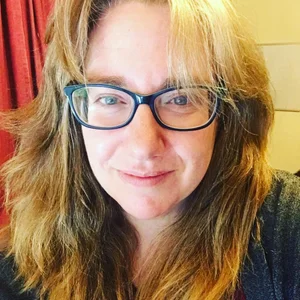
Soran Mardookhi’s The Flight follows PS752 families’ years-long pursuit of accountability
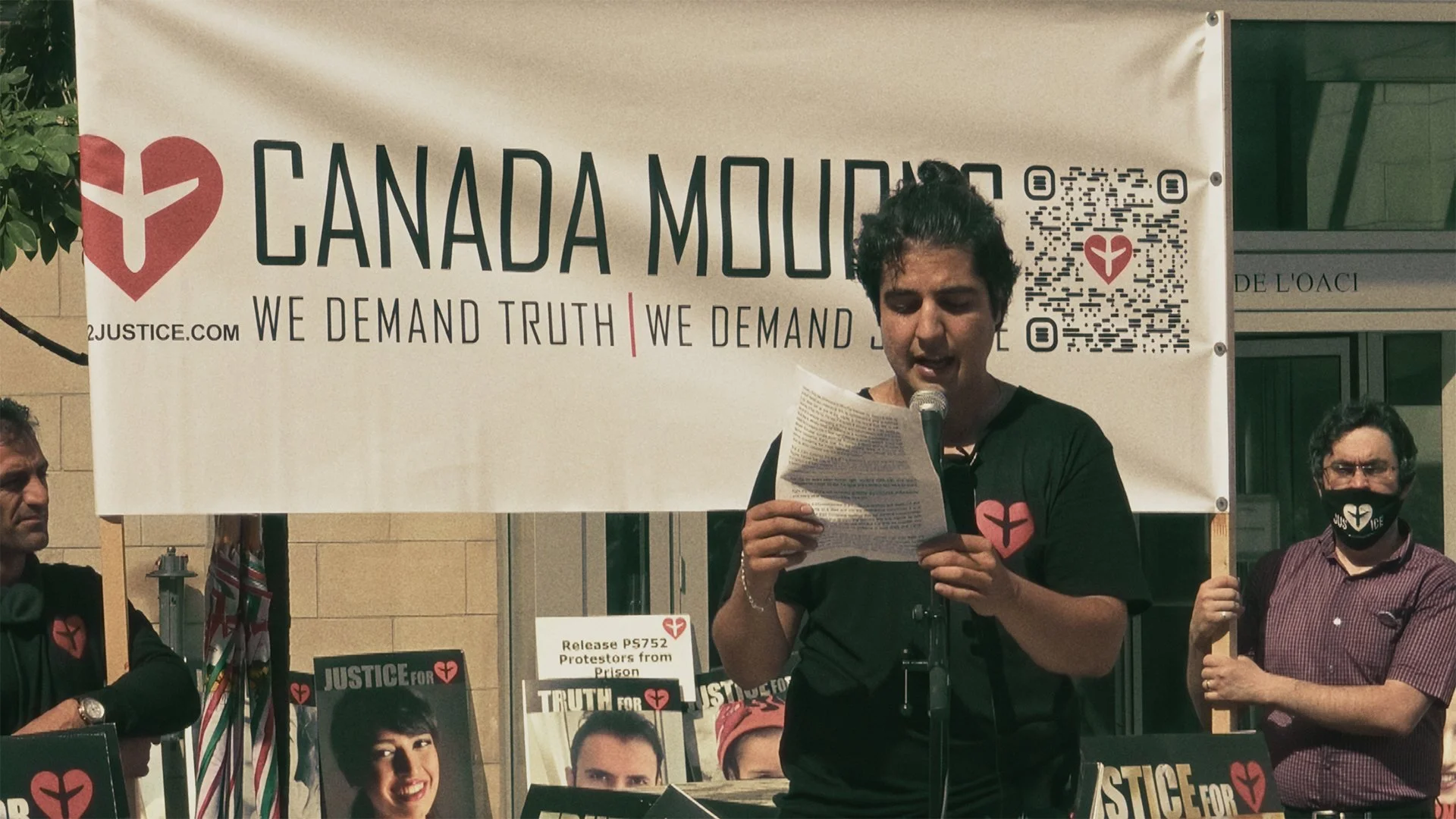
Arash Morattab speaks outside International Civil Aviation Organization headquarters in Montreal in The Flight.
Photo credit: Courtesy of the National Film Board of Canada.
Before Ukraine International Airlines Flight PS752 was downed on Jan. 8, 2020, Soran Mardookhi spoke with his brother in Sanandaj, in Iranian Kurdistan. Their family friends Arvin Morattab and Aida Farzaneh were preparing to travel to Tehran to catch their flight back to Canada. His brother called again after the aircraft was shot down: Morattab and Farzaneh had been on board.
“For me, this film began there,” Mardookhi says in his director’s statement for The Flight, his new National Film Board of Canada documentary.
The 97-minute film will have its world premiere Oct. 8 at the Vancouver International Film Festival, where it is screening in the Showcase program and BC Spotlight. Made through the NFB’s Western Documentary Unit, The Flight follows Canadian families who lost relatives aboard PS752 through the years that followed, as they became involved in an organized campaign for answers and accountability.
All 176 passengers and crew aboard PS752 were killed shortly after the flight departed Tehran for Kyiv. Fifty-five Canadian citizens and 30 permanent residents were among the dead.
Iran’s final safety investigation concluded that an air-defence unit mistook the Boeing 737 for a threat following what it described as a radar misalignment. The Transportation Safety Board of Canada said in 2021 that the scenario was plausible, while also saying Iran had provided no evidence to substantiate it and had failed to explain the underlying factors that led to the missiles being fired.
A separate Canadian forensic examination concluded that the surface-to-air missile operator deliberately launched at what the operator perceived to be a hostile target. It found no evidence that the destruction of PS752 itself was premeditated, and said the available information indicated that the Islamic Revolutionary Guard Corps missile operator likely misidentified the aircraft as a hostile target.
Mardookhi, a Kurdish Canadian filmmaker based in Port Moody, near Vancouver, grew up in Kurdistan amid war, bombardment and political repression before immigrating to Canada. In his statement for the film, he connects that background with the way he approaches stories about political power and its effects on individual lives. His personal relationship to Morattab and Farzaneh gave PS752 an immediate connection to people he knew.
Morattab and Farzaneh were married and living in Canada. The Association of Families of Flight PS752 Victims records Morattab as 35 and Farzaneh as 33 when they died. Morattab’s twin brother Armin later wrote about the five-minute age difference between the brothers and the five minutes Arvin and Aida spent in the air after takeoff.
Mardookhi followed families “over the years,” although the NFB has not publicly specified when filming began. He describes watching people with little previous connection to activism, politics or international law become part of a collective effort to investigate the downing and press governments and international institutions for action.
VIFF describes The Flight as following three Iranian Canadian families, although the NFB’s credits reveal a broader group of relatives, advocates and lawyers appearing throughout the documentary. They include Hamed Esmaeilion; Armin, Shahnaz, Shahla and Arash Morattab; Huriran Sohrab; Alborz Sadeghi; Vahid Emami; and lawyers Gissou Nia and Haydee Dijkstal. The Association of Families of Flight PS752 Victims also provided archival material for the production.
Esmaeilion lost his wife, Parisa Eghbalian, and their nine-year-old daughter, Reera Esmaeilion. He became one of the founding figures of the Association of Families of Flight PS752 Victims and later served as its president and spokesperson before resigning from those roles in March 2023. The association was established in 2020 with goals that included preserving the victims’ memories, supporting families and pursuing justice and accountability.
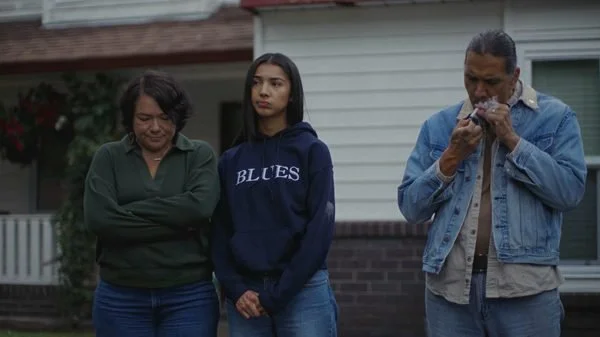
The documentary also stays with parts of family life outside hearings, demonstrations and legal proceedings. Home video supplied by relatives appears throughout the film, showing the people who died at family gatherings and in ordinary moments before January 2020. The NFB credits archival contributions from the association and several participating families, including members of the Morattab and Sadeghi families and Huriran Sohrab. Other footage follows memorial events, graveside visits, a 5K run and gatherings in Vancouver and Toronto.
Mardookhi says those materials became essential to his attempt to keep the people aboard the aircraft from being reduced to the number 176. His crew remained small, and cameras sometimes continued recording between planned moments. As production went on, he says he learned to “step back and let the families lead us.”
The Flight is a 100-per-cent NFB production from the Western Documentary Unit. Shirley Vercruysse and Teri Snelgrove produced the film, with Vercruysse and Tina Ouellette as executive producers. Dany Lavoie served as director of photography, Abbas Mojarad edited the documentary and Miguel Nunes handled sound design.
Mardookhi already had a long connection to Vancouver filmmaking before beginning the project. The City of Vancouver selected him for its 2015–18 Artist Studio Award program, identifying him at the time as a Kurdish Canadian filmmaker who had completed features, short films and documentaries. His second feature, Turbulence, received nominations for Best Canadian Film and Best BC Film at VIFF in 2014. City records say he earned a BFA in cinematic film directing from Tehran Soureh University in 2006; his later work includes the 2016 feature documentary Forgotten Chords.
The families’ pursuit of accountability continues through several legal processes. Canada, Sweden, Ukraine and the United Kingdom brought a case against Iran at the International Court of Justice in July 2023 under the Montreal Convention. The four countries allege that Iran breached its treaty obligations in connection with the destruction of PS752 and its subsequent investigation and prosecution. Iran raised preliminary objections concerning the court’s jurisdiction and the admissibility of the application in January 2025, and proceedings on the merits are suspended while those objections are considered.
A separate proceeding concerns the Chicago Convention’s prohibition on the use of weapons against civilian aircraft. Canada, Sweden, Ukraine and the United Kingdom brought that dispute to the International Civil Aviation Organization Council in 2024. The council rejected Iran’s preliminary jurisdictional objection in March 2025, and Iran appealed that decision to the ICJ the following month.
The four responding countries filed their counter-memorial in that appeal on March 27, 2026. The ICJ subsequently ordered a second round of written pleadings and, on Sept. 3, extended the deadlines: Iran’s Reply is due Oct. 21, 2026, while the four states’ Rejoinder is due March 22, 2027. The ICAO proceeding remains paused while the appeal is before the court.
Mardookhi did not set out to make The Flight a comprehensive account of those international proceedings. They enter the documentary through the people who have spent years pursuing them, alongside funerals, anniversaries, family recordings and the work that grew out of the crash.
At one point in the film, Arash Morattab describes the process in four words: “Justice is a journey.” The Flight has its world premiere at VIFF’s SFU Woodwards screening on Oct. 8, followed by a second festival screening Oct. 11 at Fifth Avenue Cinema.