At 75, the National Ballet of Canada puts its own history back onstage
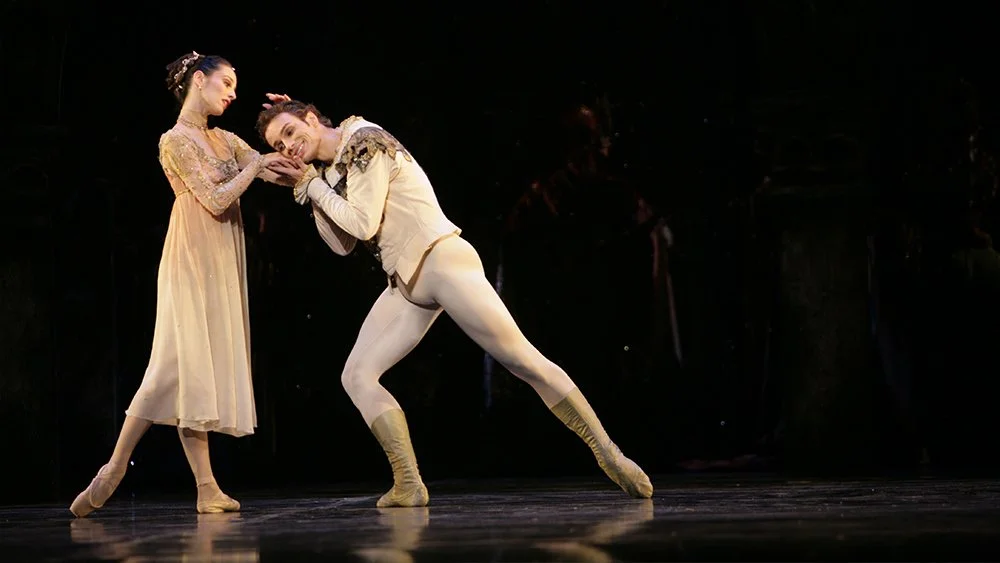
Sonia Rodriguez and Aleksandar Antonijevic in Romeo and Juliet in 2006, when the ballet was the final production the National Ballet of Canada performed at Toronto’s O’Keefe Centre before moving to the Four Seasons Centre for the Performing Arts.
Photo credit: Cylla von Tiedemann
When John Cranko’s Romeo and Juliet opens the National Ballet of Canada’s 75th-anniversary season on Oct. 31, the company will be returning to a ballet that has followed it through much of its history.
The National Ballet first performed Cranko’s 1962 work on April 14, 1964, at Place des Arts in Montreal. Forty-two years later, Romeo and Juliet was the final ballet it presented at Toronto’s O’Keefe Centre before moving to the Four Seasons Centre for the Performing Arts in 2006. The production returns this fall for the first time since 2009, running through Nov. 8.
Single tickets for the 2026–27 season went on sale Sept. 22, bringing an anniversary programme announced last year into its immediate performance season. Across the schedule, artistic director Hope Muir has drawn repeatedly from works connected to different periods in the National Ballet’s development while commissioning new work and changing some of the company’s established programmes.
That history reaches back to Nov. 12, 1951, when the National Ballet gave its first performance at Eaton Auditorium in Toronto. The company’s fuller account of its founding credits Sydney Mulqueen, Pearl Whitehead and Aileen Woods with organizing and raising money for a Canadian ballet company and bringing Celia Franca from England to Toronto. Franca became the National Ballet’s founding artistic director.
By the time Romeo and Juliet entered the repertoire in 1964, the company was beginning a period of extensive touring. Cranko had created the ballet for Stuttgart Ballet two years earlier, set to Sergei Prokofiev’s score, and the National Ballet subsequently took it to Canadian and international stages.
The ballet also accumulated a distinctly Canadian performance history. Filmmaker Norman Campbell adapted Cranko’s production for CBC Television in 1965 with Veronica Tennant and Earl Kraul in the title roles. Tennant continued dancing Juliet through her National Ballet career and returned to the role for her retirement in 1989.
The version appearing this season carries another Canadian contribution. Jürgen Rose’s original costumes were destroyed by fire in 1973, and Canadian designer Susan Benson reimagined the production in 1995. Her sets and costumes remain part of the revival opening the anniversary season.
The season closes in June with another work connected to the National Ballet’s early decades. Rudolf Nureyev staged his version of The Sleeping Beauty for the company in 1972, with its National Ballet premiere at the National Arts Centre in Ottawa on Sept. 1 of that year. The company credits the production, including performances at the Metropolitan Opera House in New York, with helping establish its international reputation during a period of expanded touring.
The Sleeping Beauty returns June 18 to 27, 2027, giving the season two large classical productions that entered the National Ballet repertoire during Franca’s tenure.
Elsewhere, the anniversary programme reaches back almost to the beginning of the company and then changes the material.
The National Ballet performed Act II of Coppélia during its first year and mounted the complete ballet in 1952, which the company identifies as its first full-length ballet. Erik Bruhn created another version in 1975; that production remained in the repertoire until 1998.
Muir has commissioned choreographer Val Caniparoli to return to the story with Dr. Coppélius, a new full-length production centred on the inventor rather than treating him primarily as an obstacle in Franz and Swanilda’s story. It is Muir’s first full-length story-ballet commission since becoming artistic director in 2022.
Caniparoli is American, while three of the principal creative roles are held by Canadian women: Eda Holmes is the librettist and dramaturge, Camellia Koo is designing the sets and costumes and Bonnie Beecher is the lighting designer. The production premieres in Toronto March 13 and then travels to the National Arts Centre in Ottawa from April 22 to 24.
The anniversary season’s Canadian history also extends into work created within the past two decades. Vancouver-based choreographer Crystal Pite’s Emergence returns in November alongside Sol León and Paul Lightfoot’s Silent Screen. Karen Kain commissioned Emergence from Pite in 2009, when it became her first commission for a large classical ballet company. Canadian composer Owen Belton created its original score.
Its return 17 years later places a Canadian contemporary commission alongside the older works being revisited for the anniversary. Pite’s relationship with the National Ballet continued after Emergence, including Angels’ Atlas, which the company premiered in 2020.
The season also introduces a new full-evening work from David Dawson, who became the National Ballet’s Resident Choreographer in 2025. He is the first person to hold the position since 2007, following a line that began with Canadian choreographer Grant Strate in 1964 and later included Constantin Patsalas, John Alleyne and James Kudelka.
Dawson’s The Beginning of Forever, running June 5 to 12, is his first National Ballet commission since taking the position. The three-part work has a newly commissioned score by composer and cellist Peter Gregson.
Kudelka, meanwhile, remains present in the anniversary year through his 1995 production of The Nutcracker and a new work being created specifically for principal dancer Heather Ogden’s farewell gala on June 8. Ogden, who was born in Toronto and trained at Richmond Academy of Dance in British Columbia, joined the National Ballet in 1998 and will retire after 29 years with the company.
The relationship between the company and Canada’s National Ballet School also becomes part of the season itself. Students from the school will perform Christopher Wheeldon’s Scènes de Ballet in its entirety as part of Echoes of Stravinsky in February and March. The National Ballet says it will be the first time in its history that the school has shared a programme with the company. Franca and Betty Oliphant co-founded the school in 1959, eight years after the National Ballet’s first performance.
Muir has also changed one institution inherited from an earlier artistic director. The Erik Bruhn Prize, established after Bruhn’s death and first held in 1988, is being replaced in March by the Erik Bruhn Festival of Emerging Artists. The competitive element has been removed. Young dancers from participating companies will still perform classical repertoire and contemporary works created for the event, but the National Ballet is presenting the revised format as a showcase built around artistic exchange and professional development rather than prizes.
Bruhn served as National Ballet artistic director from 1983 until his death in 1986, and during his tenure he commissioned work from Canadian choreographers including Robert Desrosiers, Danny Grossman and David Earle.
The company is also taking parts of the anniversary beyond its regular Toronto season through Sharing the Stage partnerships. Second Soloist Keaton Leier returned to his hometown of Saskatoon on Sept. 19 for a programme with the Saskatoon Symphony Orchestra. The National Ballet will appear at the FirstOntario Performing Arts Centre in St. Catharines on Oct. 24, followed by a March 6 collaboration with Ballet BC in Vancouver, which is marking its own 40th anniversary. Dr. Coppélius will then travel to Ottawa in April.
The programme remains centred on Toronto, but those partnerships add a broader Canadian component to a season built around a company carrying “National” in its name.
Another anniversary falls within the larger one. Share the Magic, the National Ballet programme that provides free access to performances through community organizations, marks 40 years in 2026. Since it began in 1986, the company says nearly 120,000 people have attended performances at no cost. It now works with over 60 community partners, including schools in underserved areas, social-service agencies and health and support organizations.
Share the Magic will also provide the first performance of the National Ballet’s 75th-anniversary Toronto season.
At 1 p.m. on Oct. 31, over 1,800 community members experiencing challenging circumstances are expected at a free performance of Romeo and Juliet. The formal anniversary gala follows at 7:30 that evening, with Cranko’s ballet returning to the stage where the National Ballet will begin its 76th season.