Narco Mennonites Episode 1 recap: “This Mennonite Is a Drug Dealer”
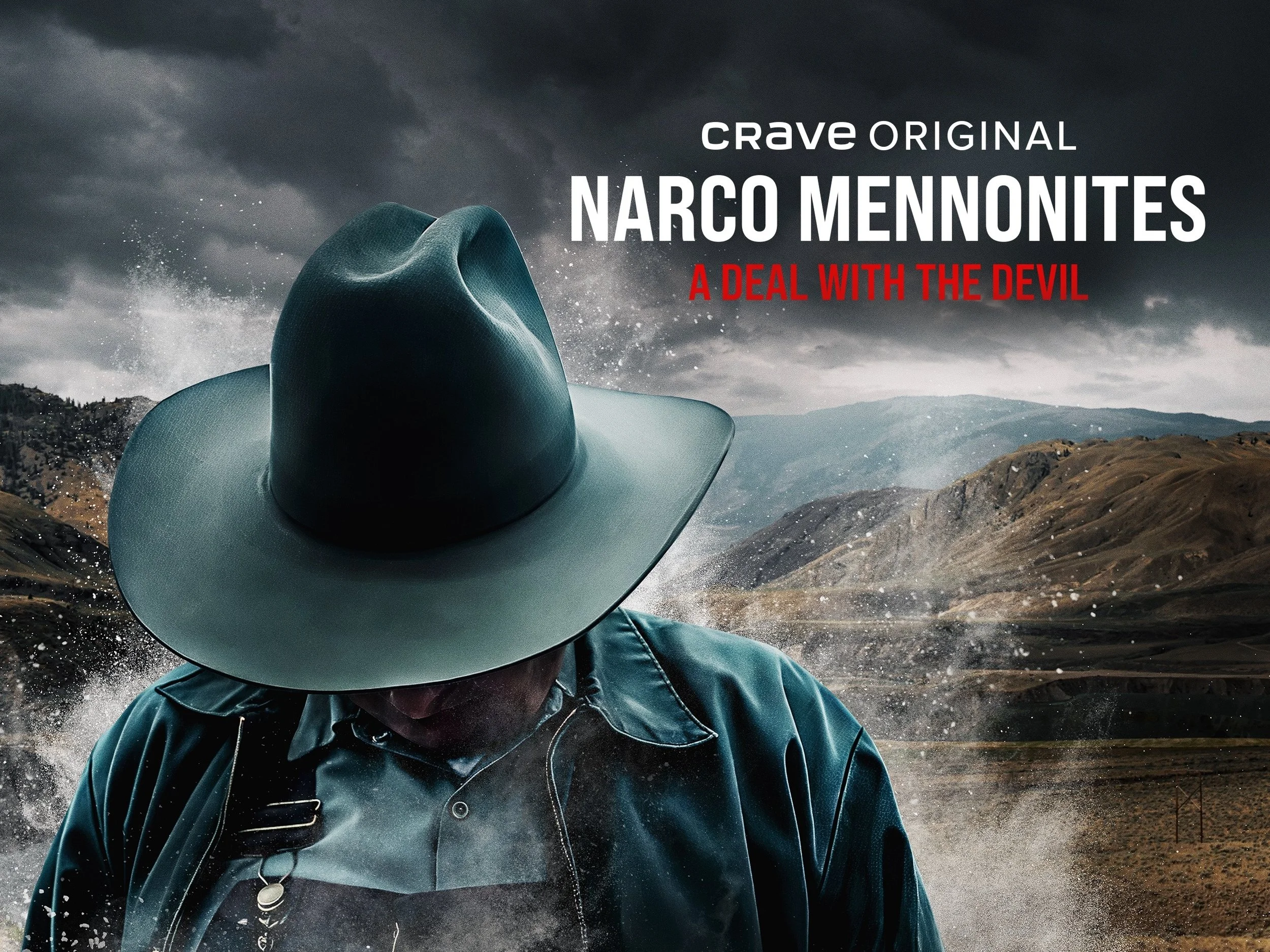
Crave’s three-part documentary series Narco Mennonites traces a drug-trafficking network that stretched from southwestern Ontario to Mexico and the United States.
Photo credit: Crave/Bell Media promotional artwork via Prime Video
I knew almost nothing about Narco Mennonites before starting it. I didn’t remember hearing about this story in the news, although I wondered whether something might come back to me as I watched, and my general picture of Mennonite life was pretty broad: religious communities, farming and conservative traditions. Early in the episode, I also caught myself mentally sorting Mennonites, Hutterites and Amish communities because some of those images had become mixed together in my head over the years.
Johan Harms appears briefly at the beginning, saying he wants to “set the record straight,” before the episode moves through interviews with retired Ontario police officer Bernie LeBlanc, journalist Andrew Mitrovica, author Sam Quinones and others describing a small number of Mennonites who became involved in drug trafficking. Almost immediately, the story is moving between Canada, Mexico and the United States while introducing several people and decades of history, and I was interested but already wishing for a few more dates on screen.
The Ontario connection
A retired Ontario police officer says investigators began encountering unusually compressed marijuana in the mid-1980s. It was different from the loose, locally grown marijuana they were used to seeing, and police believed it was being brought in from somewhere else. LeBlanc’s part of the story begins a few years later, when he was sent to Leamington in 1989 as part of an undercover drug investigation.
A civilian source told LeBlanc about a Mennonite man who was allegedly selling drugs. LeBlanc says he initially dismissed the idea because his knowledge of Mennonites was limited and he associated them mainly with religion and a conservative way of life. He and the source eventually drove to a Mennonite home, where LeBlanc remembers seeing work clothes and baby diapers hanging on the line outside and thinking there was no way he was about to buy drugs there.
A Mexican Mennonite named Abraham Harms answered the door. LeBlanc asked to buy some weed and said he would take “a quarter,” meaning a quarter-ounce. Harms went to a cupboard, pulled out a kilogram brick and cut off a quarter of it instead.
LeBlanc remembers thinking, “Oh, my God. This Mexican Mennonite is a drug dealer,” which gives Episode 1 its title. I liked LeBlanc almost immediately as an interview subject. He has a dry way of telling the story, including his own assumptions going into that first meeting, and he makes the Ontario investigation one of the easier threads to follow in an episode with a lot of moving parts.
The undercover investigation continued, and Harms eventually offered to take LeBlanc to Mexico. His superiors had no intention of allowing that, so another deal was arranged at a dock in Wheatley, where Harms brought five kilograms of marijuana. LeBlanc describes standing there trying to signal his arrest team and repeatedly recounting the money to stall when the signal did not seem to be working, before sirens finally arrived and officers came down the dock with shotguns.
According to the documentary, Harms was arrested, released on bail and then left Canada for Mexico rather than returning to face the charges. A retired officer interviewed in the episode says Harms was still able to work through contacts after leaving Canada and that the trafficking continued.
Following Abraham Harms to Mexico
The episode then moves to journalist Andrew Mitrovica, who says that in 1991 he was searching through material at the CBC library when he found a small Windsor Star story about Cornelius Banman, who had been caught at the border with marijuana concealed inside a false-bottom sofa. Mitrovica began tracing who Banman was working for and says the trail eventually led him back to Abraham Harms.
Mitrovica could go somewhere Canadian law enforcement could not, so he travelled to Mexico as part of the CBC investigation. In archival CBC and The Fifth Estate footage from Cuauhtémoc, journalist Hana Gartner confronts Harms about drug trafficking and asks whether his children had been used as couriers. Harms says very little, while the footage also introduces his sons, particularly Enrique and Johan, and shows Enrique in jail in Juárez on heroin charges.
The questioning becomes uncomfortable when Gartner asks about Harms involving his children. Looking back on the encounter, Mitrovica says he believes there was a moment when Harms recognized what he had done by bringing them into the drug business. That is Mitrovica’s interpretation of Harms’ reaction rather than something Harms himself confirms.
Not long afterward, Abraham Harms died in Mexico. The documentary says he was killed in a car crash on a highway near Cuauhtémoc. LeBlanc recounts being told that Harms drove off the road, struck a tree, climbed back toward the highway and was then hit by another vehicle, while Mitrovica says there were suspicions within law enforcement that the crash may not have been accidental. The episode does not resolve that question.
After Harms’ death, Quinones says his sons Enrique and Johan continued developing the drug business their father had started, with the operation eventually moving beyond marijuana. At that point, the documentary introduces another Abraham, and this is where I could have used a family chart along with the timeline.
Abraham Harms is the man from the Ontario investigation. Abraham “Abe” Wiebe is a different man, married to Helen Wiebe, whose story takes over much of the second half of the episode. With several Harms men already in play and another Abraham entering the story, I found myself working harder than I wanted to simply keep everyone straight.
Another Abraham, another part of the network
Helen says she began dating Abraham Wiebe when she was 18 in Mexico. Before they could marry, they were required to confess wrongdoing to church leaders, and Abraham admitted stealing money from a previous employer. Helen says the bishop told him he had done too much to be forgiven, which she describes as devastating to his faith, and she says she was also pushed out of the church community.
Helen also says Abraham began physically abusing her shortly after they were together. Her story then moves backward into her own childhood, when she grew up without electricity because it was considered sinful within her particular community and lived under strict expectations around clothing, hair and church attendance. Her mother died when Helen was around 10, and she describes physical abuse by her father and growing up feeling that she did not receive love from anyone. She becomes visibly emotional while talking about it, and her own account carries this section without needing much added commentary.
By the mid-1990s, Helen and Abraham were living in Thomas, Oklahoma, where Abraham’s brother-in-law Frank Klassen was also living. Klassen remembers Abraham working irregularly, drinking heavily and spending time with a group of Mexican friends, including Javier Morales. Helen says she knew drugs were coming from Mexico and knew Abraham was involved in trafficking, although she did not understand exactly who was supplying or selling them.
Klassen describes Abraham showing him how drugs could be concealed in vehicle wheels and explaining how much money he could make for relatively little work. Klassen says he was tempted because he was struggling financially, but he decided he did not want that life for his family and walked away.
Money comes up repeatedly in the episode. Several participants talk about poverty, drought, limited agricultural income and the appeal of earning quickly what farm labour might take much longer to provide. Those accounts are about the people and communities involved in this particular story, rather than an explanation for Mennonite communities generally.
Abraham Wiebe’s role changed after he was stopped for drinking and driving in Oklahoma and began talking to police. A former narcotics agent interviewed in the documentary remembers initially looking at him as a farm kid who did not seem likely to know much, but Abraham began describing transportation methods, smuggling locations and other details the agent says were known only to people close to the operation.
Investigators obtained access to a rural farmhouse and barn outside Thomas and used the property in an undercover operation. Abraham was supposed to present it to Morales as a place where tractor-trailers could unload drugs away from town, while police wired the property with cameras and established surveillance teams. Helen says trucks often arrived around two or three in the morning, with Abraham outside helping while she wrote down licence plates and phone numbers.
The episode describes drugs hidden inside tyres, truck frames and hollow beams running through trailers, with packages wrapped in layers of plastic, powder and foil. Some had to be pulled from the trailer beams using a long pole. Quinones describes the smugglers as particularly adept at mechanics and creating concealed spaces in vehicles, presenting that ingenuity as part of the way the trafficking network operated.
This is where I started having trouble following how much time was passing. The episode moves quickly from Abraham becoming an informant to the farmhouse operation and then through repeated overnight deliveries, and during my notes I actually went backward because I wasn’t sure whether I had missed a timeline marker. One participant calls it a year-long investigation, while another says that toward the end they had been working it for almost nine months, so clearly much more time is passing than the editing initially made me think.
By 1999, Oklahoma investigators were contacting Canadian police. The Americans had begun realizing that the network they were following extended much farther than Oklahoma, while Ontario investigators already had history with some of the same people. The former Oklahoma agent describes drugs moving to places including Florida, Chicago, Mississippi, Colorado and New Mexico, and the investigators talk about realizing that the operation was much larger than they had initially understood.
The takedown and Abraham Wiebe’s disappearance
When the investigation reached its takedown, the documentary gives some large numbers. The former agent puts the case total at about 22,000 pounds of drugs, including roughly 2,300 pounds of cocaine and a smaller amount of heroin, and also describes multiple arrests and search warrants. Those figures are his account in the documentary; contemporary reporting on the investigation gives somewhat different totals, so I would not treat every number here as independently settled.
The episode also uses illustrative footage while recounting events from the 1990s, and at one point semis are shown driving past modern wind turbines. I found that strangely distracting because I was already trying to work out where we were in the chronology and briefly wondered whether the documentary had jumped forward again. There is another sequence later where horses and children appear to be moving backward, which initially made me think we were being taken back in time, but it seems to be a stylistic choice rather than another chronological shift.
After the takedown, the former narcotics agent says Abraham and Helen were placed into a protection program in Oklahoma City. Helen says Abraham had become increasingly depressed toward the end of the investigation and did not want to talk to either the traffickers or the agents anymore, and after the arrests he wanted to return to Mexico. Klassen says he warned Abraham that going back was dangerous and that the people involved might kill him, but Abraham returned anyway, with Helen and the children eventually going back to the area where he had grown up.
In Mexico, Abraham left with a man who Helen says was interested in buying their car. They were supposed to travel toward the border, but Abraham did not return. Six days later, Helen says her mother-in-law discovered a broken window and a letter attached to a rock. The letter said Abraham was alive but threatened to kill him, Helen and her family if she spoke again to anyone in the United States, and the former narcotics agent says he told Helen to take her children and get across the border.
The account of what happened to Abraham after his disappearance comes through law-enforcement sources rather than anything the episode establishes directly. The former agent says a source told him Abraham had been kidnapped, beaten and tortured because of his cooperation with authorities, then killed and thrown into a lake.
Later, when the agent is asked whether he believes Enrique Harms was responsible for Abraham Wiebe’s disappearance, he says a source and Rene Cisneros told him Enrique had Abraham killed and that another reporter had given him the same information. He says he believes that account. Episode 1 presents it as an allegation relayed through those sources; it does not establish that Enrique ordered Abraham Wiebe’s death.
Mitrovica describes Enrique as emerging as the “heir apparent” to his father, while the documentary says the trafficking operation expanded into cocaine and heroin and developed connections with Mexican cartels and other criminal organizations. Then the episode returns to Johan Harms, Abraham Harms’ son, who appeared briefly at the beginning. He sits down for an interview and says he wants to set the record straight, which is where Episode 1 ends.
I definitely wanted to keep watching, although I still wanted a clearer timeline. There is an enormous amount packed into the first episode, and the Canadian connection alone kept pulling me forward: an OPP investigation in southwestern Ontario leads to a Mexican Mennonite trafficker, a CBC investigation follows the story into Chihuahua, and years later an Oklahoma investigation connects back to Canadian police.
The number of people and overlapping names makes the episode harder to follow than it needs to be. There are multiple members of the Harms family, two central men named Abraham, movement between three countries and several years passing within the episode, so a few more dates and identifiers on screen would have helped. I was also fascinated by the geography of the whole thing because Canadian Mennonites and Mexican drug trafficking seemed, when I started, like two pieces of a story that should be nowhere near each other.
I had one other very modern Canadian reaction to the early marijuana trafficking. Cannabis has been legal here since 2018, so watching an enormous police investigation develop around bricks of marijuana creates a strange bit of historical distance, even though the trafficking itself was illegal and the story soon moves into cocaine, heroin, organized crime, threats and alleged violence. I don’t want to minimize any of that; it is simply difficult in 2026 to watch those early scenes without noticing how much the legal and cultural context surrounding cannabis has changed.
By the end of Episode 1, the story has travelled from Ontario to Chihuahua to rural Oklahoma and into a trafficking network spanning much more of North America. I started the episode knowing almost nothing about any of it, and despite occasionally losing track of who was who and exactly when we were, I finished it curious enough that I would have gone straight to Google if I hadn’t wanted to keep watching without knowing what happens next. Johan Harms is now sitting down to give his version, so for the moment, I’m staying out of Google.