CMF says $345.5M in funding spurred $1.93B in Canadian screen production
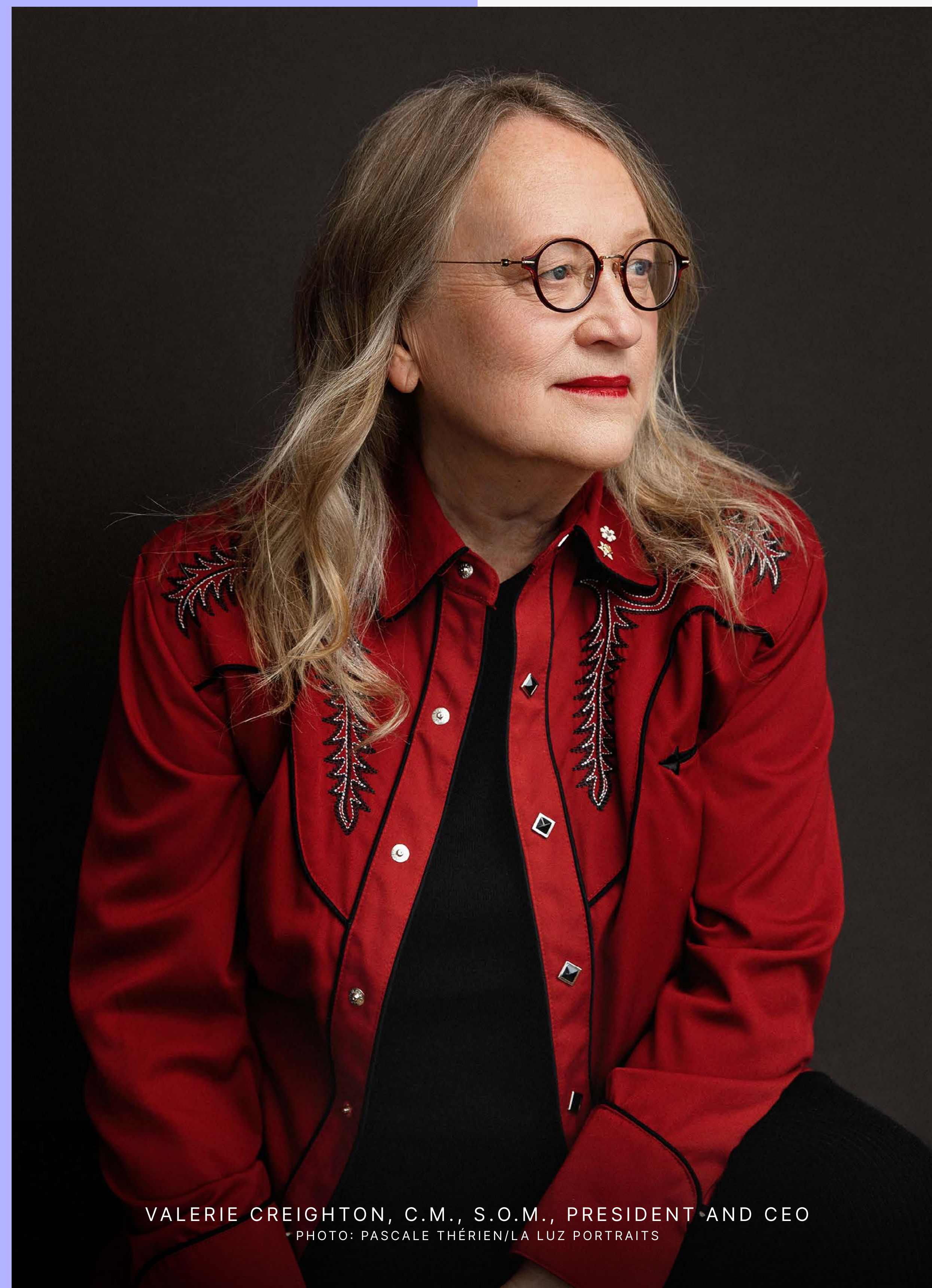
Canada Media Fund president and CEO Valerie Creighton in the organization’s 2025–2026 annual report, Ripple Effect.
Photo credit: Pascale Thérien/La Luz Portraits
The Canada Media Fund says $345.5 million in program funding supported 1,248 audiovisual and interactive digital media projects and 103 industry initiatives in 2025–2026, helping generate $1.93 billion in Canadian production volume.
CMF released the figures Sept. 28 in its 2025–2026 annual report, Ripple Effect. The fund describes the $1.93 billion as a record level of production activity associated with its investments. CMF’s program funding total was $345.5 million: $338.8 million went to content and another $6.7 million was allocated to industry growth. The fund had a program budget of $346.7 million for the year.
The $1.93 billion does not represent money spent by CMF. The annual report gives a funding leverage ratio of 1:5.75, meaning CMF calculates that each dollar it invested elicited $5.75 in public and private financing. Production accounted for 90.9 per cent of program funding, followed by development at 6.3 per cent, industry activity at 1.9 per cent, predevelopment at 0.6 per cent and export at 0.3 per cent. Among content funding, 62.6 per cent went to English-language projects, 33.6 per cent to French-language work, 2.6 per cent to Indigenous-language projects and 1.2 per cent to projects in diverse languages. That language breakdown excludes industry funding.
The report also attributes about 16,900 full-time equivalent jobs to CMF-supported production activity. The figure is an economic-impact estimate rather than a count of individual workers hired directly by the fund. CMF says its estimates were produced with an economic-impact assessment tool developed by Nordicity, using production budgets to calculate direct employment as well as indirect and induced effects elsewhere in the economy.
For direct employment, the model takes the share of production budgets allocated to wages and salaries — typically above 50 per cent, according to CMF — and divides it by an average annual salary of approximately $70,000 in Ontario’s screen-production sector. Non-labour spending is distributed across 32 commodity categories using Statistics Canada Supply and Use Tables, with additional multipliers used to estimate employment and income created in supplier industries and through household spending. The report says the same model estimates the GDP contribution associated with that activity.
CMF breaks those estimates down by region. Quebec accounted for the largest reported share, with an estimated 6,937 FTE jobs and a $768.5-million GDP contribution from CMF-supported activity. British Columbia was estimated at 2,647 FTEs and $296.5 million in GDP, while the Prairies accounted for 1,432 FTEs and $158.1 million. Northern Canada was estimated at 314 FTEs and $35.4 million in GDP contribution.
The annual report also details targeted funding beyond the headline totals. The Indigenous Program, administered by the Indigenous Screen Office, supported 17 production projects with $7.5 million and 22 development and predevelopment projects with $1.1 million. Indigenous Program productions received another $5.8 million through the Broadcaster Envelope Program, English Regional Production Bonus and Northern Incentive, while CMF contributed $250,000 to three projects through an Indigenous Screen Office interactive and immersive partnership.
Regional incentives included $10.8 million for 77 English-language productions outside the main production centres, $2.4 million for 25 French-language Quebec productions outside Montreal and $335,000 for four projects through the Quebec French Regional Development Program. Northern production and development incentives totalled $894,000 across 11 projects.
CMF also reports more than $6 million invested in 103 professional-development, organizational-capacity, market-access, accessibility and research initiatives. Its Accessibility Support Program provided nearly $24,000 to help applicants who identify as Disabled Persons/Persons with Disability(ies) address barriers in the funding application process. The report no longer places Gender Balance and Diverse Community results in its main program-funding summary, directing readers instead to CMF’s demographic dashboard and annual Demographic Report for that data.
The production figures come during a year in which CMF’s own revenue declined. Total revenue fell 12.8 per cent to $349.6 million from $400.9 million the previous year. Federal government contributions declined 8.2 per cent to $198.9 million, while contributions from broadcasting distribution undertakings fell 8.1 per cent to $131.3 million. CMF notes that the previous year also included a one-time $14.3-million compliance adjustment that did not recur in 2025–2026.
The annual report cautions that its statistics reflect CMF’s year-end position and remain subject to change. Some funding agreements that had not yet been signed when the report was published are included in the dataset, and figures throughout the report have been rounded.