Canadian sci-fi Part 1: The 2010s cluster
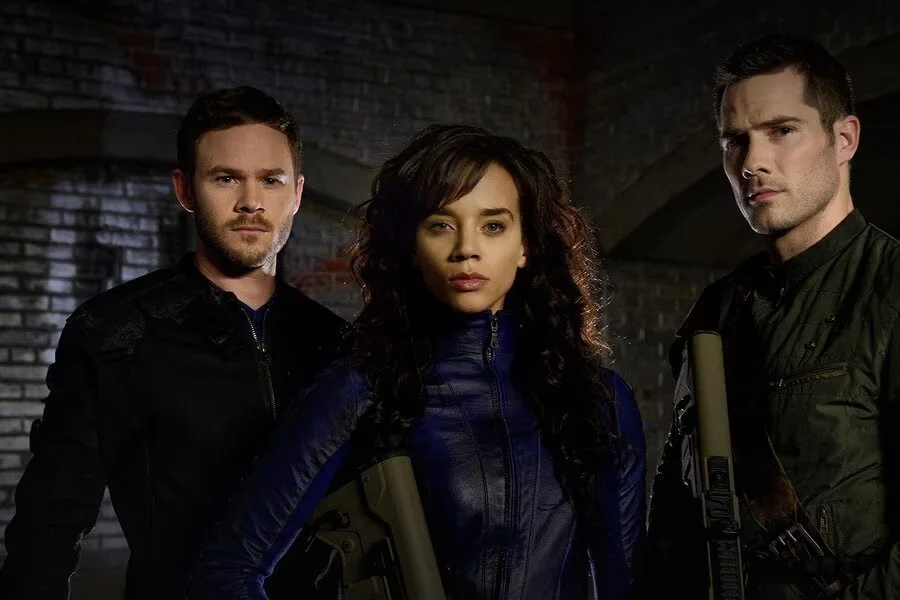
Luke Macfarlane as D’avin Jaqobis, Hannah John-Kamen as Dutch and Aaron Ashmore as John Jaqobis in Killjoys. Bell Media used the same trio in its 2015 publicity for the Space original series.
Photo credit: SYFY publicity
On Friday, June 19, 2015, Space premiered Killjoys at 9 p.m. The second episode of Dark Matter, which had debuted a week earlier, followed at 10. The next night, Orphan Black closed its third season. For that brief stretch in June, three Canadian science-fiction series were airing new episodes on Space at the same time.
Taken alone, that weekend could look like a scheduling coincidence. Put it beside what had already been happening on Canadian television, however, and it becomes a useful marker for a much larger concentration of homegrown speculative series. Earlier that spring, Space had carried the second season of Bitten and the third season of Orphan Black. Showcase was preparing for the fourth and final season of Continuum that fall, while Lost Girl, whose fifth and final season had begun in December 2014, would return with its final eight episodes. CBC’s Being Erica had ended several years earlier, after using time travel as the framework for four seasons of a character drama about a Toronto woman revisiting pivotal decisions in her life.
The shows did not come from a single network, producer or financing structure, and they were not interchangeable versions of one Canadian formula. Some had American broadcast partners. Some travelled widely through international distribution. They ranged from cloning conspiracies and bounty hunters to werewolves, Fae mythology, corporate dystopia and therapeutic time travel. What they shared was more basic and easier to document: over several years, Canadian broadcasters were repeatedly commissioning Canadian-created or Canadian-produced speculative dramas, and Canadian production companies and creative personnel kept returning to the genre.
That distinction matters because Canada has also spent decades serving as a production location for American science-fiction and fantasy. A series does not become Canadian because Toronto, Vancouver or another Canadian city stands in for somewhere else. The group at the centre of this story had substantive Canadian production histories of their own, even when foreign broadcasters and distributors were involved.
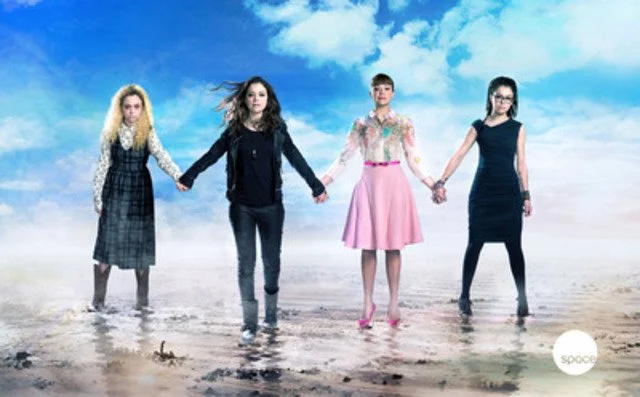
Cutline: Helena, Sarah, Alison and Cosima, all played by Tatiana Maslany, in Canadian artwork for Orphan Black Season 3.
Photo credit: Space / Bell Media
A cluster becomes visible
The chronology stretches back before that 2015 Space weekend. Being Erica debuted on CBC in 2009. Created by Jana Sinyor and produced by Temple Street Productions in association with CBC, it used speculative mechanics without looking much like the space-based science fiction that often defines the genre in popular memory. Erica Strange could return to moments she regretted, revisit the choices she made and discover that altering an event did not necessarily produce the result she expected.
A year later, Showcase premiered Lost Girl. Prodigy Pictures developed the series with Canwest Broadcasting and Showcase, with Michelle Lovretta as its creator. The premise placed Bo, a succubus who had grown up outside the Fae world, inside a supernatural society divided into competing factions. Her refusal to fit neatly into the structures around her became part of the series from the beginning, alongside relationships that crossed the boundaries the Fae world tried to impose.
Continuum followed on Showcase in 2012. Created by Simon Barry and developed and produced by Vancouver’s Reunion Pictures, it opened with Vancouver police officer Kiera Cameron thrown from 2077 into the present alongside members of the group she had been pursuing. Its time-travel mechanism gave the series room to work through competing ideas about corporations, state power, political violence and the future that the present might produce. It also made Vancouver part of the story itself rather than a production location disguised as an American city.
In 2013, Orphan Black arrived on Space. Co-created by Graeme Manson and John Fawcett, produced by Toronto’s Temple Street Productions in association with Space and BBC America, and filmed in Toronto, it began with Sarah Manning encountering a woman who looked exactly like her. The cloning conspiracy widened quickly, but the relationships among Sarah and the other women who shared her DNA became increasingly central. The series developed its own vocabulary around Clone Club while building a family structure that included biological connections, chosen loyalties and people pulled into that network from outside it.
Space added Bitten in 2014. The broadcaster had brought the project into development with No Equal Entertainment and Hoodwink Entertainment in 2011 and ordered it to series the following year; eOne later joined as a production partner. Based on Canadian author Kelley Armstrong’s Women of the Otherworld novels, the series followed Elena Michaels as she tried to maintain a human life in Toronto while remaining connected to the werewolf Pack she had tried to leave behind.
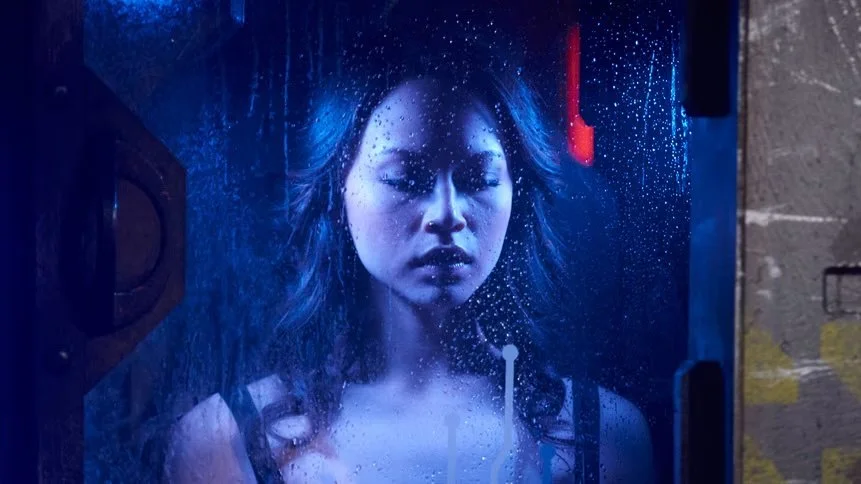
Cutline: Melissa O’Neil as Two, Marc Bendavid as One and Jodelle Ferland as Five in Dark Matter.
Photo credit: SYFY
Then came Dark Matter and Killjoys in 2015, arriving one week apart on Space.
Dark Matter was created by Joseph Mallozzi and Paul Mullie and produced by Prodigy Pictures. Developed in association with Space and filmed in Toronto, it began with six people awakening aboard a spacecraft with no memory of who they were. Learning their names was relatively easy; learning what they had done before losing their memories was more difficult. Much of the series grew from the gap between those histories and the people the crew wanted to become once they were given some distance from them.
Killjoys had already been moving through Bell Media’s development process for several years. Creator Michelle Lovretta’s project entered Bell Media’s Writer Only Drama Development program in 2012, Space ordered it to series in 2013, and Syfy joined the production the following year. Temple Street produced the series in association with Bell Media and Syfy. Its central team — Dutch, Johnny Jaqobis and D’avin Jaqobis — worked as warrant agents in a system that regularly forced professional orders, political conflict and personal allegiance into the same problem.
Seen year by year, the concentration becomes clearer. Canadian television moved from Being Erica in 2009 to Lost Girl in 2010, Continuum in 2012, Orphan Black in 2013, Bitten in 2014, then Dark Matter and Killjoys in 2015. Existing series remained on the air while new ones joined them, which is why the June 2015 schedule is such a useful centre point. It catches several strands of that period at once rather than identifying a single beginning.
Different broadcasters, different routes to the screen
It would be easy to turn that timeline into a cleaner story than the evidence allows. Space and Showcase were both important to the period, but their slates were separate. CBC’s role in Being Erica was different again. International partners mattered to some productions, while individual series drew on different distributors, production funds, tax credits and broadcaster relationships.
Orphan Black and Killjoys, for example, both involved Temple Street and Space, yet their international structures were different. Orphan Black was produced in association with Space and BBC America. Syfy joined Killjoys after Space had already developed and ordered the project. Dark Matter came from Prodigy Pictures and was developed in association with Space. Those distinctions are important because the presence of an American broadcaster or distributor does not erase the Canadian development and production history, but neither does a Canadian broadcaster mean every show was financed or sold in the same way.
Bitten provides one documented example of the funding mixture that could sit behind Canadian genre television. Its production disclosed participation from the Rogers Cable Network Fund, the Cogeco Production Program and the Canadian Film or Video Production Tax Credit. That tells us something about Bitten. It does not establish a financing template that can simply be applied to Continuum, Orphan Black, Dark Matter or the rest.
The same caution applies to audience numbers. Broadcasters issued releases celebrating ratings for individual programs during this period, and several series accumulated substantial audiences and international exposure. Those releases can establish that particular shows performed well under the measures their broadcasters reported. They do not, by themselves, prove that Canadian science-fiction was universally inexpensive, consistently profitable or sustained by one dependable audience equation.
There is still a production network visible across the group. Temple Street’s credits connect Being Erica, Orphan Black and Killjoys. Prodigy Pictures connects Lost Girl and Dark Matter. Lovretta’s work links Lost Girl and Killjoys. Bitten brought in writers who had worked on Orphan Black and Continuum, while Fawcett, one of Orphan Black’s co-creators, was among its first-season directors.
That overlap does not mean Canada had one closed circle making all of its speculative television. It does suggest that genre experience was accumulating within a Canadian production community. Companies returned to science fiction and fantasy, writers and directors moved among series, and broadcasters continued to order work from people who had already demonstrated that they could build this kind of television.
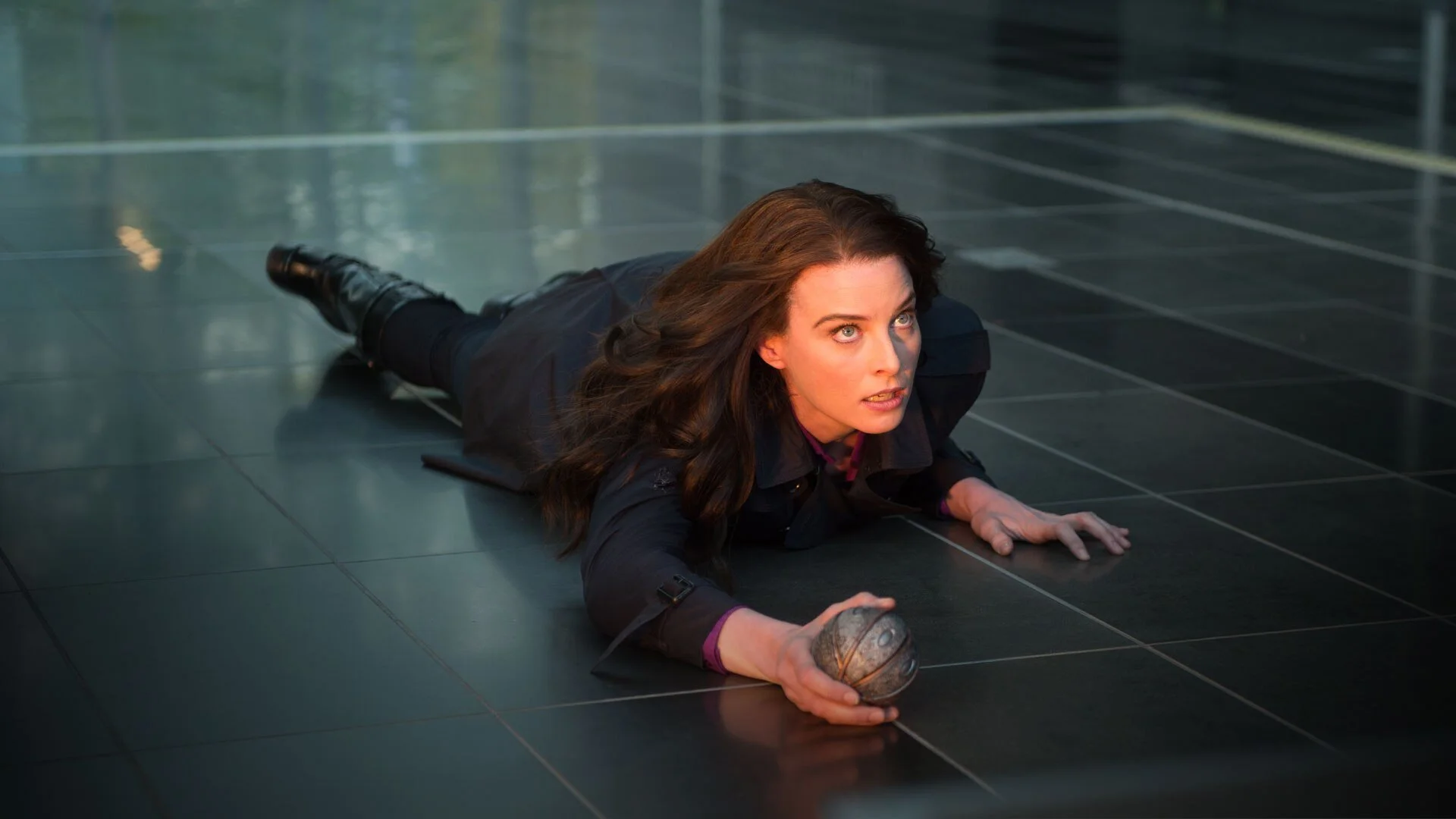
Cutline: Rachel Nichols as Kiera Cameron in Continuum.
Photo credit: Reunion Pictures / SYFY
The shows were different, but some concerns kept returning
The thematic similarities become interesting precisely because the shows are so different on the surface. Being Erica is intimate and contemporary. Continuum is a time-travel police thriller. Orphan Black begins as a conspiracy story. Bitten draws on supernatural romance and werewolf mythology, while Dark Matter and Killjoys move into space. Lost Girl builds its world around the Fae.
Across those forms, identity keeps turning up as an active problem rather than a settled fact. Erica can revisit earlier versions of herself but still has to decide what to do in the present. Kiera’s certainty about the world she comes from is complicated by what she learns in the past. Sarah enters a community of women who share her face without sharing her history. Elena has tried to build a life away from the Pack, but leaving does not erase what connects her to it. The Raza crew discovers criminal identities attached to people they no longer remember being.
That makes autonomy another recurring concern. Bo is introduced to a Fae system that expects her to choose a side. The clones in Orphan Black are repeatedly confronted by institutions that treat their bodies, fertility and identities as things that can be controlled or owned. Dark Matter asks how responsible its characters are for lives they cannot remember and whether a documented past has to dictate their future. Killjoys repeatedly puts its characters inside organizations whose rules and political priorities compete with personal judgment.
Chosen relationships run through several of those stories as well. Clone Club begins with biology but expands beyond it. The Dark Matter crew starts as a group of strangers linked by a ship and a missing past, then has to decide whether the people around them deserve loyalty. In Killjoys, Dutch and Johnny’s partnership gives the show a central male-female relationship that does not need to become romantic to carry emotional weight.
These patterns are strong enough to discuss as textual analysis, although they do not justify a claim that Canadians are inherently more interested in found family or that Canadian broadcasters deliberately commissioned these series because of one national preference. The evidence can support saying that these themes recur. Explaining why they recur requires more than noticing them.
Queer representation is similarly concrete in some of the individual shows. Anna Silk said in a 2010 interview that Bo’s bisexuality in Lost Girl was there from the beginning. In Orphan Black, Cosima’s relationship with Delphine became part of a series that Space itself described in terms of sisterhood and the bonds among its central women. Those examples belong in the record of the period without being stretched into an assertion that every Canadian speculative series shared the same approach to sexuality or representation.
The women at the centre of several of these programs are also difficult to miss. Erica, Bo, Kiera, Sarah and the other Leda clones, Elena and Dutch occupy very different fictional worlds, but Canadian speculative television during this period repeatedly placed women at the centre of genre premises rather than confining them to supporting roles around a male hero. That pattern is visible in the programs themselves and does not require a claim that one broadcaster or policy created it.
There are other similarities worth pursuing later in this series: humour inside otherwise serious genre stories, suspicion of large institutions, characters moving between communities rather than belonging comfortably to one, and relationships that do not always follow the most conventional route. Those observations need creator testimony, scholarship and closer textual work before they become an argument about a distinctive Canadian storytelling culture. Part 1 only needs to establish that there is enough material here to ask the question seriously.
The policy landscape was changing too
While these programs were airing, Canada’s specialty-television system was also changing. In March 2015, the CRTC eliminated genre exclusivity for English- and French-language discretionary services. Under the previous system, some specialty channels had been restricted to particular kinds of programming and received a degree of protection from direct competition while meeting Canadian-content and other programming obligations.
The CRTC argued that removing those restrictions would give services more flexibility and encourage domestic competition. The timing is impossible to ignore when looking at a genre channel such as Space, particularly because the change came just as Orphan Black, Bitten, Dark Matter and Killjoys were making 2015 such a crowded year for original Canadian genre programming.
Timing is not causation, however, and the evidence does not support a simple claim that ending genre protection ended this period of Canadian science-fiction. Other changes were unfolding around the same time, including the restructuring of television packages, shifts in specialty-channel economics, the growth of streaming platforms and changes in international distribution and commissioning. Untangling those factors requires its own reporting.
What the chronology does establish is that the cluster eventually thinned out. Being Erica reached its fourth and final season in 2011. Lost Girl completed its fifth and final season in 2015, while Continuum ended after its fourth. Bitten entered its third and final season in 2016. Orphan Black and Dark Matter finished in 2017, and Killjoys followed in 2019.
By then, the specific collection of programs that had accumulated across CBC, Showcase and Space was gone. That does not mean Canada stopped making speculative television, and it does not establish that the country lost the ability to make it. Later Canadian productions belong in that accounting, as do the changes in where television is commissioned, financed and distributed.
What disappeared was the particular concentration represented by that earlier run: multiple substantively Canadian genre series arriving within a few years of one another, sometimes overlapping on the same channels, with Canadian production companies and creative personnel repeatedly returning to speculative television.
The June 2015 Space schedule captures that concentration in miniature. Killjoys could premiere on Friday night, a new Dark Matter could follow it, and Orphan Black could close its season the next evening. Around them sat Bitten, Continuum, Lost Girl and the recent memory of Being Erica, each with its own history and its own route to the screen.
The larger questions come after establishing that record. Why did Canada have enough commissioning space for this cluster to develop? How much did specialty-channel regulation contribute? How did international partners and financing structures make the productions possible? Why do found family, autonomy, unconventional relationships and suspicion of institutions recur so often across very different series, and how much of that pattern survives closer scrutiny?
Before any of those questions can be answered, the period itself has to be visible. For much of the 2010s, Canadian science-fiction television was not represented by one isolated success. There was a group of series, a set of recurring companies and creators, several broadcasters willing to commission genre drama, and a stretch of time when Canadian speculative television kept turning up on the schedule.