Eight recipients receive 2026 Governor General’s Visual and Media Arts Awards
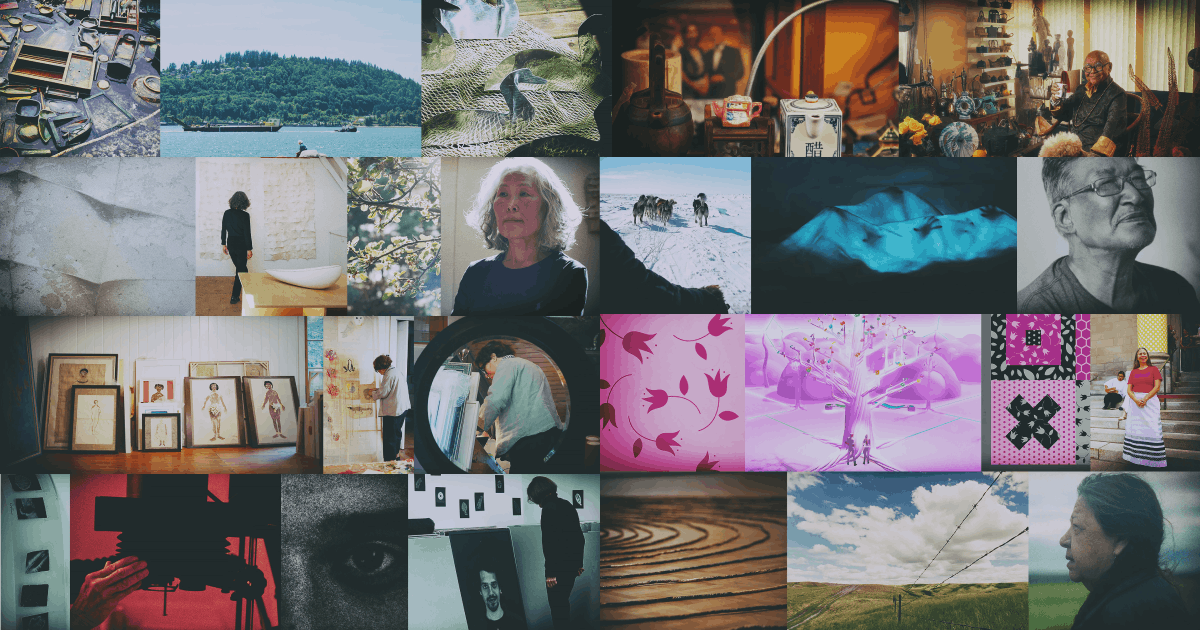
The Canada Council for the Arts’ official 2026 GGArts collage features this year’s recipients alongside examples of their work. Canada Council for the Arts
Photo credit: Canada Council for the Arts
Eight artists and arts contributors from across Canada have received the 2026 Governor General’s Awards in Visual and Media Arts, with this year’s recipients working across textiles, film, installation, photography, digital media and art history.
The Canada Council for the Arts announced the winners Sept. 16. Six received Artistic Achievement Awards, while textile artist Chung-Im Kim received the Saidye Bronfman Award and art historian Roger Lee received the Outstanding Contribution Award. Each recipient receives $25,000 and a bronze medallion produced by the Royal Canadian Mint.
A selection of work by the eight recipients will be shown at the Beaverbrook Art Gallery in Fredericton beginning Nov. 7. The exhibition is presented and supported by the Canada Council in collaboration with the National Gallery of Canada and the Beaverbrook Art Gallery.
Kim, who lives in Cookstown, Ont., has built a textile practice that brings together industrial materials, handwork and the Korean Bojagi tradition. She began her career in textile and surface design in Seoul before moving to Canada in 1990. Her recognition through the Saidye Bronfman Award also carries a permanent-collection connection: each year, the Canadian Museum of History acquires a work or series of works by the award recipient.
Lee’s Outstanding Contribution Award recognizes work outside the category of an individual artistic practice. Born in Vancouver and connected to a Chinese Canadian family with roots in Victoria, Lee taught art history at the University of Regina for more than three decades. His GGArts nomination statement also points to his work as an educator, collector, mentor and advocate and to his efforts to expand attention to Asian Canadian and diasporic art histories within Canadian arts institutions.
Among the six Artistic Achievement recipients is Kainai artist Faye HeavyShield, whose work gives the 2026 awards a substantial Alberta connection. HeavyShield lives on the Blood Reserve in southern Alberta and works across sculpture and installation, drawing on land, family history and Blackfoot language. Her body of work includes Venus as Torpedo, which was re-staged at the Art Gallery of Ontario in 2025.
Vancouver artist Carole Itter has worked across installation, performance and film, with ecological and feminist concerns recurring through her practice. Her history in the city includes a long association with artist Al Neil and the Blue Cabin at Dollarton, where Itter returned for a residency in 2025.
Filmmaker Zacharias Kunuk, from Igloolik, Nunavut, has spent decades telling Inuit stories through film from his home community. A co-founder of Isuma, he is best known internationally for Atanarjuat: The Fast Runner, the 2001 Inuktitut-language feature that brought Inuit filmmaking to audiences well beyond the North. His Governor General’s Award recognizes a career that has continued to centre Inuit voices, language and knowledge in screen work.
Quebec artist Lyne Lapointe, who lives and works in Mansonville, first became widely known through site-specific projects made with Martha Fleming in abandoned buildings during the 1980s and early 1990s. Her later work has moved through painting, installation and mixed media, with the body, gender and social structures recurring across the practice.
Marie-Jeanne Musiol, based in Gatineau, has developed an experimental photography practice around plant life and electromagnetic fields. Her images record light traces produced by plants, building what arts organization DAÏMÔN has described as an “energy herbarium” that sits between botanical observation and electrophotography.
Montreal-based Skawennati, a Kanien’kehá artist from Kahnawà Mohawk Territory, works in machinima, digital environments, sculpture, fashion and performance. Her projects have placed Indigenous people within technological and speculative futures, including the long-running TimeTraveller™ project. She also co-founded Aboriginal Territories in Cyberspace and daphne, an Indigenous artist-run centre in Montreal.
The awards themselves date to 1999, although the Saidye Bronfman Award was established earlier, in 1977, and later joined the Governor General’s Visual and Media Arts program. The six Artistic Achievement Awards recognize bodies of work in contemporary visual and media arts, while the Outstanding Contribution Award can recognize professional or volunteer contributions to the field.
Each of the 2026 recipients has also been paired with Canadian filmmakers for an official video portrait. Alberta filmmakers are involved in two of this year’s commissions: Edmonton filmmaker Christopher White created the portrait of HeavyShield, while Conor McNally of Edmonton-based Illiop Productions created Kunuk’s. The films are available through the Governor General’s Awards website and Canada Council channels.
The bronze medallions presented to the recipients measure 75 millimetres across and carry a maple tree between two crowned lion heads, along with the Latin motto Excellentiae in artibus causa. The recipient’s name, award and year are engraved on the reverse.
The Beaverbrook exhibition opens Nov. 7 in Fredericton. As of Oct. 1, Beaverbrook’s current events page does not list public programming specifically tied to the exhibition.