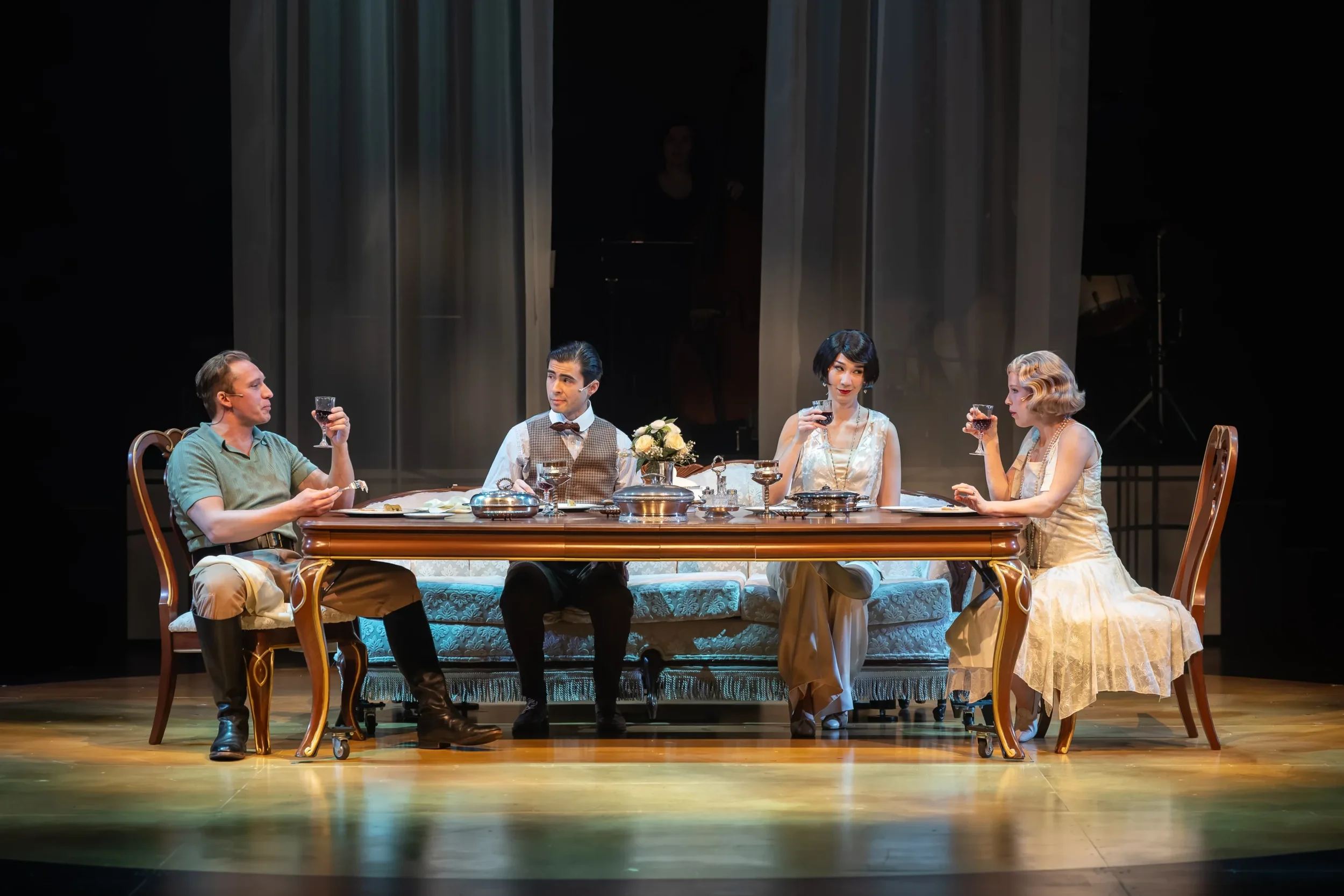
Timothy Dowler-Coltman, Richard Lee Hsi, Bailey Chin and Tess Benger in the Citadel Theatre's 2026 production of The Great Gatsby. Costume design by Deanna Finnman.
Photo credit: Nanc Price / Citadel Theatre
In the Citadel Theatre’s 2026 staging of The Great Gatsby, costume designer Deanna Finnman had to plan for what happened when an actor left the stage as carefully as for what the audience saw. A cast of 12 played numerous characters in Erin Shields’ adaptation of F. Scott Fitzgerald’s novel, requiring costumes built for rapid changes between roles. “Some of the costume changes are under one minute and include footwear and a wig change so it's very quick,” Finnman said in an email interview. That speed determined where fastenings went and how backstage dressers coordinated the change.
The production, directed by Daryl Cloran, had its world premiere at the Citadel in Edmonton, where it ran from October 31 to November 22, 2026. It is being produced with the Grand Theatre in London, Ontario, and the Royal Manitoba Theatre Centre in Winnipeg, where the adaptation is scheduled to appear next season. For Finnman, the process began in early spring with Cloran and with the script itself, which was still changing while the costumes took form.
“Research for me always begins with a deep dive into the script,” she said. Finnman also returned to Fitzgerald’s novel and investigated people she believed had inspired some of its characters. She then turned to books and period photographs, paying particular attention to New York fashions. In her account, the city’s “sleek and modern feel” provided a different point of reference from 1920s clothing in England or elsewhere in Europe. She praised Shields’ adaptation for staying true to Fitzgerald’s story while updating it for a modern audience.
Once she had a sense of the setting, Finnman built each character’s wardrobe around personality and the particular actor playing the part. She describes the process as “creating sort of a closet of what they would wear and then picking the designs out of that.” The production’s Daisy Buchanan, played by Tess Benger, and Jordan Baker, played by Bailey Chin, called for very different approaches.
“Daisy has this really soft, floral, ultra feminine kind of look that's sort of echoed in all of her costumes and speaks to the character's vulnerability,” Finnman said. For Jordan, she chose a sleeker look: “Jordan's costumes are super sleek and boldly fashion forward of the art deco world and Jordan's strong assertive personality.” Finnman said both looks are true to the period, although they are executed differently.
Those distinctions were refined over months. Finnman consulted set designer Lorenzo Savoini about the colour palette while the script continued to develop, then passed completed costume plans through the budgeting process led by head of wardrobe Patsy Thomas. Sourcing included a fabric-shopping trip to Montreal and Toronto. She recalls construction beginning in early September, with fittings and alterations continuing as the performers arrived for rehearsals about a month before opening. Changes remained possible right up to opening night.
Finnman estimates that at least a dozen people worked on the costumes at the Citadel under Thomas, with another four or five people creating specialized pieces remotely. The work included cutting and sewing, hatmaking, dyeing and shoe painting. Two hair and wig specialists developed period hairstyles, including wet sets and bobs. She resisted singling out any one colleague, describing the costumes as the work of many specialized artisans.
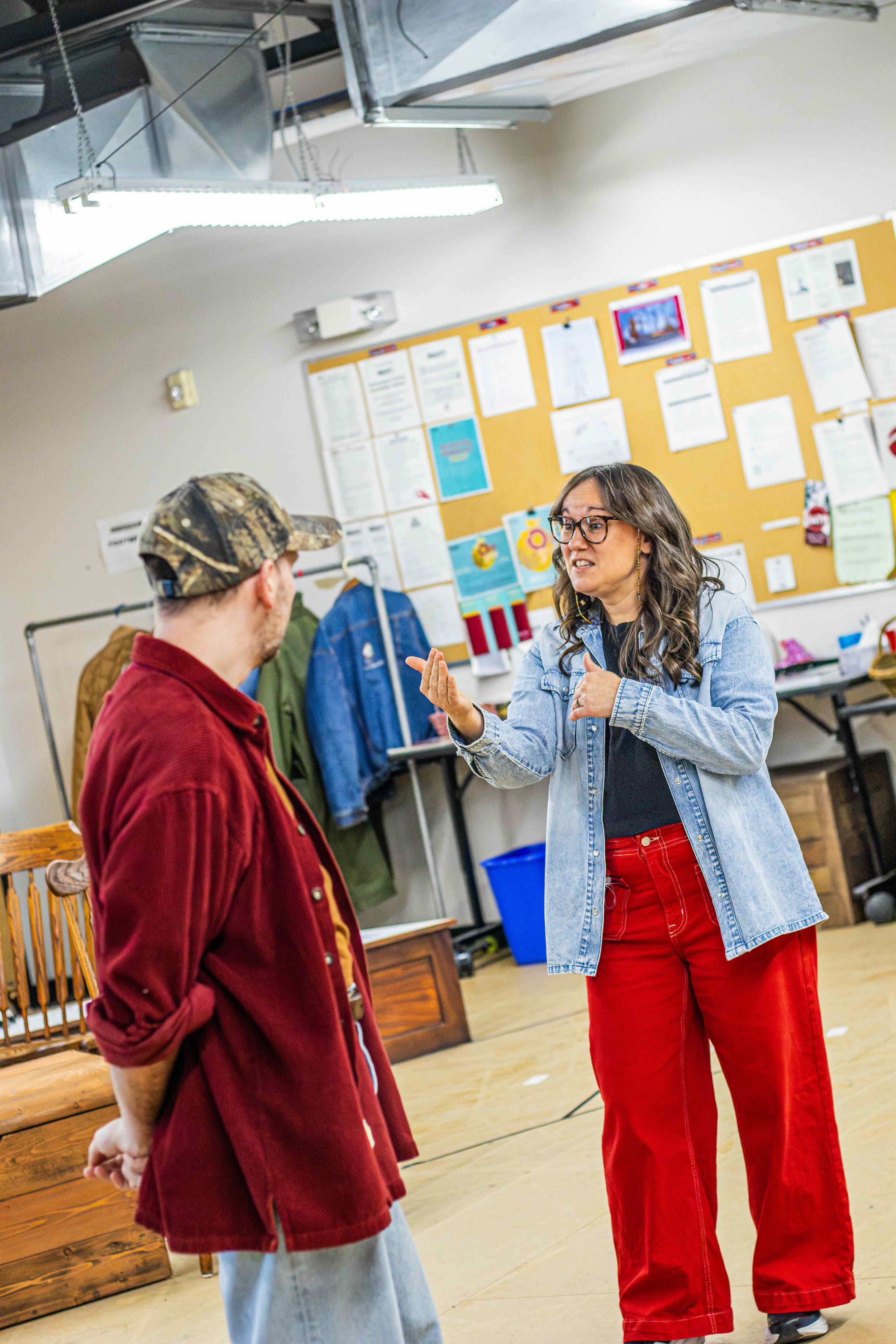
The backstage crew has its own design problem to solve. A quick change requires a sequence that dressers can carry out reliably, often while handling garments intended to look complicated from the auditorium. “That means really thinking through where the closures are, and how the dressers can choreograph those changes successfully,” Finnman said.
Gatsby, played by Duncan Cox, wears a robe in his last scene with a small insignia on it. “It is actually an embroidered Jay Gatsby monogram stylized to match the one featured on the set,” Finnman said. She believes the detail belongs in the character’s wardrobe even though the audience is unlikely to notice it: Gatsby, in her reading, would pay that much attention to his clothing.
When the show continues at its partner theatres, Finnman expects the same costumes to go with the same actors. “All of the performers are contracted to continue the show at all three venues,” she said. That means the garments have been built for specific performers, and she does not anticipate having to refit them for a new company. The delicate pieces will require attention, however, and she says wardrobe staff at Royal Manitoba Theatre Centre and the Grand Theatre will take responsibility for repairs and maintenance.