
Fonda warns the town to stay away from the water, Wade finds an unlikely opportunity aboard a research vessel, and Calvin's determination to confront the creature puts him at odds with his family.

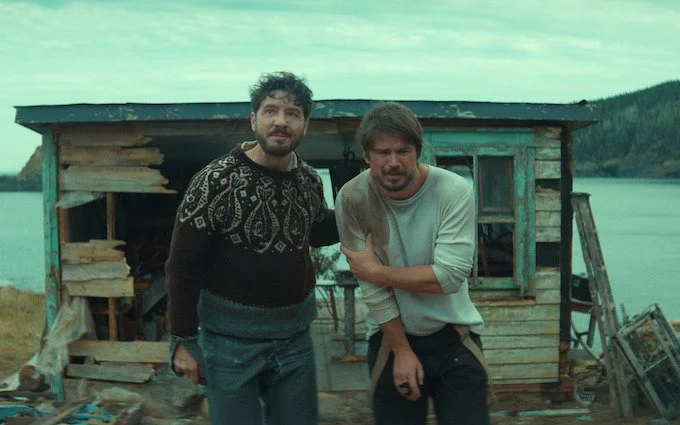
Cutline: Charlie Heaton as Wade Penney and David Wenham as Steve Bruner in Episode 3 of Netflix's Below, “Sir John Franklin.”
Photo credit: Netflix
Spoiler warning: This recap contains spoilers for Episode 3 of Below, “Sir John Franklin.”
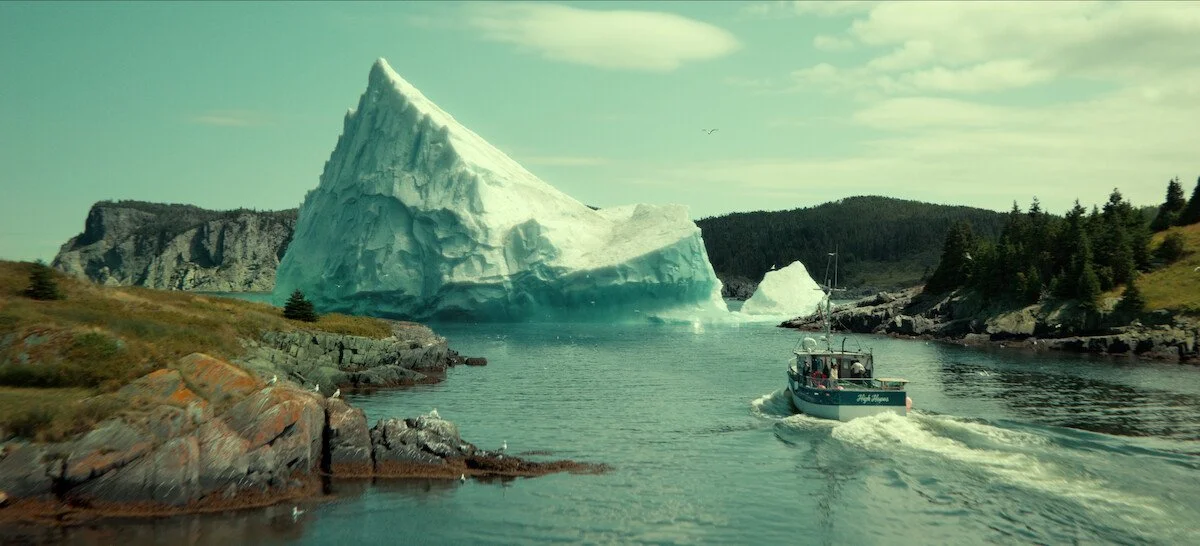
Episode 3 of Below opens with Wade back out near the iceberg, despite everything that happened to Jerry Biles. A large research vessel approaches, and Wade soon meets its crew. His extraordinary thirst, nightmares and missing memories from the accident remain unexplained.
Back in Snooks Arm, Fonda Howander addresses a community meeting. She believes the sinking of the Portuguese fishing vessel, Jerry's death and the disappearance of the two tourists may be connected to an unusually aggressive cephalopod. Until the authorities know more, she recommends staying at least 50 feet from shore.
The warning is not particularly welcome. One resident recalls the scientists involved in the 1992 cod moratorium and the lasting consequences for Newfoundland fishing communities. Calvin supports Fonda, telling the room he has seen the creature and believes it killed Jerry. Ruth assures everyone that the Coast Guard and fisheries officials are involved, but Calvin is already determined to take matters into his own hands. Ruth, still trying to salvage Come Home Year, reminds people that Linda's bar has happy hour.
Wade finds people who listen
The newcomer is the RSV Sir John Franklin, commanded by Steve Bruner. Its sonar equipment and other technology impress Wade, who is accustomed to much smaller boats. Bruner describes the expedition as conservation work, with an interest in climate change, but the crew seems especially interested in Wade.
There is real history behind the ship's name. In 1845, Sir John Franklin led an expedition in search of the Northwest Passage aboard HMS Erebus and HMS Terror. Both vessels were lost in the Canadian Arctic. Inuit accounts helped establish what happened to the expedition, and Inuit knowledge was essential to locating the wrecks of Erebus in 2014 and Terror in 2016. The fictional research vessel isn't part of that history, but its name carries an ominous association.
He tells them about the iceberg accident and shows them the circular marks across his back. When they ask whether he has experienced headaches, insomnia, excessive thirst or hallucinations, he admits to all of them. Wade even describes the Old Hag, the woman who has been appearing in his room. That name is part of real Newfoundland folklore: the Dictionary of Newfoundland English records the Old Hag as a nightmare in which a sleeper may feel pinned to the bed. One researcher suggests he may have been exposed to a substance secreted by an unknown cephalopod, possibly one capable of changing an animal's behaviour. It's a theory, although the crew seems to know an unusual amount about his symptoms.
When Bruner mentions needing someone familiar with the local coves, Wade volunteers. He's thrilled to be offered a place aboard the vessel. After struggling to prove himself to Calvin, Wade is finally being treated as someone whose knowledge of these waters is useful. The crew has also shown an unusual interest in his symptoms.
Mary and Noah, meanwhile, are arguing about going home. Noah is on the phone with Air Canada, trying to arrange a way back, while Mary wants him to spend time with her family. He also mentions a missing diamond ring that belonged to his grandmother. I wondered in Episode 2 whether the thing he was searching for in his bag might be an engagement ring, and that possibility hasn't gone away.
Calvin and the family
Calvin intends to take his boat out to find the creature. Mary points out that Jerry's larger vessel was destroyed and begs him to stay home long enough to be a father and get to know Noah. He won't listen. Then Ruth removes the engine coil from his boat, bringing his expedition to an abrupt halt.
The siblings fight about more than his recklessness. Calvin believes the animal offshore is the same thing responsible for their father Leo's death when the family home sank decades earlier. Ruth fears losing him too. She tells him Phonse and Noelle intend to vote for resettlement, and Calvin challenges her about whether she plans to leave as well. He sees the possibility as a betrayal, although Ruth has spent years looking after him.
He eventually encounters Wade with Bruner's crew and spots equipment that looks suspiciously like a harpoon system. Bruner insists the expedition is about conservation, but Calvin isn't persuaded. He offers to guide the crew himself if they'll leave Wade behind. Wade is furious: once again, his father has stepped in to take over something he wanted to do. Calvin says the men cannot be trusted and points out how unwell Wade looks.
Wade is increasingly agitated, and I couldn't tell how much of his anger came from his understandable frustration with Calvin and how much might be connected to the iceberg. His behaviour is becoming more erratic, but his father isn't especially good at recognizing when his own actions make matters worse.
Jay has his own reason to want the resettlement vote to pass. He approaches Jan Hickey, the local liaison officer, about the proposed $60,000 per-resident payment. He doesn't have straightforward proof of residency in the cove, but Jan suggests that mail addressed to him there might help. Their conversation makes it clear that the relationship between them has become personal, and Jay is hoping that gives him an advantage.
Dr. Sayed's extraordinary theory
Fonda meets marine zoologist Dr. Hugo Sayed near the iceberg. She knows his research and awkwardly introduces herself before explaining her theory about an aggressive cephalopod and a contaminant in the ice. He admits it sounds crazy but invites her to examine his work. His equipment is substantial, and he says much of his research funding now comes from private sources.
Sayed doesn't think the animal is an ordinary giant squid. He believes it belongs to a much older, more dangerous species, which he calls Species A. According to him, changes in the Arctic environment have driven it from its deep, cold habitat, and it periodically follows the Labrador Current south. He suspects the creature marks icebergs with secretions to establish its territory.
Those secretions may be dangerous when absorbed or ingested, depending on the amount. That's an alarming possibility in a town where people have been harvesting iceberg ice, and it could explain some of Wade's symptoms. But this is still Sayed's interpretation, not a complete explanation of what we've seen.
He shows Fonda a drawing supposedly made by a survivor of an Arctic expedition in 1742. In Sayed's account, stranded sailors took shelter inside the carcass of a creature they called a kraken. By the time help arrived, most were dead. The survivor described men fighting over tools and trying desperately to dig through the ice so they could drown themselves in the water below.
The sailors' desperate attempts to reach seawater recall Wade's intense thirst, giving Sayed's story an immediate connection to what's happening in Snooks Arm. The alleged 1742 incident is presented as part of Sayed's account within Below, rather than established historical fact.
There is also genuine Newfoundland history behind the idea of a monstrous squid. In 1873, fishermen at Portugal Cove in Conception Bay reported an encounter with a giant squid and recovered part of a tentacle, which reached naturalist Moses Harvey. He later obtained a complete specimen, helping scientists document an animal that had often been dismissed as a sea monster or “devilfish.” The details of the fishermen's encounter have changed in the retelling, but the specimens, and Newfoundland's contribution to early giant-squid research, are well documented.
Trouble at Linda's bar
That evening, Linda's bar is busy. Wade is enjoying the company of the Sir John Franklin crew, while Calvin and Ruth manage a tentative reconciliation over drinks. Their fight hasn't been resolved, but Calvin seems to understand that Ruth is exhausted from looking after everyone.
Jay approaches Connor and his associate with what he considers good news: he has gathered documents to support his residency claim and believes he can collect $60,000 in six to eight weeks. The men aren't willing to wait. Calvin intervenes when the confrontation turns ugly and discovers that Jay owes them $80,000. It's an astonishing debt for someone who has been boasting about how well he's doing out west, and even the payment he's counting on wouldn't cover it.
There are smaller details that make the evening feel particularly uneasy. Linda finds it strange that the visiting sailors came ashore but left without having a drink. I also wondered whether one of the songs was a version of “Wellerman,” although I wouldn't identify it without checking the music.
Wade's encounters with the woman from the water are becoming more disturbing and intimate. Some of the filming reminded me of Stranger Things, especially the way an ordinary town becomes threatening after dark. And the final frantic scenes involving Barry, Fonda's laboratory colleague, bring us back to Sayed's account of sailors trying to reach the water. Whatever is affecting people, the danger appears to extend well beyond the creature's direct attacks.
By the end, I was particularly worried about Wade. He's found people who seem willing to give him responsibility, but they may have reasons of their own for wanting him aboard. And whatever followed him home from the iceberg shows no sign of leaving.




Ontario alternative pop-rock duo Little White Lies released “String Me Along” on October 2, a song that Katie Rose Campbell says grew out of a difficult U.S. tour and a change in how the band approaches its career