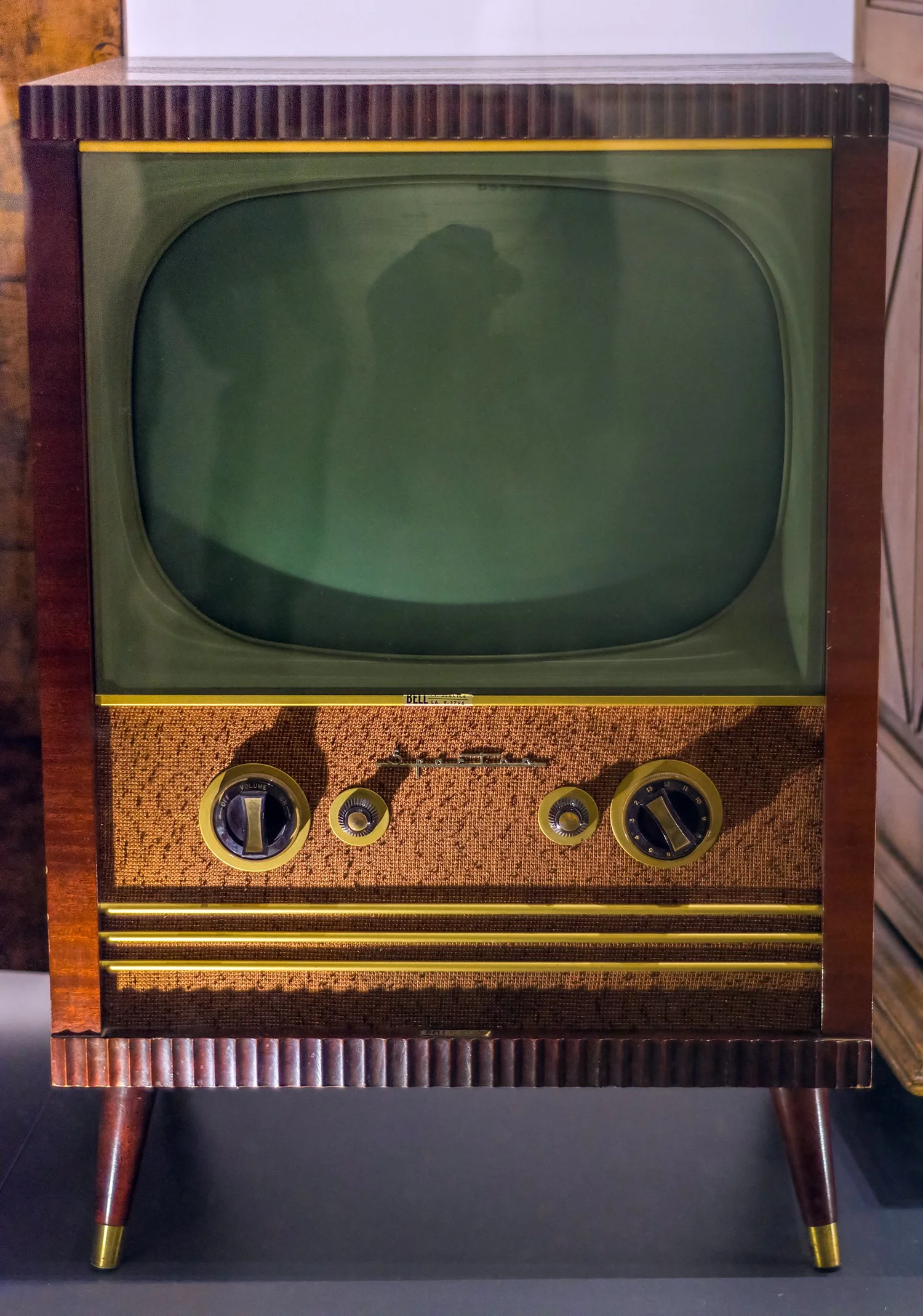
A Sparton of Canada television set from 1947, part of the Musée de la civilisation's collection in Québec City. Canadian television service began regular broadcasts in Montréal and Toronto in September 1952.
Photo credit: Wilfredor
Canada's first regularly operating television station, CBFT in Montréal, officially began service on September 6, 1952. Statistics Canada identifies Club d'un soir as the first show broadcast on the station's inaugural evening. CBC's English-language station CBLT in Toronto followed two days later, on September 8.
The official opening dates tell only part of the story. Radio-Canada's children's puppet series had already appeared during August 1952 test broadcasts, and television experiments in Montréal began much earlier, in 1931. The answer changes depending on whether the question refers to experimental transmissions, test programming or the beginning of regular service.
Canada was experimenting with television before 1952
In 1931, a station using the call sign VE9EC conducted an in-house experimental television transmission in Montréal, using facilities associated with La Presse and radio station CKAC. The Canadian Communications Foundation records the experiment in its history of broadcasting regulation. These early transmissions were part of the development of television technology, years before Canadian audiences could tune in to a regular domestic service.
CBC/Radio-Canada was preparing its own service well before the September 1952 openings. Research published by the Association québécoise des marionnettistes describes a closed-circuit television demonstration involving puppeteers Louise and Charles Daudelin in November 1951. In Montréal, CBFT transmitted a test pattern on June 2, 1952, and televised baseball from De Lorimier Stadium on July 18, according to the Canadian Communications Foundation. The station's official opening was still weeks away.
Pépinot et Capucine was on television before the official launch
One of the earliest Canadian-made programs was Pépinot et Capucine, a French-language children's series featuring puppets. Historian Francis Ducharme, writing for the Association québécoise des marionnettistes, reports that trial broadcasts and previews were shown during August 1952 on television sets displayed in shop windows. His research cites contemporary schedules in La Patrie and La semaine à Radio-Canada. The Université de Sherbrooke also places the beginning of the program's broadcasts in August, recording August 10 as a milestone in early French-language children's television.
The records disagree about the formal premiere. Ducharme identifies September 7, 1952, while puppeteer and historian Johanne Rodrigue describes a Pépinot et Capucine broadcast at 4 p.m. on September 6. Both accounts sit alongside evidence of August trial transmissions, before CBFT's official opening.
The program grew out of characters created by Jean-Paul Ladouceur, who directed the early children's broadcasts. Edmondo Chiodini made early puppets, and writer Réginald Boisvert developed the characters and stories. Ducharme's research describes rehearsals and preparations while the station was still operating on a trial basis. By September, the team had already developed material specifically for television.
CBFT's official opening in Montréal
On September 6, 1952, CBFT Montréal formally inaugurated CBC/Radio-Canada television service. It was initially bilingual, carrying French- and English-language programming on one channel. The Canadian Communications Foundation records an opening schedule of roughly 23 hours a week, with more programming in French than English.
Historical accounts identify Club d'un soir as the first program of CBFT's official inaugural evening. Statistics Canada and the Canadian Communications Foundation use that framing. The opening-night designation is accurate when kept separate from the test transmissions and puppet programming shown in Montréal earlier that summer.
The first English CBC programs: Let's See and Sunshine Sketches
Toronto's CBLT began official service on September 8, 1952. Its opening programming included Let's See, a 15-minute guide to the evening's television lineup that also carried a weather forecast. Meteorologist Percy Saltzman appeared alongside Uncle Chichimus and Hollyhock, puppets created and performed by John Conway. The Canadian Museum of History documents Conway's puppets in CBLT's inaugural English-language broadcast. With weather, schedule information and puppetry in the same program, Let's See served a general audience.
The next evening, September 9, brought Sunshine Sketches, which Queen's University's directory of CBC television programs identifies as the first dramatic production on English CBC television. The half-hour series adapted Stephen Leacock's Sunshine Sketches of a Little Town for the screen, with episodes written by Henry Kaplan and Don Harron and produced by Robert Allen. It continued through the inaugural television season and was also known as Addison Spotlight Theatre. Its distinction belongs specifically to English-language dramatic television; the French-language puppet productions were already under way.
La famille Plouffe and the early Canadian soap opera
CBC/Radio-Canada identifies La famille Plouffe as Canada's first television soap opera. Adapted from Roger Lemelin's novel Les Plouffe, it premiered on Radio-Canada on November 4, 1953, following an earlier radio version. The continuing drama followed a working-class family in Québec City's Lower Town. Radio-Canada broadcast it through 1957, and the story also reached English-language CBC audiences in an English version beginning in 1954.
The series followed members of the Plouffe family from episode to episode, adapting a narrative that had already moved from novel to radio. Its continuing storyline was a different television format from the short dramatic adaptations and children's puppet adventures that CBC audiences had seen in 1952.
Hockey, new stations and the spread of television
Sports broadcasts also became part of Canadian television almost immediately. Statistics Canada dates the first televised hockey game in Canada to October 11, 1952, when René Lecavalier called the Montreal Canadiens against the Detroit Red Wings in French. Its record places the first English-language televised hockey game on November 1, with Foster Hewitt calling Toronto against Boston. Hockey Night in Canada had existed on radio before television, so its long broadcast history cannot be used to identify Canada's first original television show.
Regular Canadian television began in Montréal and Toronto, while viewers in parts of the country had already been receiving American signals across the border. The Canadian Communications Foundation reports that about 75,000 Canadian homes were watching U.S. stations by 1951. Imported American entertainment also became part of Canadian television schedules, alongside locally made news, sports and original programming. The launch of Canadian stations and the arrival of Canadian-made programs were related developments with different timelines.
The Canadian system expanded quickly during 1953. CBC television opened in Ottawa; CKSO-TV in Sudbury became the first privately owned Canadian television station that October; CFPL-TV followed in London, Ontario, in November; and CBC's CBUT opened in Vancouver on December 16. By 1955, CBC/Radio-Canada says its television services reached 66 per cent of Canada's population. Viewers outside those service areas would have to wait longer for local access.
For the official opening of CBC television in Montréal, Club d'un soir is the documented first program of the inaugural evening. The summer screenings of Pépinot et Capucine are why an account of Canada's first television show cannot start and end there.