Free to apply, thousands to exhibit: the economics of Artist Project 2027
Applications to Toronto’s independent-artist fair are free for 2027, while a standard booth starts at $3,250 before tax and several other costs remain with the artist.
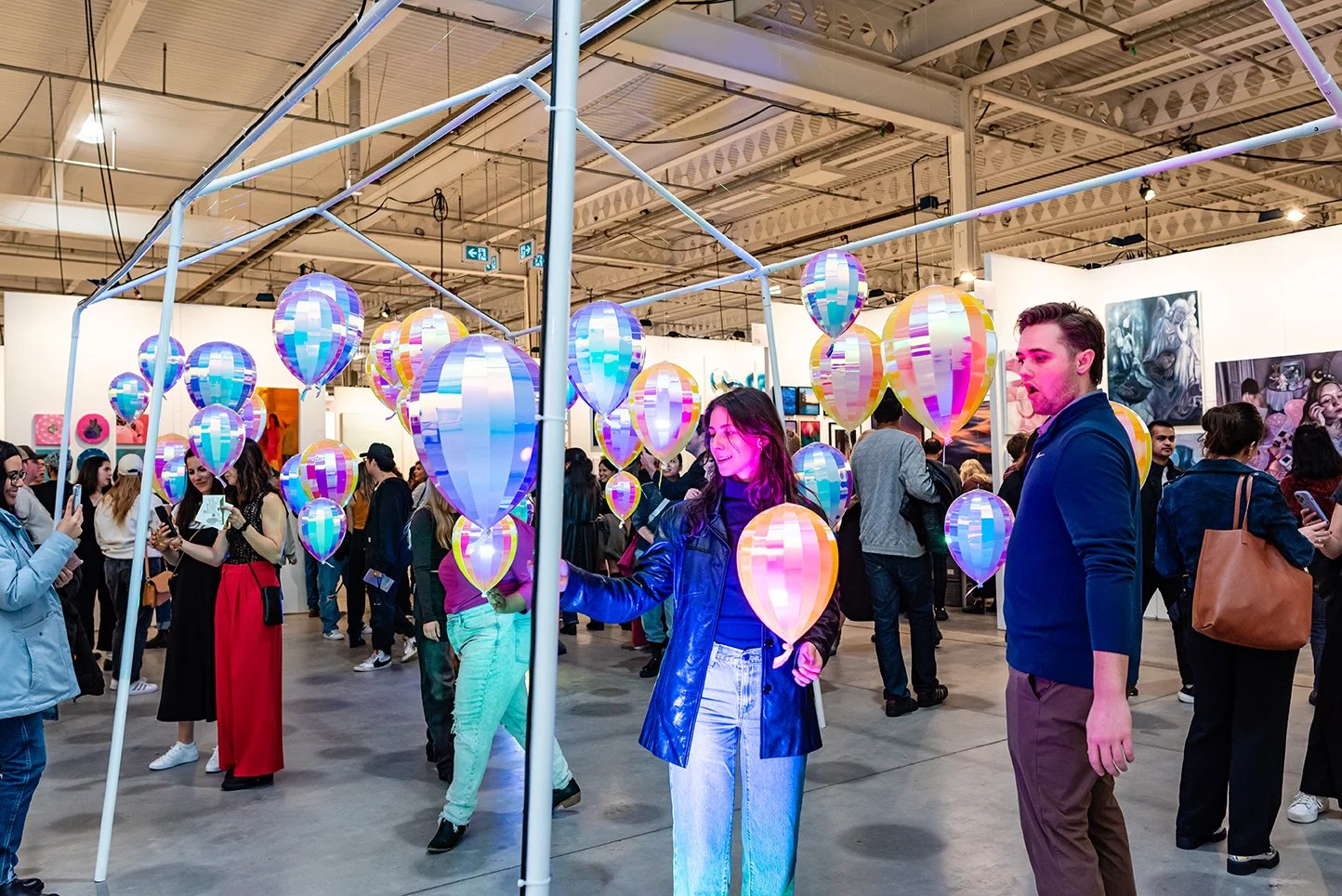
Visitors browse Artist Project in Toronto. Applications for the May 13–16, 2027 fair are free, while standard Main-section booth fees start at $3,250 before HST.
Photo credit: Artist Project
An independent artist accepted into Toronto’s Artist Project next spring can take the smallest available booth for $3,250 before HST. A 10-by-20-foot space costs $8,000, and adding a corner raises the price by another $600 or $1,000 depending on booth depth.
Before any artwork is sold, the exhibitor may also need insurance, storage, tools and other expenses that Artist Project specifically excludes from its booth prices. Artists travelling to Toronto may face additional costs for transportation, accommodation or shipping their work.
For the May 13–16, 2027 edition, however, applying to the jury is free.
Artist Project opened applications Sept. 10 and says there will be “zero application fees” for 2027, with applications due Oct. 31. Its current public material does not state what applicants paid in 2026 or explain why applications are free this year.
For artists selected for the Main section, the larger financial commitment comes after acceptance.
The lowest Main-section rate is $3,250 for a five-by-10-foot booth. Five-by-15 costs $4,500 and five-by-20 costs $5,600. Deeper booths range from $4,200 for 10-by-10 feet to $8,000 for 10-by-20. With Ontario’s 13 per cent HST, the smallest booth reaches $3,672.50 and the largest $9,040 before additional expenses. A corner on the largest booth would bring the booth invoice to $10,170 including HST.
Those prices include 11-foot gallery-style walls, artist signage and lighting, along with complimentary and discounted tickets, an online artist profile, a show-guide listing and exhibition and marketing support. Artist Project says insurance, storage, tools and other associated costs remain outside the booth fee.
Artist Project says the fair attracts more than 18,000 attendees and markets directly to collectors, curators and other art-world professionals. It takes no sales commission.
The structure gives artists a route into a major commercial art event without applying through a gallery. Art Toronto, by comparison, says it does not accept independent artists and directs individual artists looking for exhibition opportunities to Artist Project.
Artist Project’s published prices have increased since at least 2024, although the packages are not directly comparable. Its 2024 rate sheet listed a five-by-10-foot base booth at $2,640 and a 10-by-20 at $6,650 before HST. Lighting, insurance, Wi-Fi, parking and other costs were separate that year, while the 2027 booth package includes lighting.
For a smaller group of emerging artists, Artist Project removes the exhibition-space charge altogether.
Its juried Untapped Emerging Artists Competition is open to first-time Artist Project exhibitors who are students, new graduates or self-taught artists. Selected artists receive free exhibition space consisting of 20 linear feet of 11-foot wall within the shared Untapped area, along with lighting, tickets, an online profile and show-guide listing.
Twenty artists participated in Untapped in 2026. Artist Project has opened the program again for 2027, although its current application material does not state how many artists will be selected.
The 2026 People’s Choice award went to Emerald Repard-Denniston and included automatic acceptance into the following Artist Project fair and $1,000 toward booth fees. Against the current 2027 rates, $1,000 would cover less than one-third of the cheapest Main-section booth before tax.
Ottawa-based photographic artist Yu-Sheng Chiu entered Artist Project through Untapped in 2026. Writing afterward about her photographic project Ghost of Her Sorrow, Chiu described conversations with visitors and the feedback she received while showing alongside other emerging artists. Her account does not disclose sales or other financial results from the fair.
Artist Project also awards free exhibition space to installation artists. Its current 2026 installations page names 16 artists, with Briony represented by two works. Artist Project says it provides free space to installation artists each year, but a 2027 installation call, eligibility requirements and the number of available places are not currently published on its application page.
For artists paying for Main-section space, the return can include exposure and professional connections that are harder to put on a balance sheet.
Toronto charcoal artist Katherine Curci, who is now represented by Olga Korper Gallery, has described Artist Project as a place where she could observe how viewers responded to her drawings and experiment with framing, scale and installation over successive appearances. Her account supports a professional-development value to the fair, although neither Curci nor her gallery establishes that Artist Project itself led to her eventual representation.
Other artist-authored accounts reviewed for this story offer similar detail about presenting work and meeting viewers without supplying a complete financial picture. Chiu focuses on feedback and conversation. Hamilton artist Justine Eva Smith, a Main-section exhibitor in 2026, has written about preparing and installing her booth and meeting visitors and other artists, but her public recap does not include booth expenses or total sales.
That leaves an important part of Artist Project’s economics difficult to establish from public material alone. The fair publishes exactly what artists pay for space and what that fee includes, while the participating artists whose accounts are publicly available rarely publish the full combination of booth costs, travel or shipping expenses, sales and later commissions needed to calculate whether a particular appearance broke even.
For 2027, an artist can at least enter the selection process without paying at the application stage. Artists accepted into the Main section still face a minimum booth charge of $3,250 before tax and other expenses, while those selected for Untapped receive their exhibition space free.
Those two routes put very different financial stakes behind the same opportunity to put work in front of Artist Project’s audience.